SALT
LAKE BIBLE COLLEGE
a workbook by
Dr.
T.E. VanBuskirk
A verse by verse study of the book of I. John
The King James Version of the English
Bible will be considered the final authority
and the only acceptable standard by
which all teachings are weighed.
I. John
Workbook
© 2004-2012 by Dr. T.E. VanBuskirk
All rights reserved.
No portion of this book may be reproduced for any reason
without written permission from the author.
Limited permission to copy is granted only for use
by students of Salt Lake Baptist College and Salt
Lake Bible College. They may reproduce
them for their personal use and they
may use them for any ministry
in which they are involved.
TABLE OF CONTENTS
THE BOOK
KEY
TO
Gnostic Comparisons and Refutations
PART ONE
PART TWO
PART FOUR
PART FIVE
Welcome to the "Book of First John" class.
In this class we will examine the letter's origins, author, purpose, and a verse by verse study of its contents.
The textbook is divided into six sections. Not more than one section is to be completed each week. Some sections may take two weeks to complete. You must look up all scriptures referenced and read them in your KJV Bible. You must also read the entire book of I John while proceeding through the textbook. These are two separate requirements. Reading the book of I John in its entirety does not substitute for looking up every scripture referenced while progressing through the lessons. Likewise, looking up every scripture referenced while progressing through the lessons does not substitute for reading the book in its entirety.
 You must also look up every Gnostic doctrine referenced as you see them
indicated in the textbook by the Gnostic key symbol followed by the
numbers indicating the Gnostic teachings.
You must also look up every Gnostic doctrine referenced as you see them
indicated in the textbook by the Gnostic key symbol followed by the
numbers indicating the Gnostic teachings.
At the end of each section you will stop and take the Section Test that corresponds with the section you just finished studying. All section tests are “open book,” which means you may use your textbook while taking the tests.
ATTENDANCE:
Minimum attendance for the course overall is 7 weeks.
Minimum attendance for each lesson in the course is 1 week.
TESTS:
ALL TESTS IN THIS COURSE ARE ACTIVE AND ARE REQUIRED FOR ALL STUDENTS!
After completing a test:
If you failed the test then you must restudy that entire section, looking up the correct answers to all questions missed on the test in the textbook and/or your KJV, whichever is appropriate, and then retake the test on or after the next day. Repeat this process until you finally pass the test.
If you missed any of the questions on any test, including tests for which you received a passing score, then you must review the section corresponding to that test and look up the correct answers to any questions answered incorrectly.
Once you have found all of the correct answers, then you may continue on to the next section of the textbook. Attendance for study of the next section begins the day after you take and pass the test for the previous section.
FINAL TEST
This test is closed book.
- Once you have completed all sections of the textbook and passed all of the corresponding tests, and found the correct answers to any questions missed on any test, then you may retrieve the password and, upon receiving the password, take the Final Test for the course. Final Test is "closed book" and you must submit a Closed Book Test Contract Form in order to receive the password.
- If you fail the final test then you need to restudy both the textbook and all of the section tests and then retake the final test. Repeat this process until you pass the Final Test.
- Once you have passed the final test, do not take it again.
- If you miss any questions on the Final Test even though you passed it, you are required to review the textbook and all of the section tests and find the correct answers to the questions you missed.
- INSTRUCTIONS FOR ALL TESTS -
When
you click a TEST link it will download
to your computer. When download is completed, click
"Open" or "Open when done". A window may pop
up
stating that "Windows protected your PC". Click
"More info" and then click "Run anyway" in
the white rectangular box at the
bottom of that window.
- RESULTS PAGE -
Be
sure to submit a copy of the Results page
in order to have your score registered
to your file.
And now, on with the class.
Dr. T.E. VanBuskirk
THE BOOK
Date- The first epistle of John seems to presuppose a knowledge of the Gospel of John and, therefore, must have been written subsequent to it. Since the Gospel of John is believed to have been widely published (not necessarily "written" but "published") between A.D. 85 and A.D. 90, then First John must have been written sometime around or after A.D. 90. Also, there is no mention of the persecution under Domitian when, in A.D. 95, the Apostle was banished to Patmos where he wrote The Revelation shortly thereafter. Nor is there any mention of the book of the Revelation itself. Therefore, the epistle is believed to have been written prior to the persecution and John’s banishment; and prior to the writing of the book of the Revelation.
The most logical and historically accepted date for the writing of I John is, therefore, A.D. 90 to 91.
Author- There has been some
question of which "John" wrote the epistle. Was it John the Apostle or
John the Ephesian elder mentioned by Irenaeus, Papias, and Polycrates?
A careful examination of the internal evidence given in John
and I John lead to a compulsory conclusion that they were both written by the
same author; and, that the common author of both was the Apostle John.
Place- According to reliable tradition the epistle was written from Ephesus.
Purpose-
From
a mixture of Greek, Oriental, Jewish, and Christian elements, an abhorrent
mixture was concocted called Gnosticism. This philosophy concerned the meaning
of existence or being; and toward the end of the first century Gnosticism was
being used of the devil to make inroads into biblical Christianity and Christ’s
church. Many who claimed to be Christians, but were not, tried to deny or
explain away some of the most basic doctrines of Christianity.
The term itself, Gnostic, was an extremely vague term because
of the incompatible range of philosophies and religions of which it was made up.
Therefore, some who called themselves Gnostics were puritanical to the extreme
while others were libertarians who literally gloried in their sin and
debauchery. Some were intellectual giants while others were intellectual
pygmies. Such diversity in beliefs and actions manifested itself in the churches
of that time in diverse and troublesome ways. Some Gnostics were so close in
their beliefs and actions to orthodox Christianity that they caused nothing more
than small ripples of inconvenience or came across as merely a little bit
strange. Others, however, were so extremely radical in their thinking and
actions that they were centers of subversion in the beliefs and actions of the
churches where they maintained their membership. We might view the one end of
the spectrum as mere trickles of strangeness while the other end would have to
be characterized as raging whirlpools that sought to inexorably pull all of
those around them down into a cesspool of heresy and/or debauchery. Whether they
raged or trickled the result of their heresy would be that in the end they would
destroy both the life and the faith of their churches.
By the time of the writing of the epistle, Gnosticism was
making such inroads into the churches that John, under inspiration of God, was
led to refute the major teachings of Gnosticism while at the same time
strengthening the faith and beliefs of the true believers.
John would not bother himself in this epistle with the simply
bothersome Gnostics, i.e., those who were only somewhat "strange,"
these were already well warned against by Paul and others. (cf I Tim 4:7 where
false teachings were called "profane and old wives, fables" which
we are admonished to "refuse;" and II Tim 2:16, where
Paul warns us that we should "shun profane and vain babblings," all
of these are to be applied to those who twist the Word of God with Gnosticism
and other heresies.) In the first epistle of John we see that he, John, ignored
the trivial and instead he unflinchingly faced down and reproved the more
virulent and destructive forms of Gnostic heresy; he, so to speak, went right
for the throat and bit the head completely off of their heresies.
One of the main tenets of
Gnosticism (Gnostic, def. one
who knows) is that they alone "know God" and that their knowledge
of God was different than what was known by the "average" Christian.
The Gnostic’s knowledge, many times, was derived from ecstatic visions and
experiences; and the orthodox Christians who had no such special experiences
were viewed as somehow deficient and limited in their knowledge of God because
of their lack in those areas. In answer to this, John cautions and teaches in
the epistle with passages concerning "knowing God"
(2:4), and doctrines that are so "different" from orthodox (biblical) doctrines (2:24).
Dualistic Philosophy- Another major tenet of the Gnostics was the dualistic philosophy concerning spirit and matter. The former (spirit) was viewed as inherently good and the latter (matter) as inherently evil. This, according to Gnosticism, made the incarnation an absolute impossibility. In fact, it made it more than just impossible, it made it unthinkable! "Christian" Gnostics were faced with a seemingly insurmountable problem. How could "good" God be incarnated as "evil" flesh? This led to various heresies such as:
1. Docetism- which taught that the incarnation was in appearance only.
2. Cerenthianism- Started by Cerenthus who taught that Jesus and Christ were two different beings. Jesus was the man and at his baptism the "celestial Christ" (5:6 "he that came by water") descended upon him and merely spoke through him. Although the words were Christ's no one could really hear him, they heard the voice of Jesus. And although they could actually touch Jesus, certainly no one of evil flesh could touch the perfect Christ. Upon the completion of Christ's use of Jesus, He then left him and Jesus was then crucified. This meant that the crucifixion of Jesus had no significance whatsoever. As Cerenthus taught, "He (Christ) did not come by blood."
In answer to the heresy of Docetism and the even
more twisted heresy of Cerenthus, John wrote:
I Jn 2:22 "Who is a liar but he that
denieth that Jesus is the Christ,"
and 5:6 in which he unequivocally states about Jesus
Christ,
"This is he that came by water and blood,
even Jesus Christ;
not by water only, but by water and
blood."
In answer to several other major tenets of Gnosticism, John wrote:
1. Concerning those who thought they were "in the light" and yet looked down on their brethren from their own "privileged" spiritual height he wrote I John 2:9.
2. Concerning those who considered themselves on such a high "spiritual plane" and able to have "fellowship with God" that they no longer considered the sin done in their naturally "evil" bodies to be of any "spiritual" consequence at all he wrote 1:6, 8 & 10.
3. In answer to those Gnostic "Christians" that worried not about God's biblical laws but only about the Gnostic "laws" he wrote 3:4.
4. God, through John, also answers those many Gnostics who considered themselves to have almost attained to divine status or to have at least ascended so far above the "unenlightened" brethren that they considered those unfortunates to be on as base a plane as the lower creatures of God's material creation, the animals, birds, fish, reptiles, etc. Such an unbelievably high, pneumatoV, (spirit) being as themselves felt no more obligated to love as equals the less spiritual Christians than we would feel obligated to love a spider or an earth worm. To them he wrote I John 3:10, 15 and 4:8, 20.
5. And in answer to the basic tenet that was universally agreed upon by Gnostics, that Jesus was not Christ come in the flesh, which was the basis from which most of the previously mentioned heresies sprang, John writes that Christ undeniably did so and specifically connects the two by using the term "Jesus Christ" ten times in this book alone. (I Jn 1:3; et al) He also goes on to say that those who deny the fact that Jesus was the Christ come in the flesh (as the Gnostics did) are speaking by the spirit of antichrist and not by the Spirit of God. (I Jn 4:1-3)
The
Apostle John- John has been called the Apostle of love
and from his writings we see that this is so. Before his conversion he was one
of the "sons of thunder" (Mk 3:17) who was a bigot (Mk
9:38; Lk 9:49), vindictive (Lk 9:54), and scheming (Mt 20:20-21
cf. Mk 10:35-37) but the power of God's love shown to him in the Lord Jesus
Christ changed all that. Therefore, to John, the highest expression of God is
love (Jn 3:16) and the highest motivation for Christians and an indicator
that they are truly born of God is also love. This is shown in his heated rebuke
and teachings against the Gnostic's lack of love for the spiritually
"unlearned" brethren. His answer to them is given in I Jn 2:9-10;
3:11, 14; 4:7, 12, 16, 20, 21 and he also links belief and love with an
inseparable bond in 5:1. Then the third link in the unbreakable chain is
given by him- the keeping of the commandments; i.e., living righteous and
avoiding all sin. This third link is joined to the other two with 5:2-3.
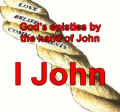
With these three: love, belief, and keeping the commandments of God, John has
been used of God to arm us to refute every doctrine of Gnosticism. In addition,
he has given the Christians who were being swayed by the Gnostics, both those
who had stayed and those who had left to start their own communities (2:18-19),
an unbreakable chain to keep  them tied to God. If any link is neglected then the
chain is weakened and will soon become broken and worthless. To switch to a
different metaphor, that of a three-stranded rope, if the believers will attend
to all three, love, belief and the
commandments, then they of John's time and on down to us today can claim the
promise in Eccl 4:12 "... a
threefold cord is not quickly broken."
them tied to God. If any link is neglected then the
chain is weakened and will soon become broken and worthless. To switch to a
different metaphor, that of a three-stranded rope, if the believers will attend
to all three, love, belief and the
commandments, then they of John's time and on down to us today can claim the
promise in Eccl 4:12 "... a
threefold cord is not quickly broken."
Available to all- In this epistle, I John, the point is made that all of the "secret enlightenment" promised by the Gnostics, is already freely given from God to the believer, in Christ. And that those words spoken by Him as Jesus, in the flesh, are not some secret to be learned from the Gnostics but were plainly spoken by Him and are there for all to believe and receive. If they will. Therefore, the Christians can be assured that they already possess what was promised by the Gnostics, that they might "know God." and that love for the brethren is part of the commandment of God and another indicator of our salvation.
In refuting Gnosticism, which is the purpose for which this epistle was written, God through John has given to us a three-fold cord to bind us to Him and to one another in true, loving, Christian fellowship. And this three-fold cord is based in belief, love, and obedience to the commandments of God, all given by God in his Word (His living Word, Jesus Christ, and His written Word, the Bible) and not through some secret teachings of the Gnostics that are claimed to give us a "special enlightenment" so we can know God. Its all ours for the taking, in Christ!
The benefit of the epistle for today-
We may think that Gnosticism is a collection of dead
heresies and, therefore, that the first epistle of John is of no use to us
today. If we do think that, then we couldn’t be more wrong.
It is true that Gnosticism lost much of its strength and
support by the fourth and fifth centuries but never make the fatal mistake of
thinking that it died out. Since the blight of the new translations springing from
the heretical seed of the "new" Greek text of Westcott and Hort in the
late 1800's, Gnosticism has found an ally with which to start its rampage of
destruction anew in the world and within Christianity at large. Many Gnostic
teachings are once again running rampant and are even a greater threat to more
people today than they were back during the time of the Apostle John and his
epistle. The reason for my making that statement is simple logic. There are many
more people in the world today than there were then. That means many more lost
people that will stay lost and be consigned to hell because of Gnostic teachings
today and many more Christians that can be tempted and led astray into Gnostic
heresies today. Ergo, because it is running as rampant today as it was then, but
it has a much much larger group of people to affect and infect, then it is an
even greater threat today than it was then. Just a few of the more well known
individuals and groups who are propagating Gnostic doctrine today are:
1. The Jehovah’s Witnesses, who deny the deity of Jesus Christ; therefore, they deny that Jesus Christ is come in the flesh and teach an old Gnostic doctrine as a doctrine of their church.
2. Kenneth Copeland, an extremely famous TV preacher/teacher, denies that Jesus is the most high God and thus he also propagates Gnostic heresy.
3. The Mormon Church which denies that Jesus is God in the flesh and claims that He is just one of many spirit children of God who came to earth as a man and then ascended to godhood by his works. The first is a direct Gnostic teaching and the second is an offshoot of Gnostic teachings. Therefore, they too propagate Gnosticism.
4. EVERY preacher and church that uses one of the New Versions of the Bible. The new versions are, by and large, all rampant with mistranslations, omissions, and additions that are Gnostic in content and intent. Therefore, every preacher that uses them is guilty, either purposely or unintentionally, of propagating Gnosticism to all of those who sit under his preaching and teaching from those heretical texts. This would have to include all of the mainline churches that generally use the New Versions. These are such churches as Lutherans, Catholics, Presbyterians, Assemblies of God and the various other charismatic churches, Church of God in Christ, Church of Christ, Southern Baptists, and any others that use the New Versions. These are all guilty of spreading Gnosticism throughout Christianity today. Most sadly, it would also include those few Independent Baptist Churches that have turned their backs on the true Word of God (KJV) and started using the New Versions.
These are just a few of the individuals and groups that make the teaching of I John so relevant and so necessary for today. We need its three-fold cord to bind us to God and keep us from the heresy of Gnosticism. We also need I John to give us effective ammunition to use in the war for the souls of the lost which we must wage against Satan and his Gnostic slide to hell!
Gnosticism and Mormonism-
This study was originally written for the Sunday night Bible
study at Ogden Bible Baptist Church in Ogden, Utah. During the beginning of the
study of the book, one brother immediately came up with the statement that
Gnostic teachings sounded a lot like Mormon teachings. I agreed with him,
wholeheartedly. I had considered that very point but had not included it in the
notes for the study. After his statement I reconsidered and included this short
segment giving just a few of the Gnostic teachings of the Mormon church.
1.
The Mormons consider themselves the only group that
really knows who God is.
This is a basic tenet of Gnosticism and is even the meaning
of the term, Gnostic.
2. The Mormons believe they are the true Church. This is
a basic doctrine of the Gnostics.
3. The Mormons believe they have "new truth"
not possessed by orthodox Christians.
This is also a basic tenet of Gnosticism.
4. The Mormons believe in a pre-existence before coming
to earth.
The Gnostics also believe a similar doctrine. They believed that Christ, "the anointed," was the pre-existent form that became Jesus of Nazareth; and of the four "luminaries:" Geradamas, "Adamas, the heavenly Adam," was pre-existent Adam; the "heavenly Seth," was pre-existent Seth; and that "the posterity of Seth" were the pre-existent forms of those in the Gnostic Church. Also, they believed that "the luminous afterthought," was the pre-existent form of Eve. This parallels the Mormon belief of pre-existence.
5. The Mormon church believes that Mormons need to obey Mormon laws; although many of them contradict God’s biblical laws (commandments.) The Gnostics taught exactly the same thing.
6. We are warned in I John to be wary of the Gnostics and any others who teach doctrines that are so different from orthodox (biblical) doctrines. Mormon doctrine is at radical variance with bible doctrine; therefore, we are to be wary of them.
7. Mormons believe that Jesus is not the most high God (see #4 above). This denial is a most particularly Gnostic doctrine.
Summary: It is easy to see that Gnostic influences are very apparent in various teachings of Mormonism. Therefore, we must conclude that Mormonism may not be totally Gnostic in and of itself; but we also must conclude that they are perpetuating many Gnostic teachings. My question is, "How much Gnostic doctrine do you have to perpetuate in order to be considered Gnostic?" An example will give you an understanding of my point of view. It’s not the 99.5% good food that kills the rat, it is the .5% rat poison. Therefore, I believe that any religion that teaches even one spiritually poisonous Gnostic doctrine must be considered a Gnostic religion. Since we have already discovered with just a cursory examination that Mormonism teaches at least a half-dozen Gnostic doctrines then we are, or at least I am, forced to consider it a Gnostic religion.
KEY TO
Gnostic Comparisons and
Refutations
Throughout the Book of I John
Whenever you see this "G" symbol followed by a number,
that is an
indication that the passage directly relates to
a key doctrine of Gnosticism as
numbered on the Key page.
Click on the symbol and it will open up the key page
in a
new window.
STOP
HERE and TAKE TEST!
SECTION ONE TEST
-
If you failed the test, then restudy this section and retake the test on or after the next day.
-
Once you have passed the test, do not take it again.
-
If you missed any questions on the test, then restudy the section and find all of the correct answers to any questions that you missed. A copy of your test was sent to you with the correct answers on it. You may use that for comparison purposes to make sure you have found the correct answers in the textbook.
PART ONE
I. The Word Declared (Jesus Christ.) (I Jn 1:1-2)
A. The person, the eternal Word- Christ. (1:1-2)
John starts with the person of Christ- "that which" he John has to declare.
1. The Word "... was from the beginning..."
He did not "come into existence
at the beginning;" He "... was from the beginning;" i.e.,
He was already there, in existence, at the beginning.
2. They heard the Word.
1, 4, 5, 10, 12
3. They saw the Word.
4. They touched the Word.
5. They knew the Word was the Word of life.
6. The life was manifested unto them. (:2)
a. He, Jesus Christ, was that eternal life manifested unto them. (:2 cf :3)
b. John and the other Apostles personally saw him.
c. John and the other Apostles bore witness as to what they saw personally.
d. They give their testimony to others of what they had personally seen.
7. The distinct personality and equality of Christ is affirmed. (:1-2 cf Jn 1:1-2)
"life was manifested... eternal life... with the Father..."
a. The distinct personality of Christ is affirmed.
He is not the Father but was "with" Him.
b. "with..." His equality with the Father is shown by the word "with." (cf. Jn 1:1-2)
B. Gnostic heresies repudiated.
During this time there were already several prevalent Gnostic heresies afoot: One, that Jesus Christ was not a distinct personality from God the Father; Two, that Christ was not equal with God; and Three, that Jesus Christ, the man, was not actually the eternal Son of God. Here, in the first two verses of the epistle, God has already had John refute all three of these heresies by stating that Jesus Christ IS the eternal Word of God; and that He IS a distinct personality from God the Father; and that the human being, Jesus Christ, that John and the other Apostles, heard, saw, and touched WAS and truly IS the eternal Son of God.
II. The purpose. (I Jn 1:3-4)
John now tells us WHY he declares this message of Christ.
1. Fellowship amongst Christians is based first and foremost on the Incarnation of Christ, the living Word of God, as Jesus. (I Jn 1:3a) (Fellowship is the main theme of this entire epistle.)
The two intertwined facets of fellowship.
1, 6, 9
a. Its one facet is human; i.e., Christian to Christian. (I Jn 1:3a)
"Ye... have fellowship with us..."
b. The other facet is divine. All Christian fellowship is from human to human and at the same time it is between human and God. (:3b)
"... truly our fellowship is with the Father, and with his Son Jesus Christ."
2. Just as the basis for fellowship is the Incarnation of Christ; so the basis for Joy, for the Christian, is fellowship in its two facets, human and divine. (:4)
Continue
on to:
The Conditions of Fellowship
(I Jn 1:5-10)
I. Fellowship Conforms to Certain Standards. (I Jn 1:5-7)
These scriptures give the lie to the Gnostic doctrine that moral conduct means nothing.
A. Holiness of God. (:5)
1. From "him," Jesus Christ, we learn an important fact about God. We learn that,
"God is light, and in Him is NO darkness at all."
2. Holiness is not what God DOES- it is what God IS; i.e., holiness is a part of His very essence. In theological terms, holiness is one of the attributes of God.
3. This lays the very foundation for the Christian’s code of conduct.
B. The
Christian’s conduct and
fellowship must emulate and center
1, 7, 8
around that essence of God just mentioned- holiness. (:6-7)
1. The negative.
a. To be out of the will of God, to be living in an unholy manner (cf :5 "darkness"), and still claim to have fellowship with Him is nothing else but a complete lie. (:6a)
b. "... and do not the truth:" (:6b)
The truth of holiness is not only verbal, it also must be born out by our actions.
2. The positive.
A true Christian walks in God’s light (in
holiness) and not in darkness.
14
There are two consequences of walking in God’s light.
a. We can have fellowship one with another. (:7a)
b. And we receive ongoing sanctification. (:7b)
1) Walking in God’s light exposes our frailties- our sins.
2) And the blood of Christ cleanses us from "sin" (singular), as the singular principle itself; and also from sin in its many forms, "all," as in ongoing sanctification.
C. Confession. (I Jn 1:8-10)
1. Confession of
the sin principle itself. (:8)
7, 8
To "have sin" is a phrase used only by
John in the New Testament
(Jn 9:41; 15:22, 24; 19:11) and refers to
the principle of sin itself, not to the act or acts.
2. The results of a lack of confession of the sin
principle.
a. We deceive ourselves. (:8a)
To use a phrase from the Wycliffe Bible Commentary, we
"lead ourselves astray, doing for ourselves what Satan endeavors to do
for us."
b. We reject the truth, the light of God, and live in
self-imposed darkness. (:8b)
3. Confession of
sin in its various forms. (I Jn 1:9)
7
a. We must confess our sin in each of its forms ("sins")
admitting that every one of its forms is wrong. There are no big
sins, nor are there any small sins. There is just sin.
b. Once we confess that our "sins" (plural)
are each and every one part of that thing called "sin" (singular
cf. :8)
and view them the way that God does, in a forsaking manner, and realize
that each one of the manifestations of it necessitated the death of Christ
for payment, then God forgives us through the blood of Christ (:7)
for the day by day outward actions ("sins") which are
manifestations of our singular sin. (I Jn 1:9)
1) "forgive[ness]..." This is God freeing us from the punishment due us because of our sin, through the sacrifice and the shedding of the blood of Christ.
2) "cleans[ing]..." This is God freeing us from the darkness, the unholiness, the pollution of sin, by the blood of Christ.
4.
Confession of sin in the concrete rather than the abstract. (:10)
a. We must admit that we personally
have committed the actions of sin.
b. To refuse to do so is to call God a liar because
everywhere in the
7, 8
Bible, God makes the statement that all men are sinners.
(Ro 3:9, 23; 11:32; Gal 3:22; also see the sin offerings
of the Old
Testament that every person had to offer for their sin.)
c. In addition to calling God a liar, we are proving
that "his word is not in us,"
because His Word says that we all have sinned.
II. Summary.
True Christian fellowship, human to human and human to God, depends on seeing the light and responding to it in the abstract AND the concrete. This results in moral conduct (walking in the light) brought about by a realization of our sin (exposed to us by the light) and a forsaking of it by us in emulation of God’s holiness.
We must leave no sins unconfessed nor forsaken, and then we will not only grow individually as Christians but we can also grow through true fellowship with other godly Christians as well as through true fellowship with God.
STOP
HERE and TAKE TEST!
SECTION
TWO TEST
Once you have passed the test, do not take it again.
If you missed any questions on the test, then restudy the section and find all of the correct answers to any questions that you missed. A copy of your test was sent to you with the correct answers on it. You may use that for comparison purposes to make sure you have found the correct answers in the textbook.
The Conduct of Fellowship
(I Jn 2:1-29)
I. Conduct Based In Imitation. (I Jn 2:1-11)
7
A. Imitation introduced. (:1-2)
1. The aim of imitation. (:1a)
The tense of "sin not" in the Greek
indicates not sinning AT ALL!
2. Failure of imitation. (:1b)
"And if any man sin" takes into account the fact that we are, after all, human beings; and though we are to zealously aim at not sinning (by imitating Christ) the fact is that we will, from time to time, fall short of the mark (commit a sin.)
3. The righteous pleader to the Father if we fail. (:1c)
a. "advocate" Gk paraklhton, para-klay’-ton, one called or sent
for to assist another; spec. one who pleads our cause for us.
b. This word is used only by John in the NT. (Jn 14:16, 26; 15:26; 16:7)1) In the book of John, the word is used to describe the Holy Spirit- "the Comforter," who assists us Christians in the physical absence of Christ from this earth.
2) In I John, the word is used to describe Christ- "an advocate" who assists us Christians by pleading our cause before the Father when we do sin.
c. "Jesus Christ the righteous..." He, Christ, is totally righteous; therefore, He is qualified to effectively plead our cause before the Father, the righteous God.
B. Propitiation. (I Jn 2:2)
This seems to be a change from the theme of "imitation" but it is not.
It is however an expansion of a thought so that it includes the entire
human race.
1. Imitation.
When we fail to imitate Christ, He pleads our cause with the Father based upon His (Christ’s) being the propitiation (atoning sacrifice) for all of our sin. (:1b)2. Expansion of the thought of propitiation to include the whole world.
Although propitiation is the basis of Christ’s advocacy for Christians, propitiation itself is not only for the sins of Christians but is also for "the sins of the whole world" (meaning the whole human race.) (:2)
a. Christ’s advocacy before the Father is ONLY for those who have accepted Christ as their sacrifice (their propitiation) because that one perfect (righteous) sacrifice was sufficient to cover ALL of our sins. (:2a cf Heb 10:10-14)
b. Propitiation, on the other hand, is sufficient for the sins of every human being
who ever was, is, or ever will be, not just for us Christians. (I Jn 2:2b)How sad it is that most people will go to hell for sins that God says the atoning sacrifice of Christ ("propitiation") is sufficient to cover. In their case, it is not "propitiation" that is lacking but "appropriation." They reject Christ as the sacrifice for their sins and thereby force God to judge them by their works (Rev 20:11-15); i.e., they force Him to judge them still in their sins, find them guilty, and send them to hell and at the final judgment to cast them into the lake of fire forever. And all of this because they have not an "appropriation" of Christ’s "propitiation" for themselves even though it is offered to them- they are lost only because they refuse to accept Christ and be saved!
3. "propitiation" (I Jn 2:2a)
"And he is the propitiation..." We must note that God has John use the word "propitiation" rather than the use of the word "propitiator."
The reason for this is so that we will realize that Christ is not just a propitiator but that He himself is also the propitiation that is offered.
"he" Gk autoV, au-tos" self, very, alone We would say "He himself..."
"propitiation" Gk ilasmoV, hil-as-mos, a root word meaning a propitiation, an expiationThis is God’s way of telling us that Christ was not only the Saviour (4:14) who is the true high priest (Heb ch. 7; 10:10-21; ) who offers the blood upon the mercy seat, which also is Christ (Ro 3:25) but He is also the acceptable offering (I Jn 2:2 "propitiation") that is offered by Him upon himself; i.e., HE IS everything: the acceptable sacrifice, the high priest, and the mercy seat. Truly He IS the Saviour!
C. The pattern we
are to imitate. (2:3-6)
1, 7, 8
1. We are to keep Christ’s Word. (:3-5)
a. It gives us assurance that we do know Him. (:3)
b. Those who don’t obey Christ’s commandments,
such as the Gnostics,
show they are lying frauds; i.e., they do not really know
Christ. (:4)
c. Obeying His commandments shows our true position- in
Christ. (:5)
2. We are to imitate Christ’s walk (way of life.) (:6)
D. We need to show a proof of our imitation- love. (:7-11)
How is our love manifested to others? Through loving the brethren!
1. Love was commanded from the "beginning" of the Christian life. (:7)
Therefore, it is not new to the Christian but "old." We had it and heard it from "the beginning" of our new creation in Christ through both the living Word and the written Word.
We know he is talking about the "beginning" of the Christian life because of his use of the word, "Brethren," which limits the time frame to the Christian life, beginning with the new creation, rather than the temporal time frame of the old creation, the universe.2. Love is reiterated here as also being something "new." (I Jn 2:8a)
To the lost and to the believer that has not yet realized the truth of it or who was being led astray by the Gnostics, and as a rebuke to the Gnostics who thought they were too "exalted" to be loving to their "less enlightened" brethren, John teaches God’s commandment to love one another as being something "new," to them. (cf. Jn 13:34 & 15:12)3. A statement of what is real, orthodox (biblical), truth about love. (I Jn 2:8b)
a. Love is of God and IN God. "in him..."
b. And if you are truly saved, it is also "in you..."
c. Why? (:8c)
"because the darkness is past, and the true light now shineth."
There is no darkness in God (1:5) and if you are saved then the light shines in you as it does in God. Or at least it should if you are truly saved.4. A refutation of Gnostic elitism. (:9-11)
a. Gnostics claim to be enlightened (in the light.) (:9a)
b. But their lack of love for the brethren proves they are not. (:9b)c. Love of the brethren proves who is really in the light. (:10a)
d. The results.
1) Positively. (:10b)
Those who love the brethren and truly walk in the light will have nothing in their own behaviour that might cause a brother to stumble.
skandalon, skan’-dal-on, (Eng. scandal) a stumbling-block,
anything against which one stumbles, an impediment2) Negatively. (:11)
a) Those who claim to be in the light but show a lack of love toward the
brethren, such as the Gnostics, are in reality walking "in darkness,"
not in the light.(:11a)b) They are so much in the dark that they are blind and can’t find their
own way because of the darkness around them. (:11b)c) And compared with the statement in :10b that those who love the brethren and thereby prove they are truly walking in the light and give no "occasion of stumbling," then here in :11 we can easily see that the blind Gnostic stumbling around in the darkness would naturally give a multitude of offenses to the brethren that would cause them to stumble also.
Mt 15:14b ...And if the blind lead the blind, both shall fall into the ditch.
II. Conduct Expressed In Separation. (I Jn
2:12-15)
7, 8, 14
A. The reason for separation lies
in the position enjoyed by all Christians.
They are all in Christ (saved), and so enjoy a special
position that brings with it responsibility.
1. All Christians are as "little children" and have experienced the forgiveness of their sins that, in Christ "for his name’s sake", was universally made available to all mankind.
There is no "special" salvation reserved only for the few, as the Gnostics believed, but only a universally available one that has been experienced by all who have accepted Christ as their Saviour and thereby become children of God.
(:12 cf. Mt 18:3; 19:14; Mk 10:14-15; Lk 18:16-17; 24:47; Ro 8:16-17; Eph 1:5)2. The division of the congregation into two groups. (I Jn 2:13-14)
a. "fathers..." (:13a & :14a)
All had experienced forgiveness but some occupied a place of prominence
in the congregation because of their maturity in their knowledge of God and His ways.
b. "young men..." (:13b & :14b)
The younger converts (as true, new converts always are) are zealous and strong.
They, through "the word of God" within them, are victorious over the devil.3. "little children..." (:13c)
Once again God addresses the group as a whole, as Christians who’s sins are forgiven,
and lets them know that they, not the Gnostics, are the ones who really "have known the Father."
B. An exhortation to walk as befits their special
position in Christ. (:15-17)
1. The way of separation.
a. True, godly, love is not to be expressed in love of, nor indulging in, the lusts of the world. (:15-16) Someone who is truly saved will not indulge in the sins of the world. (Jas 1:27)
b.
Lust and pride are the antithesis of true, godly,
love. (I Jn 2:16)
7, 8, 15
They are not of God but of the world. (cf. Mt 6:24;
Ro 12:2; Jas 4:4)
2. The result of separation. (I Jn 2:17)
Those who follow the lust of the world will perish with it;
but those who follow the way of God will abide as long as He will, "forever."
3. The life of separation. (:17b)
Separation is not just an attitude it is a way of life; i.e., those who are truly separated think right, true, but they also act right. Thus, they are those that "doeth the will of God."
C. Our creed for conduct- affirmation that Jesus is
Christ. (:18-29)
Why we are properly separated from the world and its sins of
the flesh, the eyes, and pride in possessions, and to be separated to God and to
be godly in our conduct toward one another and toward those who are lost and in
the world, begs for a creed for our conduct; and that creed, for us, is
affirmation. This separates us from the heretical apostates, some of whom
appeared religious in their actions but denied Jesus was Christ.
1. Why do we need a creed for conduct? (I Jn
2:18-21)
a. Because the deterioration of the world deeper into heresy and further away from God is accelerating toward the end time; i.e., John was saying, even back then, sin was deepening and they were running out of time. If time was already running out 2,000 years ago, where does that leave us today on God’s clock? (18a)
b. We also need a
creed because of the antichrist crowd that existed even at
11
the time of John that tried to lead them, and now us, away
from God and into
sinful heresy. (I Jn 2:18b- 19)
1) Only John, of all of the NT writers, uses the term "antichrist," and that only 4 times. (I Jn 2:18, 22; 4:3; II Jn 1:7)
2) That term "antichrist" is,
however, analogous to the terms: "man of sin" and "son
of perdition" used by Paul in II Thess 2:3; and "that
Wicked" of II Thess 2:8; and "the prince"
of Dan 9:26; and "the king" of Dan ch. 11.
Also, it is analogous to John’s own term, "the beast,"
of his book of the Revelation.
(Rev 13:18; et al)
3) The Gnostics proved they were antichrist
heretics by leaving the orthodox congregations
and starting their own groups. (I Jn 2:19)
a) "They went out from us..." They
attended the church and put on airs that they were
really born-again
Christians; i.e., they claimed to be saved. (:19a)
b) "but they were not of us..."
Although they claimed to be Christians, they possessed
only a head
knowledge of Christ and not a heart knowledge. (:19b)
This type of people are what we term
"apostate;" i.e., they were never truly saved,
they were simply religious people.
c) The proof
that they were antichrist heretics was that they left the orthodox
(biblical) congregations to start their own heretical congregations. (:19c)
d) But the true Christians had a special anointing ("unction")
from God
1, 13, 15
and because of it they had within themselves the
God-given ability to
discern between truth and error. "ye know
all things." (:20)
NOTE 1: Christ and unction are from the same
root word, criw,
khree-o’ to anoint
The Wycliff Bible Commentary
makes the point that John may have been drawing a parallel between
Antichrist and his "antichrists" and Christ and his "christs"
(meaning the true Christians).
I tend to agree. This would be a logical
reason why we need to have a creed to direct our conduct. That need being, to
show outwardly to the world that we are truly Christ’s "christs"
inwardly.
NOTE 2: "the Holy One," in the NT, refers
to the Son, not the Father. (Mk 1:24; Lk 3:34; Acts 2:27; 3:14; 13:35)
e)
Why did John write to them?
Not because they were lost and therefore ignorant of
and unable to understand the things of God, but because they possessed the
God-given ability to understand. Because of their special unction from
God, they not only knew truth from error but they also knew that no lie is
of the truth.
(I Jn 2:21)
2. What is the essence of the
creed? (I Jn 2:22-29)
a. Affirmation that Jesus is the Christ.
5, 10, 11
1) Only a liar would deny this. (:22a)
2) By denying the Son they also deny the Father since the Father and the Son are one.
(:22b cf. Jn 10:30-33;
Ex 3:14; Jn 8:58)
3) Since the Father and the Son are one, then your
relationship with the Father and your
relationship with the Son are inextricably
intertwined.
i. Negatively.
A reiteration that those who deny the son,
specifically the Gnostics are in view here, did not have the Father
either. This condemnation of the Gnostics, and any others who espouse
their heresy, could not be made any more plain. To not have a living
relationship with the living Son of God negates any possibility that the
unbeliever could ever have such a relationship with the Father. (I Jn 2:23a)
ii. Positively.
An affirmation that those who did believe that Jesus
was the Christ really did have a
living relationship with the Son; and
that meant that they also had a living relationship
with the Father. (:23b)
NOTE: Manuscript discoveries of the last century
(20th) have shown that the latter half of verse :23
was most likely actually in the originals; and, therefore, it really
didn’t need to be italicized in the KJV.
b. Encouragement to hold onto the creed of affirmation
that Jesus is the Christ.
1) Hold on to it. (:24a)
2) It is the guarantee of your relationship with the
Father and the Son. (:24b)
3) It is also the assurance of your possession of God’s
promise of eternal life. (:25)
3. Warning about those who deny the creed. (:26)
Their attack is in the form of a planned and ongoing
seduction.
"seduce" Gk planwntwn, plan-ohn’-tone, lead astray
The Greek word is an active, present participle. Therefore,
the connotation is an ongoing, active effort to lead astray. An example of this
usage can be seen in the understanding of the word seduction as it is applied to
men and women. When a man seduces a woman, he initiates an active, ongoing plan
that is carried out, step by step, to convince her and involve her in a physical
relationship for his own purposes. Meanwhile, he tries to make the process and
ends attractive to her so as to not scare her off. It is a romantic wooing
rather than an unpleasant frontal assault such as would be carried out in a
military battle.
Concerning the seduction by the Gnostics, the same type of
plan is used by them; so be wary. They carry out a "spiritual"
seduction that, step by step, seeks to carry out a spiritual "wooing"
rather than an unpleasant frontal attack.
4.
You ("ye, you") and the creed. (:27)
a. Past action of the Holy Spirit that continues with
you. (:27a)
1) You have that special
anointing from the Holy
Spirit; and it "abideth in you."
2) Therefore, you don’t need the Gnostics, or
anyone else, to teach you about Jesus
being or not being the Christ (our
creed.) (I Jn 2:27a)
b. Present
continuing action of the Holy Spirit in you. (:27b)
6, 7, 8, 13, 15
1) You have the continuing ministry of the Holy
Spirit within by which He
continues teaching you things.
"the same anointing teacheth you..."
2) And, since that anointing is with the Holy
Spirit, then what is taught to
you truly "is truth, and is no lie..."
3) The result of that anointing.
i. From it you have been taught the truth. "even
as it hath taught you..."
ii. And since the teachings and teaching ministry "abideth"
(continues) in you,
so also will you continue to "abide"
in him (Jesus Christ.)
c. The results of abiding in Christ. (:28)
1) The group.
i. To whom is he speaking?
Here, once again, John addresses the group as a whole. "little
children..."
ii. And he exhorts them to continue to "abide in
him."
2)
What type of abiding is being commanded?
i. The use of the term "and now"
lets us know that this verse is a summary.
ii. Since the term "little children" is
used once again, then we may refer back to
verses :1, 12, 13, & 18,
where the same term is used. When we do so and take
into account the term "and
now," indicating a summary, then we see that both conduct
and
creed are being referred to here in verse :28.
4) How long are they to abide in Him? Until "he shall appear... his coming."
"coming" Gk parousia, par-oo-see’-ah, presence, coming, arrival, advent
5) The results at His coming if they do continue to abide
in Him in creed and conduct.
i. At His appearing, they will be able to hold
their heads up when giving an account
of their conduct and their
adherence to their creed.
"confidence" Gk parrhsian,
par-rhay-see’-ahn, freedom in speaking, boldness of
speech
ii. They will not have to shrink away in shame ("be
ashamed") at His coming.
aiscunqwmen,
ahee-skhoon’-tho-men to be ashamed
From aiscunh,
ahee-skhoo’-nay, shame, disgrace; cause of shame,
dishonourable conduct
D. Connection and transition. (:29)
1. Connection. The logical connection between our creed and our conduct is that our creed, that Jesus is Christ, assures us that Jesus is righteous; therefore, our conduct will be to emulate Jesus and habitually do righteousness.
2. "born of him." This is the only place that Christ is said to beget. Realize that Christ is God, the one who begets Christians, and here John is making this divine connection.
3. Transition. "born of him" makes the transition to 3:1 and the connection to the Father.
STOP HERE and TAKE TEST!
SECTION THREE TEST
If you failed the test, then restudy this section and retake the test on or after the next day.
Once you have passed the test, do not take it again.
If you missed any questions on the test, then restudy the section and find all of the correct answers to any questions that you missed. A copy of your test was sent to you with the correct answers on it. You may use that for comparison purposes to make sure you have found the correct answers in the textbook.
The Characteristics of Fellowship
(I Jn 3:1-24)
John has made both a connection between Jesus Christ and the Father and also a transition with the phrase "born of him," in 2:29. Now he will expand on that thought; beginning with a joyous exclamation in 3:1 "Behold what manner of love the Father hath bestowed upon us, that we should be called the sons of God."
As John calls Jesus the "Son of God" seventeen times in the books of John and I John, three times here in I John he calls those who are born of God the, "sons of God." This is truly a joyous thing. To think that Christians have as close a relationship with the Father, in Christ, as Christ himself, is a doctrine that boggles the mind. This is but one more statement of the wondrous position enjoyed by Christians, in Christ; and John expresses his joy at that thought.
Now that our joyous position has been clarified, John will get on with his expansion of our position by giving the characteristics of fellowship.
I. Purity as a Characteristic of
Fellowship. (I Jn 3:1-3)
A. The world cannot have a knowledge of us and our
ways because they don’t know God.
This includes, specifically, the
Gnostics. (:1)
1, 15
B. Contrast and the result. (:2-3a)
1.
Contrast.
a. Present. (:2a)
We are now, in the present, already the "sons of
God."
b. Future. (:2b)
We don’t know exactly what the future result of that will
be; but we do know that when Christ comes, we will "see him as he
is," and we will "be like him."
2.
Result.
a. Knowing that
we will face him and having that "hope" that we will then be as
He is, results in an ongoing striving for personal
purity now in the present. (:3a)
7, 8
b. "purifieth himself"
1) Because this phrase is used in conjunction with
a looking toward an entrance into the presence
of Christ (:2) and its context as
leading into the following verse (:4) and its
reference to the Law,
then we can view this cleansing as meaning a ceremonial cleansing.
Under
the Law, it was required that a ceremonial purification be accomplished
PRIOR to entering
into the presence of God. (Jn 11:55 cf. OT, Num, Ezra, Neh)
i. There was an outward cleansing. (Ex 40:12)
ii. And an inward cleansing. (Ex ch.29)
2) This cleansing was both outward and inward; thus, it should be the same way for the Christian who is looking toward an entrance into the presence of God. They should cleanse the body from sins of the flesh and they should cleanse their hearts from iniquity.
(Ez 36:24-27; II Cor 5:21; Heb 10:22; Jas 4:8)C. The example of purity to follow- Christ. (I Jn 3:3b)
We should be pure "as he is pure." Since Christ was pure inside and out, then we should also be pure both inside and out.
II. Righteousness and Love as Characteristics of Fellowship. (I Jn 3:4-18)
A. Righteousness
as a characteristic of fellowship. (:4-10)
1. Righteousness and the Law. (:4-5)
7, 8
a. Negatively- sin. (:4)
1) "comitteth sin..." The idea here
is habitually committing sin.
Obviously sinless perfection is not what is in sight here
or else John would not
have written "that ye sin not" and "if
any man sin," in I Jn 2:1. Using both terms
as he did shows
us that perfection is the ideal that we are to strive for but God knows
how
weak we are and He made provision for when we fall short.
Therefore, here in verse :4 he has to
be referring to the habitual commission of sin;
or, if you will, someone who
characteristically sins.
2) Definition of sin: sin is a transgressing of the
Law; and, reciprocally, transgressing of the
Law is defined as sin.
3) Since this epistle is a general one rather than one
specifically for the Jews and since it was
written in answer to the moral
laxness of many of the Gnostics, then we can safely view
the term "law"
in its widest sense.
This would include the Mosaic Law of the Old Testament;
and the Natural Law of
Ro 2:14-15 written in the hearts of godly
Gentiles which, by the way, agrees with the OT
Law; and the Law of Christ
given in Ro 8:2. All of these are guides to godly living; godly
"morality" if you will. Therefore, since this epistle was
written to refute moral laxness,
then all of the "Laws"
affecting morality should be taken into account.
b. Positively. (:5)
1) Christ was "manifested to take away our
sins." (Is 53:5-6; Heb 1:3; I Pet 2:24)
2) And Christ, our example, was sinless; i.e., He was
totally righteous.
(II Cor 5:21; Heb 4:15; I Pet 2:22)
2.
Righteousness as an indicator. (I Jn 3:6)
If we are truly in Christ ("abideth in
him") and since Christ is totally sinless (:5)
then the true
Christian should have a character to match that of the one he abides in;
and
that character would be sinlessness not sinfulness; i.e., we will not habitually
sin.
a. The truly saved are indicated by their lack of
habitual sin. (:6a)
b. The lost are indicated by their plentitude of sin. (:6b)
1, 7, 8
c. Therefore, habitual righteousness or the lack of it is
an indicator of your position;
and that is either in Christ (saved) or not in
Christ (lost.)
d. If sinning
is a reigning characteristic of a person’s life rather than the exception
in it,
then that person is unregenerate. (Ro ch. 6; esp. :12 &
:22) This is in accord with
what John is saying here in I Jn 3:6.
3. "Little children" (:7) Another
loving warning from John, the mature
6, 7, 8, 13, 15
Christian teacher, to his students echoing the
tone a father would use
when lovingly warning his children about deceivers.
a. Watch out for those that would "deceive"
you for they are out there. (:7a)
"deceive" Gk planatw,
plan-ah-toe, to lead astray
b. The truly righteous "doeth
righteousness." (:7b)
("doeth" is again present tense,
active participle, meaning "habitually" doeth)
c. The example of righteousness that is to be
emulated- "he," meaning Christ:
who is also the source of
our righteousness. (:7c)
d. Summary.
To protect the readers from infection by the heresy of
the Gnostics which would lead them astray into improper conduct, John
lovingly tells them that you can tell what a person really is from his
actions. And those truly righteous, or if you will, those who are truly
saved, will emulate the perfect righteousness of the one who saved them,
Christ. He also is telling them that anyone who tells you any different,
specifically here the Gnostics, is trying to "deceive"
you; i.e., they are leading you astray from the will of God and away from
the path of sinlessness that our position, in Christ, demands of us.
Righteous character is evidenced by righteous conduct
which is evidence of regeneration which is the effect and indicator of our
true position in Christ.
With John we can truly and joyously say as he did in 3:1,
"Behold, what manner of love the Father hath bestowed upon us,
that we should be called the sons of God:" and no child of God,
who truly loves his Father in return, would EVER want to habitually
disgrace His family with unseemly conduct!
4. Righteousness as a family trait. (I Jn 3:8-10a)
a. Sin is a family trait of the devil and his family. (:8a)
"the devil sinneth from the beginning."
The devil is the one that started sin in this universe. (Gen
ch. 3)
b. To establish the family trait of God’s family,
righteousness, necessitates that first there be a
destruction of the sinful works of the devil; and that was accomplished through the
manifestation
of God’s Son, Christ. (I Jn 3:8b)
As the manifestation of Christ is the ultimate manifestation of righteousness; so the destruction of the works of the devil by that manifestation is the establishment of that thing which is a trait of God’s family, righteousness. There is no neutral ground. The manifestation of sin is a destruction of righteousness and likewise the destruction of sin is the manifestation of righteousness. A useful example, and one that goes along with John’s earlier contrasts, is that of light and dark. The manifestation of either one necessitates the destruction of the other; i.e., they cannot co-exist. Likewise, in our lives as Christians, we cannot be partly righteous nor can we be partly sinful. We can only be one or the other, exclusively, but not both; i.e., we can be habitually righteous or we can be habitually sinful. If we are habitually righteous then if an exception happens, sin, our immediate reaction will be to confess that sin to God (I Jn 1:9) and then once again take up our habit of righteousness and strive toward our goal of purity (3:3), knowing that the blood of Jesus Christ "cleanseth us from all sin." (2:7)
c. Righteous character is a trait of the family of God that is inherited through His "seed,"
the Holy Spirit. (I Jn 3:9)
1) "is born" (perfect participle, signifying an accomplished action) (:9a)
2) "Doth not commit sin" (present tense) Again meaning to habitually not sin.
3) "seed" Gk sperma,
sper’-mah, sperm, the generative
seed of life, either spiritual or physical
Since we are talking about God’s seed (see next
section) then we are talking about the seed of our eternal life.
4) "his seed" The seed being referred to is
the "seed" of "God." (:9b)
i. "his" is a pronoun and is genitive,
masculine, singular
ii. "God" is a noun that is also genitive,
masculine, singular
iii. Therefore, "his seed" has to be
referring to the seed of "God."
5) Since the Holy Spirit is God’s seed that springs up in us to eternal life (Jn 6:36; Ro 8:11) then it is obvious that the "seed" of God within us that is being referred to must be the Holy Spirit.
6) Therefore, since God is righteous in character
and we are born of Him through His seed, the Holy
Spirit, then we will
logically inherit that character trait of righteousness from the one who
begat us,
God. Truly, we are "the sons of God." (I Jn 3:1)
7)
Because we have this inherited trait from our
Father through His seed which "remaineth in us,"
then
we "cannot sin" (present tense, again meaning cannot
"habitually" sin) because of who we
are descended from, God,
who passed on to us the character trait of righteousness not one of
sinfulness. (:9c)
d. Transition. (:10)
Righteousness and love, the two character traits that absolutely
delineate which family you really belong to.
There are only two families in the world today: God’s family and the devil’s family. (:10a)
1) If you do not habitually practice righteousness you are not of God’s family. (:10b)
2) Also, if you do not love your brother you are not of the family of God. (:10c)NOTE: Although "child[ren] of the devil" and "child[ren] of God" are common concepts in the scriptures and are used verbatim or in concept in several places in the New Testament (Mt 5:9; Lk 20:36; Jn 11:52; Jn 8:38-44; Acts 13:10; Ro 8:16, 21; 9:8; Gal 3:26; I Jn 3:12; 5:2) here in verse :10 is the only instance of their being used together. Quite useful when confronting someone who thinks the devil is merely "evil" personified. There are many so-called Christians that hold that view today. They claim to believe in God but they refuse to believe in the devil. If God exists, and we know He does and He is called the Father of the saved, then the devil exists also, else how could he be called a "father" to those who:
i. reject God,
ii. reject Jesus as the Christ,
iii. refuse to practice righteousness,
iv. and those who refuse to love the brethren?B. Love as a characteristic of fellowship. (I Jn 3:10c-18)
Since we are children of God and love is a characteristic of God then we inherit that characteristic from Him the same way we inherited the characteristic of righteousness from Him.In this segment God will teach us, through John, that love for the brethren
and righteousness are closer than brothers. Love is not just an expression that we
speak with the mouth; it is an integral part of our being, a family trait, that can be seen by
our actions toward the brethren and is an indicator of our position, in Christ, as a child of God.1. Contrast between the children of God and the children of the devil. (:10-13)
Love for the brethren is an indicator that we are part of God’s family. (:10)
a. Positive. (:11)
Love was a commandment from the beginning. (:11)Again here as in 2:7, the time frame being referred to is the "beginning" of our new life in Christ. This can be seen by the context and the language used. By context, John is talking to those in the family of God (3:1, 9-10). And the language used, "ye" and "we," when compared to the context makes it necessary that we interpret "beginning" to mean the beginning, our new creation in Christ, the time of our entrance into our new family and our new life.
b. Negative. (I Jn 3:12-13)
Cain, the first murderer, is the negative example. (:12)1) He was a child of the devil.
2) His own works were evil.
3) He slew his brother because of his brother’s righteous works.
c. Application. (:13)
The world hates us for the same reason Cain hated Abel- because they are also children of the devil and their works are evil as Cain’s was. Therefore, it is no wonder that they hate us because of our righteous works as Cain hated Abel because of his. (cf. Jn 15:18-19)d. Indication. (I Jn 3:14-15)
1) Love as an indicator. (:14)
i. If you love the brethren then that is an indicator that you have passed from death into life. (:14a)
ii. If you do not love the brethren then that is equally an indicator; but, it is an indicator that you have not made that passage from death to life. (:14b)
2) Comparison. (I Jn 3:15)
i. Hate of the brethren is comparable to murder. (:15a)
NOTE: The Bible is clear that hatred of a brother is murder. Murder in the heart, true, but
murder none-the-less. Jesus taught that sins of the heart are just as real as the action itself.
ii. Murderers do not have eternal life abiding in them; i.e., they are lost. (:15b)
iii. Therefore, the obvious conclusion is that hatred of the brethren is just as much an indication
of a lost state as is being a murderer- to which it is compared here.NOTE: In this segment we are talking about a habitual state of heart in which hatred is a common part of the person’s makeup. And when such a person is presented with a sufficient trigger, sufficient opportunity, and an available victim, then that person is capable of and could easily commit murder.
By context we also must deduce that when the object of hatred, the potential victim, is a righteous person whose righteous works glaringly show up the unrighteous works of the perpetrator by comparison, then the situation is even more volatile.
Finally we must conclude, again by context, that the potential for an actual, physical, murder is what is in sight here. I say this because the context is dictated by verse :12, which is an account of a physical murder. Therefore, to understand the word "murderer" in verse :15 to have some ephemeral or figurative sense such as "murderer of the soul" or view it as only a mental assassination of the victim would be to do violence to the context. We are left with no other choice than to view this segment as meaning that someone who hates their brother is, under the right circumstances, capable of physically murdering that brother. Such a person is obviously not saved whether they have actually committed the murder or whether they simply harbor the potential for it in their hearts. Either way, they need to repent and then accept Christ as personal Saviour. Upon doing so the heart is changed and they will no longer hate their brother. Then that removal of hate leaves room for and is replace by love for the brethren which is an indicator that they have passed from death to life according to the Scriptures. Also, the replacement of hate with love removes the potential for a physical murder such as that perpetrated upon Abel by Cain in our example from verse :12.
2.
The example of love required of believers. (I Jn 3:16-18)
Our love is to be the same as God’s love which was
expressed in Christ.
a. Self-sacrificing love is what is required of us.
(:16)
NOTE: This verse shows the deity of Christ by stating that God laid down His life for us. And since it was Christ that died, then it follows that Christ is God.
Of course there are some that will say
that "of God" was not in the Greek but was added by the
translators of the KJV. Yet, if one compares this verse with the following
one then it is obvious that "the love of God" (:17) is the
love that is being discussed here. Therefore, it was necessary for the
translators to add "of God" here in verse :16
so
that we can properly understand the verse. This gives us every right to
understand and use the verse exactly as it is written and to use it as a
proof-text for the deity of Christ. This then gives the lie to the Gnostic
heresy of then and today that Christ was not and is not
God!
16
b. True godly love is always expressed in action. (I Jn 3:16-17)
1) God’s love was expressed in the physical realm in a supreme way and so should ours if we are required to lay down our lives also. (:16)
2)
An alternative that is
possible, and commanded, for all Christians until such time as they may be
asked to make the supreme sacrifice. (:17a)
Not all are asked to express our love by giving our
lives; but, giving of our life’s substance is commanded, and possible, for
all of us.
3)
Actions are the natural expression of God’s love.
i. The former is supreme love expressed by the
supreme and godly sacrifice- our life.
ii. The latter, sharing of our life’s
substance, is an indicator and an expression of God’s love that
truly dwells within us. (:17b)
c.
Summary- true godly love is always expressed in
our actions. (:18)
If we merely express love in "word[s]"
which are simply uttered by the "tongue," then we are NOT
truly loving. However, if we express our love by our "deed[s],"
then we are loving in God-emulating "truth." He didn’t
just say it, He showed it; and we are commanded to DO the same, not just
SAY the same!
III. Assurance and Obedience as Characteristics of Fellowship. (I Jn 3:19-24)
A. The heart as the seat of
assurance.
9, 15
1. Assurance is
found in the truth and that we are in the truth is proved by
our love of the brethren as expressed in our actions toward
them. (:19)
2. If our heart should condemn us we can appeal to God
for judgment in the matter.
If we go to God for judgment then we can tell
if our heart is right or not in its judgment
concerning our expression of love toward
the brethren. (:20)
3. However, if we are pure in our love and zealous in its expression through our actions toward the brethren, i.e., if we emulate God’s expression of love successfully as we are commanded to do in the previous verses, then our heart will "condemn us not." (:21a)
4. Such a lack of condemnation of us by our own heart allows us to go to Him with boldness, or as the KJV puts it with "confidence," no longer for judgment as in verse :20, but for other purposes such as fellowship, worship, prayer, etc. (:21b)
5. The result of assurance- answered prayer. (:22a)
B. Obedience- the basis of answered prayer.
1. Obedience is based in the commandments of God. (:22b)
The commandments include the one just previously discussed,
that we love the brethren. Therefore we must focus, for purposes of both
continuity and context, upon that particular commandment.
2. Obedience to the commandments must be expressed in our
actions, exactly as we previously learned that our love for the brethren, the
commandment of God under discussion in this segment, must be expressed in our
actions toward the brethren. (:22c)
3. The commandments enumerated.
a. "believe on the name of his son Jesus Christ." The first of these commandments is that we believe everything that the name of Jesus Christ stands for. This includes the self-giving love expressed in God’s actions through Jesus Christ which was even to the death. (I Jn 3:23a cf. :16)
b. "love one another." The second of these commandments is what was taught earlier in this chapter- love for the brethren. (:23b)
C.
Assurance of salvation, the only way to true
fellowship with God, comes by this obedience in our actions and by His Spirit given to us.
1. Our actions (keeping His commandments) show that we
dwell in God and that God dwells in us. (:24a)
2. Our assurance of salvation is also by His Spirit
which He has given to us. (:24b)
The Spirit that God has given us is His Holy Spirit and is
the spirit of love. This can be deduced by comparing this chapter, with its
emphasis on love from God expressed toward us in Christ and His commandment
that we show our love for the brethren, with the following chapter. (Spec.
3:24; 4:8, 13)
STOP HERE and TAKE TEST!
SECTION FOUR TEST
If you failed the test, then restudy this section and retake the test on or after the next day.
Once you have passed the test, do not take it again.
If you missed any questions on the test, then restudy the section and find all of the correct answers to any questions that you missed. A copy of your test was sent to you with the correct answers on it. You may use that for comparison purposes to make sure you have found the correct answers in the textbook.
Cautions Regarding Fellowship
(I Jn 4:1-21)
I. A Caution to Try the Spirits. (I Jn 4:1-6)
A. Godly and ungodly spirits.
(:1-3)
1. The existence of two kinds of spirits.
(:1)
a. Those of God.
(:1a)
b. Those of the false prophets. (:1b)
2. The
examination of the spirits. (:2-6)
a. The Spirit of God is possessed by those who
acknowledge, including verbally
4, 5, 10
in their teachings, the incarnation in its full measure.
(:2)
1) "confesseth" The necessity of
confession of the Incarnation.
The word used here denotes a verbal confession of the
Incarnation.
omologei, hom-o-log-ay,
to speak in accordance, adopt the same terms of language
2) "is come" Confesses the fact of
the Incarnation.
The tense of "come" is in the perfect
and, therefore, the understanding is that the Incarnation
was not
temporary, as the Gnostics taught, but that it was an accomplished and
permanent fact.
3) "in the flesh" This is a confession
of the mode of the Incarnation.
The Incarnation was not some ephemeral or spiritual
coming. To the contrary, those who speak by the Spirit of God openly
confess that the Incarnation was specifically in the "flesh"
(Gk sarki,
flesh, the human body).
b. The spirit
of antichrist is possessed by those, such as the Gnostics, who deny the
Incarnation in its full measure. (:3)
1)
The same arguments and definitions apply here
as in verse :2, except they are used to
11
show here that those who deny the
Incarnation in any of its parts are not speaking by the
Spirit of God. (:3a)
2) Those who so deny the Incarnation are actually speaking by the spirit of antichrist. (:3b)
3)
A warning. (:3c)
It is obvious that "the antichrist" had not
yet come during that time nor has he come up to this present time. That is
the reason that God through John is making it perfectly clear that it is
not the person of antichrist that is being referred to here but the spirit
of antichrist; i.e., the power or motivating force that will enable and
drive the "antichrist" to come. This power or motivating force
was already in the world at the time of the writing of the epistle; and,
it is called the "spirit of antichrist." We
know that the power behind "antichrist" will be Satan (cf. I Thess 2:8-9) and that same power or
motivating force was behind the Gnostics of John’s time and the Gnostics of today. It has always been in the world and will continue to be until
God removes Satan and his influence from this world for a thousand years.
After which it will once again be loose in this world for a little (short)
season when Satan is loosed from the bottomless pit. Then, after the final
battle when God will defeat Satan, that spirit of antichrist will be
finally and forever removed from the earth when God casts him (Satan) into
the lake of fire. (Rev ch. 20)
Until then, there has always been and will always be
those "antichrists" and "false prophets" (I
Jn 2:18; 4:1) who operate under the power and motivating force of
Satan. One way these are recognized is by their denial of the Incarnation
in its fullness and they are categorized as "anitchrists"
11
(2:18) and "false prophets" (4:2) who are speaking by
the "spirit of antichrist." (4:3)
NOTE: We must be aware that this is a limited context in which only the one indicator of a true prophet or a false prophet is being addressed. Therefore, God is not telling us that we can judge a prophet solely by whether he preaches for or against the Incarnation in its fullness. There are other scriptural indicators as well. What He is telling us is that when someone is teaching or preaching in denial of the Incarnation in its fullness, then that man is undeniably a false prophet. Contrariwise, when a person is upholding the Incarnation, then that is one indicator of a true prophet; and, most important, God is telling us that it is an absolutely necessary one.
Remember: "A text without a context is a pretext." Never take a text out of context. To do so is to do violence to the Scriptures and can lead only to heresy.
B. Contrast.
(I Jn 4:4-5)
Bear in mind that the subject being discussed in this passage
is trying of the spirits by the
message of the truth of the Incarnation. This is
seen by verses :2-3.
1. The children of God. (:4)
Absolute assurance of victory for the children of God.
a. The children of God have the power within them to
overcome those who exhibit the spirit of antichrist. (:4a)
b. And that power is available because of the Holy
Spirit that lives within the true believers who is greater than the spirit
of antichrist from Satan that empowers those who are not believers. (:4b)
(cf. I Jn 2:13-14; 5:4-5 Eph 2:2)
c. That it is the indwelling of the Holy Spirit that
is being spoken of in I Jn 4:4 is obvious because of the context of
the verse which includes the specific reference to the Holy Spirit in verse
:2.
2. The children of the devil.
(:4-5)
a. Their antichrist lying message has been overcome
by the children of God who bear the truth. (:4).
b. They are of the world (and we know that the devil
empowers the world.) (:5a)
c. Because they are of the world they speak an ungodly,
worldly, message. (:5b)
d. Because they speak a worldly message then it is
only logical that the world listens to them. (I Jn 4:5c)
3.
Summary. (:6)
a. God’s people, the saved, listen to God’s true
message.
b. The lost, those who are "not of God"
will not believe the truth.
c. "Hereby" This refers broadly to
the whole previous discussion of false prophets who deny the Incarnation in
its fullness and demonstrate that they are not of God but of Satan and are
speaking by the spirit of antichrist; and it also refers specifically to the
fact that God’s people listen to the apostle’s message of the
Incarnation and the world, Satan's people, do not. Therefore, we must
conclude that God is saying that if God’s people believe the apostle’s
message then it is true and that if the world listens to the false prophet’s
message then it must be untrue.
The whole argument is summed up in the statement that "Hereby
know we the spirit of truth, and the spirit of error."
NOTE: This whole segment was presented as an encouragement to the true Christians of then and now who were and are under attack by the false prophet Gnostic forces. It has shown that the antichrist forces, personified in the false prophets, were (and are) empowered by Satan who infused them with a spirit of error and it also showed that God’s people are infused with the spirit of truth by the Holy Spirit. It also showed that the world will be inclined to listen to the spirit of error, the Gnostics, because they both spoke the same language. The people of God are encouraged to not be disheartened nor tempted to deviate from the truth. They, and we, are not to join the world but to "overcome them" with the truth of the Incarnation and this segment has proven that we are fully empowered to do so by the Holy Spirit. (:4)
Finally, all believers of then and now are taught that a rule of thumb is that if the world embraces some false representation of the spiritual teaching of the apostles as being true, then we can be assured that it really is false. Contrariwise, if God’s true people embrace a spiritual teaching as being true then it is true.
CAUTION: We must temper this with the fact that all of the teachings of the apostles are recorded in the infallible Word of God and that all of their teachings agree with each other and with all other teaching recorded in both the Old and the New Testaments; and only those teachings of "Christianity" that agree with the Word of God are really true.
Therefore, we cannot automatically believe that all of the things believed and taught by "Christianity" at large and down through the centuries are automatically true. This is true for 2 reasons:
1. Christianity is composed of a mixed multitude and has been since the time of the institution of "the Church" by Jesus Christ. We of course are talking about "the Church" as viewed by the world- meaning the group that externally followed Jesus, which included Judas. (Matthew 10:2; 26:14, 47; Mark 14:10; et al)
2. Down through history there have been multitudes of heretical groups that have called themselves, and have been recognized widely, as "churches." In fact, other than by comparing their teachings with the Bible, there is no way to tell if any particular "church" is truly a Christian "church" or not. The various Catholic churches, or as they call themselves the "Universal Church" is a case in point. Such a large majority of their teachings are so undeniably non-scriptural, from the 3rd or 4th centuries A.D., that whether they are even part of the true Church is extremely called in question. When the facts are examined, any true bible-believer would conclude that, as a whole, the various branches of the historical "Catholic Church" must be viewed as cults. Yet at one time the various branches of the Catholic Church spread across the known world and claimed a majority of so-called "Christians" as part of their makeup. Does that mean that everything taught by the Catholic Church must be true because most "Christians" believed them? That is absolutely not what this passage in I John is teaching. We have to realize that "Christianity" is an outward appearance or alliance with a group that claims to follow Christ. (Acts 11:26) This would have to include Judas in the original church since he outwardly followed Christ as part of the group. (See #1 in this same above.) Yet I don’t know of anyone personally who believes that Judas was saved! Therefore, we have to differentiate between "Christian" and "saved" when talking about the "people of God." "Christian" is outward and "saved" is inward. During the years of the reign of the Catholic Church there were millions who followed Christ "outwardly" and aligned themselves with the Catholic Church. However, a large percentage of Catholics, both then and now, are only nominally Catholic. Many called themselves Catholic because they were born into a Catholic family. The same goes for every other denominational group, both Catholic, Protestant, and Independent from the first Church started by Christ on down until now. Many align themselves with a particular "church" because of family association. The point is, it doesn’t matter what or who you affiliate yourself with outwardly but it is the inward affiliation that counts. You may call yourself "Christian" because of your affiliation with some group or because your family is a "Christian" family or because you live in a "Christian" nation; but, that does not mean you are "saved" which you must be in order to be the "children of God" or the "true Christians" being spoken of in this segment of I John.
Therefore, when God says in I John 4:6 that if the majority of "the world," meaning the unsaved, believe that something is true then it is false and when God’s people believe that something is true then it is true, we have to get it straight in our minds that "God’s people" is referring to those who are saved and part of the true universal Church which exists only in Heaven and is manifested on earth only as local churches and we are not referring to those who may claim external "Christianity." There are untold millions that are members of past and present "churches" here on earth who are either in or on their way to hell because of their dependence on their "church" or baptism or outward Christianity to get them to Heaven. (Mt 7:13-14; Ro 10:13; Gal 2:8-9; Titus 3:5-7) They may be on the roles down here but they are NOT on the roles up there. (Heb 12:23) Therefore, God is stating that it is only the "saved" who believe the things of God. God is also saying that when the "saved" believe that a spiritual teaching is true then that is an indicator that it is true but when the lost believe it is true then that is an indicator that it is false!
II. A Caution Concerning Love. (I Jn 4:7-10)
A. Love is of
God. (:7-10)
1, 9, 17
1. Love’s origin is in God. (:7a)
2. Love as an indicator of a knowledge of God.
a. Positively- those that know God know love. (:7b)
b. Negatively- those that don’t know love don’t know
God. (:8)
NOTE: In verse :8b (and later in verse :16), John makes another statement about the nature of God. In 1:5, John stated that "God is light," meaning that holiness is an attribute of God; and here in 4:8 he states that "God is love" meaning that love is also an attribute of God.
Because there is no article before love, then we know that John is not talking about any particular kind of love, i.e., any particular manifestation of love, but that love itself is part of God’s nature. Therefore, God does not love for any reason or cause outside of himself- He loves because it is in His nature to do so.
Also, because God is preceded by an article in the Greek, "o qeoV" instead of just "qeoV" we then know that the terms in the statement are not reversible; i.e., although we can say that "God is love," we cannot reverse that and say that "love is God." It is necessary to rightly understand this because there are some today, and in the past, that argue that "God" is just a shortened term personifying "good" and that "devil" is just a lengthened term to personify "evil." If God allowed the terms in "God is love" to be switched so that we could say that "love is God" then we would see the unbelieving apostates and the heretics insist that God is just a personification of love (or "good"). Which is exactly what many do already and have done for centuries. Also, for the Gnostics, past and present, "Love" is but one of the eternal beings, called "aeons," that emanated from the "divine center" which is called "God" or the "Abyss." This would make "Love" a "god" albeit a lesser one than "God" himself. This passage in I John, as it is written, prevents that particular heresy from springing up.
3.
The manifestation of God’s love. (I Jn 4:9)
a. He openly showed (manifested) His divine love nature
to us. (:9a)
"manifested" Gk
efanerwqh,
ee-fan-er-o’-thay, apparent,
conspicuous, clear, manifest, known
b. His love
prompted an action within His creation, the universe. (:9b)
1) "God sent..." That action was initiated by
God.
10, 12
2) "only begotten Son..." It was a supreme
action.
3) "into the world..." From infinite God into
the finite world.
c. The result- life for the believers.
4. The definition of God’s love.
(I Jn 4:10)
a. Contrast. (:10a)
1) Negative.
It is not love that we may show to God; i.e., it is not a
human love.
2) Positive.
The love being spoken of is divine- it is God’s love that He shows to us.
b. It is a love that prompts action. ("God... sent...")
c. It is a giving and conciliatory love.
"... sent his Son to be the propitiation for our sins." (:10b)
"propitiation" Gk ilasmon, hil-as-mon’ to expiate, to make an atonement for
B. A caution to emulate God’s love. (I Jn 4:11-12)
1. It is our obligation as Christians.
(:11
"Brethren...")
a. God’s love, expressed to us, puts us under
obligation.
Since "... God so loved us..." that He
reconciled us to himself by sending His only
begotten Son, Christ (:10),
then we are logically under immense obligation to Him.
b. God says that one way of fulfilling part of that
obligation is by loving one another in
emulation of Him and His love nature.
(:11b)
2.
It is the only way that the world can see the love
nature of God. (:12 cf. :17)
a. No one can see Him or His nature directly.
(:12a)
b. Through us, God’s love nature is revealed to the
world. (:12b)
"If we love one another," then "God"
and, by context, His love nature, "dwelleth in us"
here, in
His creation, for all the world to see.
3. God’s love is perfected in us when we love one
another in emulation of His love toward us. (:12c)
"perfected" Gk teteleiwmenh,
te-tel-i-o’-men-eh, to execute fully, to discharge, to be
fully developed
The more we love the brethren the more God’s love is
developed in us. When we love the brethren the way that God loves us, then the
love nature of God is fully developed, "perfected," in us and
discharged or executed fully through us for the world to see.
III. The Results of God’s Love Dwelling Within Us. (I Jn 4:13-21)
A. It is assurance of the indwelling of God.
(:13-16)
1. Assurance of that indwelling is through His Spirit
that is given to us. (:13)
2. Assurance is
through confession of Jesus as the Son of God. (:14-15)
9, 10, 12
a. The Son is the
Saviour.
(:14)
b. Confession that Jesus is the Son is necessary for
assurance. (:15)
3. Dwelling in God’s love is assurance of the
indwelling of God. (:16)
a. God’s love to us is real. (:16a cf.:9-10)
b. That love is a force working in us.
("the love
that God hath to us...")
c. It is part of the very nature of God. (:16b
"God is love..." cf. II. A. NOTE above.)
d. Dwelling in God’s love assures us that we dwell in
God and He dwells in us. (:16c)
B. God’s love will give us boldness in the day of judgment. (I Jn 4:17)
1. "our love..." This is speaking of God’s
love that is given to us.
9
2. "Herein..." Is referring to the latter part of this verse and not to the
preceding verses (although they are included as the means
of attaining the state referred
to in the latter part of this verse as we shall see
in just a moment.)
3. "made perfect..." When our love is
a perfect emulation of His love.
Gk teteleiwtai,
te-tel-i-o’-tai, to execute fully, to discharge, to be fully
developed
4.
"boldness in the day of judgment:"
Gk parrhsian,
par-rhay-see’-ahn, freedom in speaking, boldness of
speech
In the "day of judgment" we will be able to
unashamedly answer concerning our displays of love toward the brethren.
5. "as he is, so are we in the world." This is the sole basis for our boldness in the day of judgment.
God is love and
as we emulate that love, and more than emulate, as we allow His love to flow
through us while we are in this world by loving the brethren, then our boldness
at the judgment is justified.
Not because of ourselves but because of God’s
love that is perfected in us. This rules out any presumption on our part when we
understand that it is not our human love that is in sight but the divine love
that God has given to us. The only part we have in the matter is whether we
allowed His love to stagnate within us through lack of use or whether we showed
that love toward the brethren while we were alive and thereby allowed God’s
love to live and grow in us and thereby be perfected (accomplishing the
desired end) in us as it is shown through us.
To sum it up. If we stifle His love within us here, then we
will hang our head in shame there at the judgment; but, if we allow His love
within us to grow and show here until it is a true image of His divine love,
then we will be able to hold our head up, up there.
This totally destroys the concept held by Gnostics past and
present who believe that any of the Christian brethren who have not attained to
their own "lofty height" are not worthy of their love as brethren. God
says, to the contrary, that we are to love the brethren, all of the brethren,
regardless of what stage of growth they may have attained to; i.e., God is
saying that if they are saved then they are our brethren- and WE ARE TO LOVE
THEM as CHRIST LOVED US!
C. God’s love casts out fear. (:18)
Not only does God’s love give us boldness when looking to future judgment, but it also casts out fear here on earth. This is only logical. If I know I can have boldness there, then that will obviously cast out (or, if you will, do away with) my fears here as I look forward to that day.
Conditions for having no fear here.
1. First, we must understand love; specifically, God’s
love that He has given to us.
a. Love has no fear in it. "There is no fear
in love..."
b. If it is perfect love then it dissipates or scatters
fear. "casteth out..."
exw,
exo, without, out of doors and ballei,
bal’-lay, to throw, cast
c. Fear causes torment.
(I Jn 4:18)
"torment" Gk
kolasin,
kol’-as-in, chastisement, punishment, painful disquietude, torment
The context of this whole segment has been that God loved us enough to send His only begotten Son to pay for our sins (:10) and save us (:14) from the torments of hell if we believe that Jesus Christ was who He and God says He is. (:2-3) Such a love as that is not a torment to us but a comfort. Such love strikes no fear in our hearts, i.e., it promises us no torments but only supreme comfort. (Ro 8:15) And when God’s love is perfected in us, which is evidenced by our showing that same love to the brethren, then we are as He is in this world and can have boldness (:17) in the day of judgment; and such boldness is the exact opposite of fear and its attendant torment.
2. Perfect love (God’s love perfected in us) is incompatible with fear. (:18c)
III. The Proof of God’s Love Within Us. (I Jn 4:19-21)
A. It undeniably
has been given from Him to us. (:19)
We did not initiate this exchange of love, He did.
1.
We only responded to His love. (:19a)
18
2. He initiated the exchange. (:19b)
Remember, His very nature is to love (:16); therefore, He could not do otherwise but show His love to us and this He did, physically, in Jesus Christ. (:9)
3. It is a reciprocal thing; i.e., God’s love within us causes us to love Him. In fact, we could say that God’s love in us enables us to love Him; and the second, our love, cannot exist without the first, His love. And the indicator that His love dwells in us is that we in turn love the brethren. (This has already been amply shown in this chapter.)
B. The proof. (:20-21)
1.
Negatively. (:20)
a. Anyone who says they are reciprocating God’s
love and yet hates his brother is, simply, "a liar." (:20a)
b. The proof of that lies in the carnal nature of man.
(:20b)
We are first and foremost natural beings. Long before we became spiritual beings, which happened at our Salvation, we were trapped by our carnality (I Cor 2:14) and all we could see were the fleshly things. (Ro 8:5) This fact can be clearly seen in First Corinthians where the first Adam is called earthy, natural, and the second Adam, meaning Christ, is called spiritual. (I Cor 15:45-49) Therefore, since we human beings are first and foremost natural beings then we tend to place great emphasis on the natural. Now we shouldn’t do that as Christians and as we grow in God’s grace we will tend to do that less and less; nonetheless, it is still a tendency for natural to tend to emphasize the natural, whether we are saved or not and whether it is proper Christian conduct or not. (Much is written in the Scriptures to help us avoid this tendency and we are encouraged and commanded over and over to live in the spirit and not in the flesh. That is why ongoing sanctification is a Bible doctrine. However, that is another subject to be saved for another time.)
To sum it up, if we can’t love what we can
see with our eyes, our
9
brothers, which even the unsaved man can do, then how can we say
that we love God which we can’t see with our eyes, which goes against
our natural grain, so to speak? (I Jn 4:20b)
2.
Positively. (I Jn 4:21)
The proof that God’s love lies within us is stated; and
it is in the form of a commandment.
a. It is a commandment directly from God.
(:21a)
b. And that commandment is that we prove we have the
love of God in us that we reciprocate to Him
("He who loveth
God") by loving our brother ("love his brother also").
We have no choice in
this matter and God has made that imminently plain
because He said it is a "commandment."
STOP
HERE and TAKE TEST!
SECTION
FIVE TEST
-
If you failed the test, then restudy this section and retake the test on or after the next day.
-
Once you have passed the test, do not take it again.
-
If you missed any questions on the test, then restudy the section and find all of the correct answers to any questions that you missed. A copy of your test was sent to you with the correct answers on it. You may use that for comparison purposes to make sure you have found the correct answers in the textbook.
The Foundations of Fellowship
(I Jn 5:1-21)
 The basis for fellowship was given in the earlier
chapters of the book; and that basis is belief in the doctrine of the
Incarnation and adherence to the standards of conduct that God has set for us.
First and foremost among those standards is love. Specifically love for the
brethren. I have used the three-fold cord as an example of what God says binds
us to himself and to one another in true fellowship and that three-fold cord is
made up of the strands of love, belief, and commandments. The first cord, love,
is the love that God showed to us which we could then show back to him and also
includes the love that we then can, and must, show to the brethren. This is
known as "God’s love." The second cord, belief, is simply belief in
the Incarnation in its fullness. The third cord, commandments, represents the
standards of conduct that God has laid down for His children; and these are
found ONLY in His Word! These three bind us together, God to man and man to man,
in true fellowship.
The basis for fellowship was given in the earlier
chapters of the book; and that basis is belief in the doctrine of the
Incarnation and adherence to the standards of conduct that God has set for us.
First and foremost among those standards is love. Specifically love for the
brethren. I have used the three-fold cord as an example of what God says binds
us to himself and to one another in true fellowship and that three-fold cord is
made up of the strands of love, belief, and commandments. The first cord, love,
is the love that God showed to us which we could then show back to him and also
includes the love that we then can, and must, show to the brethren. This is
known as "God’s love." The second cord, belief, is simply belief in
the Incarnation in its fullness. The third cord, commandments, represents the
standards of conduct that God has laid down for His children; and these are
found ONLY in His Word! These three bind us together, God to man and man to man,
in true fellowship.
Now, God will lay out in plain terms the proof of the foundation upon which fellowship is built. How do we, and others, know that we have truly believed in Christ and accepted God’s love? As the old saying goes, "The proof is in the pudding." Well, here now is the pudding.
I. Proof of Faith in Christ Shown by Our Conduct. (I Jn 5:1-6a)
A. Conduct toward the brethren. (:1-3)
1. Faith necessitates a belief in the fullness of the
Incarnation. (:1a)
2. Our conduct toward the brethren must mimic our conduct
toward God.
9
If we truly love God then we will truly love His children;
and it is impossible to love
the one without loving the other. (:1b)
3. Assurance. (:2)
Loving God and keeping His commandments assures us that we
truly love the brethren
with the love that God gave us.
4.
How do we know
that we possess the true "love of God..." within us? (:3)
a. That we possess the true love of God is shown by
the fact that we keep His
7, 8
commandments. (3a)
b. That we possess the true love of God is also shown
by the fact that when we
keep His commandments they are not "grievous"
(a burden) to us.
"grievous" Gk bareiai,
bar-ray’-eye, heavy, burdensome, oppressive
NOTE: When I first got into church I was depending on a "fire escape" profession of faith that I had made several decades before. There had been no repentance, evidenced by the fact that there was no change in my ungodly lifestyle, in fact it got much much worse from there, and no acceptance of the fact that I was already a sinner in need of Salvation through Christ. I simply asked God to save me from hell if I ever did get bad enough to go there. Therefore, there was no Salvation; it was simply a "fire escape" profession.
Then when I got into church those decades of decadence later, I tried with everything in me to be a Christian; but, I wasn’t saved. During that next year-and-a-half I struggled with the overwhelming burden of trying to keep God’s commandments. I was afraid that if I didn’t keep them then I would somehow fail to any longer be a Christian. I was afraid that someone would find out; and, somewhere in the back of my subconscious mind, I think I was even afraid that God would find out. As much as I wanted to keep God’s commandments, they became an unbearable burden to me. Then one Sunday night one week before Mother’s Day in 1985 I realized that I was lost and going to hell and there was nothing "I" could do about it. I couldn’t depend on my "fire escape profession" and I couldn’t depend on my keeping a million of God’s commandments- even if I struggled under their unbearable burden for the rest of my life. That night I accepted Christ as my Saviour and the feeling that went through me was as if a mountain had been lifted off of my back! I no longer was carrying the burden of trying to be saved, Christ was. He carried the burden of Salvation for me 2,000 years ago; and He, not I, was the only one that God ordained to save me- all I could do was accept or reject His Salvation that was offered to me. In addition, and this pertains most to our current discussion, I no longer felt God’s commandments to be a burden. Christ kept the commandments for me and carries that burden as part and parcel of my Salvation. The Bible says that the commandments were taken out of the way and nailed to the cross. Now I keep the commandments out of love, God’s love that He gave to me in Christ, not out of salvational necessity. Christ carried and carries the burden of the commandments for me; I just get to reap the benefits of keeping them out of love. That’s not a burden; that’s a joy!
This is exactly what God is saying here in I John 5:3b "and his commandments are not grievous." To the Christian, the true Christian, meaning the believer spoken of in 5:1, the commandments of God are not some heavy burden to be toiled under. The true believer has the "love of God," within them; and we have already seen that the love of God brings with it the power of the Holy Spirit to help us keep the commandments and, as we will see in the next verse, to overcome anything!
The whole book of I John has been showing us that we truly serve God as His children and out of love, not out of salvational necessity; and one of the proofs of that is that what once was a heavy burden has ceased to be so. If the commandments are or have become a burden instead of a joy for you, then one of two things is indicated:
ONE: Either you are not saved.
TWO: Or you are backslidden or in some way out of the will of God.
Either way, if the commandments are or have become a burden- then you better CHECK THINGS OUT to see what’s wrong because God plainly says in I Jn 5:3b that "his commandments are not grievous."
B.
Victorious Christian living. (I Jn 5:4-5)
This concerns our conduct in life in general.
1. What makes us overcomers? (:4a)
Being born of God delineates an overcomer.
2. How do you
overcome the world?
Our faith is the victory. (:4b)
3. Who is an overcomer? (:5-6a)
4, 5, 10, 12
Those who believe in the fullness of the Incarnation.
II. The Necessity of Faith in Jesus Christ Is Shown by
Witnesses. (I Jn 5:6b-12)
"witness" and "record" are
both translated from the same Greek word marturia,
mar-too-re’-ah,
judicial
evidence, testimony, witness
A. The witness being spoken of here is the Spirit of truth. (:6b)
B. The heavenly witnesses. (:7)
This proves that Christ, the Word, is part of the Trinity.
Therefore, He is God.
NOTE: Many of the New Versions leave this verse out. By doing so they relegate the single most effective proof of the Trinity as well as a major proof of the deity of Christ to the scrap heap. They make erroneous statements about the late date of its appearance in the manuscript testimony (they say the second millennium) which late date has been shown to be false! It is there in the Bible- so leave it there and get on with believing it instead of denying it!
C. The earthly witnesses. (:8)
D. The witness of
God. (:9-12)
1. Comparison.
The witness of God is greater than that of men. (:9)
18
2. The internal witness.
The Holy Spirit is the constant witness: in Heaven (:7),
on earth (:8), and indwells the believer
at Salvation so that he truly
has "the witness in himself." (:10a)
3. The witness
(record) of God cannot be denied. (:10b)
4. The record (witness) is that we have
"eternal life, and this life is in his Son."
(:11)
10, 12, 13
5. Contrast. (:12)
III. Faith in Jesus Christ As Shown by Our Confidence. (I Jn 5:13-21)
A.
Confidence in believing on Jesus
Christ. (:13)
1. Believe that He is the Son of God. (:13a cf.
1a)
2, 3, 5, 8, 10, 12, 15, 18
2. And you will know that you have eternal life.
(:13b)
3. Believe on the "name of the Son of God,"
which is Jesus. (:13c cf. :1a)
This part is to encourage belief in Bible, not Gnostic, doctrine.
B. Confidence in prayer. (I Jn 5:14-17)
1. Confidence in asking and receiving. (:14-15)
a. If we ask "according to his will" then we know that He hears us. (:14)
b. And knowing He hears us gives us confidence (boldness) that we will receive a favourable answer.
Since we have asked "according to his will," then we know that we will receive a favourable answer since we have asked for what He has already willed is right for us to have. (:15)2. Confidence in praying for an erring brother. (:16)
a. There is confidence when praying for a brother when we observe him sin.
"If any man see his brother sin a sin..." (:16a)
"see" Gk idh, i’-day, from oraw, o-raw-o, to see, to behold
God will spare the brother because of your prayers. However, "not unto death" suggests
that the brother is not deeply into sin.If he were, then he would be exhibiting the characteristic of sinning and such a characteristic is that of the lost who live not in the light of eternal life but walk in the shadow of death. This verse then seems to be talking about a brother who falls into sin; and he probably has done so rather unwittingly or as a one time thing.
b. When a brother is into constant sin, sin so deep that the sinner is exhibiting the characteristic of sin such as is mentioned concerning the lost, "a sin unto death," then we must make our own judgment about whether or not to pray for the erring one.
John does not say we shouldn’t pray for that one but he does makes it a point to not say we should, our degree of fellowship with the erring one would rule in this case.
"I do not say that he shall pray for it." (:16b)c. Clarification. (:17)
Sin is sin and there is no excuse for any of it, however, not all sin is an indication that a person characteristically sins. Uncharacteristic sin is a "sin not unto death."
C. Confidence in knowing certain things. (I Jn 5:18-20)
1. Knowing that a true Christian, "born of
God," does not habitually sin. (:18)
a. "sinneth
not" present tense, active voice, meaning to not habitually sin.
b. Why? Because we habitually guard ourselves.
7, 8
"keepeth" Gk
threi,
tay-ray’, to keep watch upon, guard
2. We know that the devil cannot grasp us to cause us to
sin. (:18c)
"toucheth" Gk aptetai,
hap’-te-tai, to bring in contact, fit, fasten
There is a saying from the 70's and 80's that people used as
an excuse for their various acts of sinning, "the devil made me do
it!" Well, this verse unequivocally tells us that we, as Christians,
cannot ever use that excuse. The devil can still put temptations in our path,
like he can to any person, saved or lost, but he has no hold on us to make us
give in to that temptation. If we do give in, then it is because we are not
guarding ourselves; and, IF we are truly saved, it will be the exception rather
than the rule. Regardless of whether we succumb or not, we know that the devil
has no power over us as he does the lost. If we guard ourselves ("keepeth
himself") then we know that the devil can’t ever touch us ("toucheth
him not") in a controlling manner.
3. Confidence in knowing the difference between God’s
people and the world. (I Jn 5:19)
a. God’s people are in the grasp of God.
(:19a)
b. The world is in the grasp of "wickedness;"
and, by context and continuity from the previous verse, actually under the control of the
"wicked one," meaning the devil, who is the orchestrator
and controller of
the world and its wickedness. (:19b)
1) "wicked one" in verse :18 and "wickedness" in verse :19 are both masculine singular and both are preceded by the definite article. This allows, and in fact encourages, this particular understanding of the verse.
2) "whole world" denotes not just the people but also their thoughts, ways, inclinations, methods, i.e., the lost and their entire world system are under the control of the devil and essentially drowning in his wickedness.
4. Confidence in knowing that the Incarnation is true in its fullness. (:20)
a. We know that the Incarnation has actually taken place.
b. We know that because of the Incarnation, Christ indwells the believer.
"is come" Gk hkei, hay’-kai, to have come, to be present
This would denote that the continuing presence of Christ in the believer has to also be included as true knowledge.c. Confidence that we know the true Son of God.
"hath given us an understanding, that we may know him that is true"d. Confidence that we are "in him... Jesus Christ," i.e., we know that we are saved.
e. Confidence that we know the "true God."
f. Confidence that we have "eternal life."
IV. Faith In Christ is Encouraged by Avoiding Idolatry. (I Jn 5:21)
A. An idol is anything that takes the place of the "true God" of verse :20; therefore, we are encouraged as "little children" to keep faith in Christ and keep ourselves "from idols."
B. From context we can deduce that God, through John, is comparing a belief in the heretical "god" of the Gnostics to idolatry. Which is consistent with the rest of the Scriptures that teach there is only one true God; and the "god" of the Gnostics bears no resemblance to the God of the Scriptures. Therefore, Gnosticism is most definitely idolatry and we are warned to "keep" ourselves away from it.
NOTE: Since the New Versions are rampant with mistakes that not only stem from but even promote Gnostic teachings, then we are definitely warned by this last verse to "keep" ourselves from them also since they are promoters of the Gnostic idolatry that we are commanded to stay away from.
SUMMARY
We have just finished a comprehensive study of I John. We have studied the time of writing, origin, and author but probably the most important part of the study was the purpose for which the book was written. I say this for two reasons: One, because of Gnosticism and the problems that it caused during the NT times that are answered in the book and also because of its growing influence today being fueled by the proliferation of New Versions taken from Gnostic sources; and Two, because without an understanding of the purpose it is impossible to rightly divide the book and without that understanding some major heresies can be fueled by those misunderstandings of certain passages.
From this book we can learn a very valuable lesson that will serve us well in our studies of other books of the Bible. In order to rightly understand any of the books of the Bible we must read it in the greater context of the whole Bible, then in the context of the book, and then also in the immediate context of the passage, including the verses immediately before and after the verse. From I John we can learn that the purpose for which it was written is also a very important factor in how we interpret certain puzzling passages. One of the most glaring of these passages was brought to my attention in a conversation I had with one of my students. He was having trouble coming to grips with this passage:
I Jn 4:2-3 "Hereby know ye the Spirit of God: Every spirit that confesseth that Jesus Christ is come in the flesh is of God And every spirit that confesseth not that Jesus Christ is come in the flesh is not of God: and this is that [spirit] of antichrist, whereof ye have heard that it should come; and even now already is it in the world."
He was having trouble with understanding these verses because he was trying to take them at face value without understanding the purpose for which they were written. Using the rule of greater and lesser context, he knew that they could not mean what they seemed to mean on the surface. So he asked me about it. He commented that if they meant what they seemed to mean on the surface, then that would mean that both Mormons and Jehovah’s Witnesses were speaking by the Spirit of God because they both believe that Jesus Christ came in the flesh. This was troubling to him because both of those religions are false and their "prophets" are "false prophets." Yet I Jn 4:1, part of the immediate context, warns us about false prophets and even gives them as the reason for "try[ing] the spirits..." The problem he, the student, was having was reconciling the fact that although the prophets of those false religions are obviously "false prophets," verses :2 and :3, if taken at face value, seem to indicate that by confessing that "Jesus Christ is come in the flesh," they are showing themselves to be true prophets of God! This was an impossible contradiction to him; and for that matter, it would be an impossible contradiction to any true child of God! How to reconcile this verse with the rest of the Bible?
My answer to the student was "A text without a context- is a pretext." Without the context of the Bible as a whole, and the immediate context of the surrounding scriptures, he would not have come to the point of apparent contradiction where he was currently stalled! As a serious student of the Word of God, he had come to an impasse that is to be applauded as a credit to him. Also, he knew that he needed help in reconciling the apparent contradiction and had sought it out by coming to me as one of his teachers. This is a scripturally commanded course of action and he is to be commended as a good student of God’s Word for seeking counsel in his dilemma.
Prov 11:14 Where no counsel [is], the people fall: but in
the multitude of counsellors [there is] safety.
Prov 12:15 The way of a fool [is] right in his own eyes:
but he that hearkeneth unto counsel [is] wise.
Prov 19:20 Hear counsel, and receive instruction, that
thou mayest be wise in thy latter end.
Then I counseled him that one further context would help him in the matter of these verses. That context was "the purpose for which the book was written." We then discussed the fact that God had John write the book to counteract the heresies of Gnosticism that were already rampant in the world before the advent of Christianity and were seeking to decimate true doctrine in the early New Testament Churches. When verses :2 and :3 are examined in this light of "context of purpose" as well as in the more normal context of "other scripture," then it is easy to see that when they say that "Every spirit that confesseth that Jesus Christ is come in the flesh is of God:" they are not calling all who do so "true" prophets speaking by the spirit of God; instead they are a warning against the false prophets of Gnosticism who deny the Incarnation in its fullness; i.e., they are a direct refutation of the doctrine preached by those false prophets that Jesus is NOT Christ come in the flesh. They are a warning against that specific Gnostic teaching itself as well as a warning against those offshoots specifically known as Docetism and Cerenthianism that sprang up around it and from it.
It is easy to see from this one particular incident that it is beneficial for us to learn from the book of I John that context of purpose is just as important as anything else in rightly understanding a verse, a chapter, or even a whole book. In fact, as in the case of I John, sometimes using the other tools of interpretation will lead us to an impasse that can only be resolved by adding one more context, understanding the context of the "purpose for which the book is written."
I hope that our study has been profitable to help you understand the book itself and its teachings on fellowship and brotherly love; and also as a profitable example that understanding "purpose" can sometimes be one of the most important elements leading to rightly dividing the word of truth.
II Tim 2:15
Study to shew thyself approved unto God,
a workman that needeth not to be ashamed,
rightly dividing the word of truth.
Dr. T.E. VanBuskirk
Ogden, Ut, July 28, 2001 and Jan 5, 2008
STOP
HERE and TAKE TEST!
SECTION
SIX TEST
-
If you failed the test, then restudy this section and retake the test on or after the next day.
-
Once you have passed the test, do not take it again.
-
If you missed any questions on the test, then restudy the section and find all of the correct answers to any questions that you missed. A copy of your test was sent to you with the correct answers on it. You may use that for comparison purposes to make sure you have found the correct answers in the textbook.
FINISH SIGN IN FORM
Please submit a FINISH SIGN IN form to officially end your attendance
for
this course. Once you do so you may proceed to the Final Test.
FINAL TEST
- Once you have completed all sections of the
textbook and passed all of the corresponding
review tests, and found the correct
answers to any questions missed on any of the tests, then you may Retrieve the
Password and, upon receiving the Password, take the Final Test for the
course. Final Test is "closed book" and you must submit
the Closed Book Test Contract Form in order to receive the password to gain access to the test.
- Once
you pass
the final test do not take it again.
- If you fail the final test then you need to
restudy both the textbook and all of the section review tests and then retake
the final test on or after the next day. You may not take a retake of a failed test on the same day. You must wait a minimum of 1 day before repeating the test. Repeat this process until you pass the Final Test.
- If you miss any questions on the Final Test, whether you pass or fail, then you need to review the textbook and all of the section tests and
find the correct answers to the questions you missed.
This Final Test is
"closed
book."
Before proceeding to the Final test, you must
submit the "Closed Book Test Contract." This form
MUST
be submitted before you take the test in order
for you to receive the password for the test.
Please submit the
Closed Book Test Contract Form
You must submit the
form and receive the password
to gain access to the Final Test.
Take the FINAL TEST now.
-
If you failed the test, then restudy all sections and retake the test.
You may NOT retake the test on the same day. -
Once you have passed the test, do not take it again.
-
If you missed any questions on the test, then restudy the workbook and find all of the correct answers to any questions that you missed. A copy of your test was sent to you with the correct answers on it.
You may use that for comparison purposes to make sure you have found the correct answers.
BIBLIOGRAPHY
1. The Holy Bible, King James Version
2. Guitton, Jean. Great Heresies & Church Councils. NY: Harper and Row
3. Edited by Moulton, Harold k. The Analytical Greek Lexicon Revised,
1978 Edition. Grand Rapids: Zondervan Publishing House, 1978
4. P`etrement, Simone; Trans. By Harrison, Carol. A Separate God.
Harper San Francisco, a div. of Harper and Row, 1990
5. Eds. Eiselen; Lewis; Downey. The Abingdon Bible Commentary.
NY: The Abingdon Press, 1929
6. Eds. Pfeiffer; Harrison. The Wycliffe Bible Commentary.
Chicago: Moody Press, 1962
7. Green, Jay P. Interlinear Greek-English New Testament, Fourth Edition.
Mac Dill AFB, Florida: Mac Donald Publishing Company
8. Eds. Roberts; Donaldson. The Ante-Nicene Fathers, Vol. 1, Irenaeus, Against Heresies.
9. Hodge, A. A. Outlines of Theology.
10. Dabney, R. L. Systematic Theology.
11. Alethia, M. D. The Rationalist's Manual LONDON: WATTS & CO., 1897.