Please SIGN
IN for this class if you have not already done so on a previous page.
Return to Library.
Return to Third Year Classes.
a study by
Dr. T.E. VanBuskirk
© 2001
and 2008
by Dr. T. E. VanBuskirk
Unauthorized duplication prohibited by
law.
Permission to copy is granted to students
for study purposes only.
May not be sold or given away for use by students.
Students may make copies
for educational
purposes in their own church only.
Table of
Contents
Click the word to go to
that section.
SECTION ONE
Introduction
Tabernacle
of the Congregation
SECTION TWO
The Temple
Solomon's Temple
Construction and Consecration of the Temple
SECTION THREE
The External Furnishings
SECTION FOUR
Into the Temple
SECTION FIVE
Holy of Holies
SECTION SIX
High Priest's Garments
SECTION SEVEN
Ark
of the Covenant and the Mercy Seat
SECTION EIGHT
NOTE: Many of the pictures are
linked to a larger image and you may click on them to go to the larger image if
you like.
The smaller thumbnails that you see on the pages have been created in order to
keep the download time as small as possible for the textbook.
INTRODUCTION
As we begin our study of the Tabernacle and the Temple we need to understand several pertinent facts.
ONE: That both were places of worship for the nation of Israel. Gentiles were not allowed to worship in either one of them- ever! The only exceptions would be those gentiles who had converted to Judaism and been circumcised according to the Law of Moses, thus, they were no longer really Gentiles but proselyte Jews.
TWO: That there were two different tents constructed by Moses; and that the second one of these is what is properly called the Tabernacle.
THREE: That there were three different temples and that there is a fourth temple, a spiritual one, existent today that is the only temple recognized by God as being legitimate.
FOUR: Finally we need to understand that there will be a fifth Temple, which will be the fourth physical one, built upon the temple mount in Jerusalem sometime in the future.
FIVE: That God defines Israel as those being of Israeli descent and having the faith of Abraham; and, He defines Gentile as being anyone not of Israeli descent regardless of whether they are of the faith of Abraham or not. Gentile Christians are of the faith of Abraham but not the physical lineage; thus, they are saved and adopted but still considered gentiles.
We can then conclude that any physical temples built since the destruction of The Temple in Jerusalem in A.D. 70, whether or not they are built on the Temple Mount, cannot be considered a true temple of God. Also, we can see that any and all temples built and frequented by gentiles can never be considered true temples, even if they are built upon the Temple Mount. These things will be seen to be true beyond any shadow of a doubt as we get into the study of the Temple.
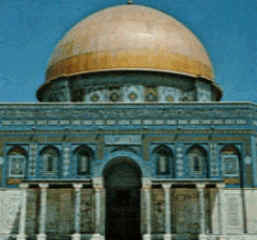
NOTE: There is currently a structure upon the
Temple Mount. It is the Islamic mosque
known as
the "Dome of the Rock." (Also known as the
"Mosque of Omar.") However, this cannot be
considered as a legitimate "Temple" built to God for at least 2 reasons:
1. It was built by gentiles.
2. It was built to a false god named "Allah"
and not to Jehovah.
Therefore, we can see that just because someone builds a structure that can be called a "Temple," and even builds it upon the site of the original temple, does not necessarily mean that it is one according to God's definition.
"TABERNACLE OF THE CONGREGATION"
Very little is known about this structure; and there is no command in the bible for it to be
built. It was preceded by the erection of 12 pillars representing the twelve tribes of Israel and
the construction of an altar by Moses immediately before his ascent to Sinai to receive the Ten
Commandments. (Ex 24:4-5)
Then this early structure, the Tabernacle of the Congregation, preceded
the first actual tabernacle and was built by Moses upon his
descent from the mountain and immediately following the incident with the people and the
golden calf.
Concerning why it was built when there was no direct recorded command for him to do so, it seems to be that Moses wanted an immediate and visible presence of God for the people. This makes sense when the context is examined:
Exodus ch. 32 & 33
He descended from the mount and found the people involved in gross sin and idolatry.
Their sin brought the judgment of God upon the people and 3,000 men died. (32:28)
He then returned to the mount and begged forgiveness for them from God. (32:31)
Upon descending from the mountain he immediately pitched a tabernacle just without
the camp.
(Ex 33:7-10)
Whether he did this to give them a visible reminder of the presence of the true God in order to discourage another "golden calf" incident, which was an idolatrous "presence" of a false "god," is not stated in the scriptures; therefore, we can only conjecture that he did it for that reason. However, the presence of the temporary tabernacle surely must have had that effect on many of the people of the congregation of Israel. Especially when the presence of God was seen upon the tent in the form of a cloud by day.
The only things that we are told about this early precursor to the "Tabernacle" proper, is that it was erected "without the camp" (Ex 33:7a); that it was called the "Tabernacle of the congregation" (:37b); that those who truly "sought the Lord went out unto the Tabernacle" (:37c); that within it the "LORD talked with Moses" (:39) and that young Joshua "departed not out of the tabernacle" but stayed there while Moses went out to speak to the people. In fact, the inference is that Joshua remained in the tabernacle constantly. Maybe to minister or maybe to protect and maintain. God did not see fit to tell us which. Regardless, we do know that only Moses and Joshua were allowed inside it.
There were no Aaronic priests yet to minister within it. No Levites yet separated from the people to erect, maintain, and minister about it. Only Moses and Joshua seem to have been allowed in it. The people went out to it to seek the LORD but in all probability they did not come near it to touch it. In fact, it seems that most remained some distance off in their tents and watched while Moses went to the tent to commune with God. (33:8, 10)
That is about all we can surmise about this tent precursor to the Tabernacle proper.
THE TABERNACLE
There are many that have tried to reconstruct the Tabernacle according to the instructions given in the Bible. However, some of the instructions are somewhat general and, therefore, interpretations of them vary widely.
Some of the better known models are
shown here.
click pictures to view full size
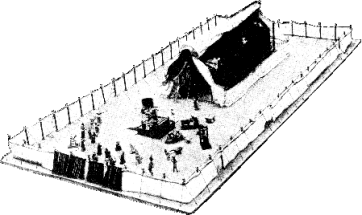
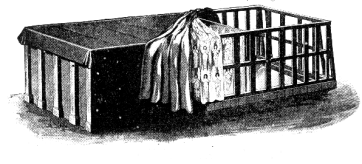 There are many more,
but from these it
is easy to see that interpretations do indeed vary widely. Some envision a tent-
like roof while others believe that a flat
roof is indicated. The flat roof design
does indeed follow the biblical pattern the
best. However, some believe that for the
tapestry to be seen from the inside it is
necessary to incorporate a hollow frame
design for the boards. This is not
forbidden by the scriptures but neither is
there a scriptural description of them that necessitates their inclusion. Upon careful examination
of the scriptural description of the structure it is easy to see that exterior and interior curtains
were described, making such a framework unnecessary.
There are many more,
but from these it
is easy to see that interpretations do indeed vary widely. Some envision a tent-
like roof while others believe that a flat
roof is indicated. The flat roof design
does indeed follow the biblical pattern the
best. However, some believe that for the
tapestry to be seen from the inside it is
necessary to incorporate a hollow frame
design for the boards. This is not
forbidden by the scriptures but neither is
there a scriptural description of them that necessitates their inclusion. Upon careful examination
of the scriptural description of the structure it is easy to see that exterior and interior curtains
were described, making such a framework unnecessary.
A life-size model existent
in Israel today is seen below.
(Click on pictures to enlarge.)
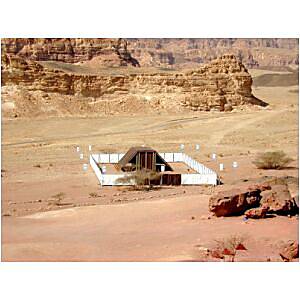
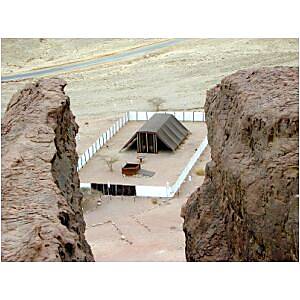
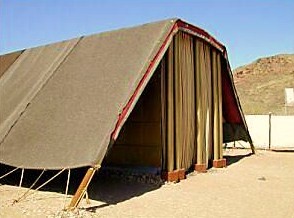
Regardless of which design for the Tabernacle is closer to the original, the important part is that of the interior design of the Tabernacle itself. The interior floor plan of the Tabernacle and the design of the court are both straightforward and minutely described in the scriptures.
The following plan is a representation of the scriptural description in Exodus chs. 25-27; 38.
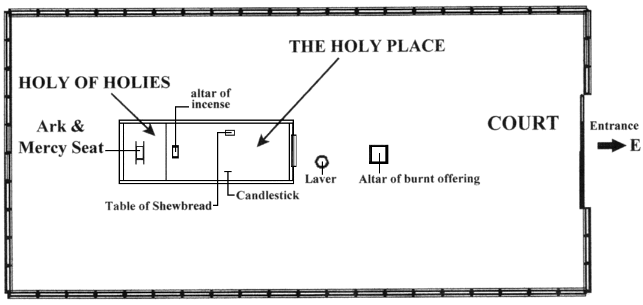
click picture to view full size
SUMMARY
Because of the similarities between the
pattern of the Tabernacle and the pattern of the Temple,
we will not delve deeply into the particulars of the Tabernacle.
Suffice it to say that every part of the Tabernacle
points to Christ, His work, and/or His sacrifice. From the coverings and materials of the Tent
to the sockets for the pillars of the hangings of the Court, all point to Christ. The offerings
offered, the furnishings, and even the very materials that the utensils were made of- all point to
Christ!
We must also remember that the Tabernacle was for Israel.
Ex 25:22 And there I will meet with thee, and I will commune with thee from above
the mercy seat, from between the two cherubims which [are] upon the ark of the
testimony, of all [things] which I will give thee in commandment UNTO THE
CHILDREN OF ISRAEL.
(Caps added)
The Tabernacle was called "the tabernacle of the congregation" 127 times. Congregation by context meaning Israel. It was given to them as part of their separation from the Gentiles.
I Ki 8:53 For thou didst separate them from among all the people of the earth, [to be] thine inheritance, as thou spakest by the hand of Moses thy servant, when thou broughtest our fathers out of Egypt, O Lord GOD.
It is the place where God met with "the children of Israel," not the Gentiles. Gentiles are all of those who are not of the line of Israel (Jacob.)
Ex 29:43 And there I will meet with the children of Israel, and [the tabernacle] shall be sanctified by my glory.
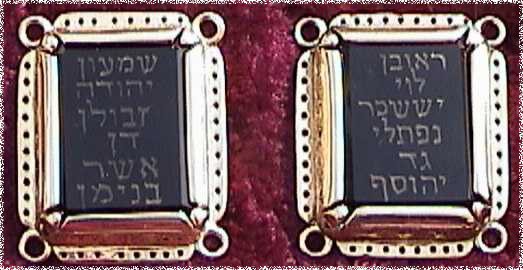
"Children of Israel" is used 600 times in the Old and New Testaments and the names of the twelve tribes were even engraved upon the two onyx stones worn on the shoulders of the ephod worn by the High Priest when he went in to do the service of the Tabernacle.
Ex 28:9-10 And thou shalt take two onyx stones, and grave on them the names of the children of Israel: Six of their names on one stone, and [the other] six names of the rest on the other stone, according to their birth.
Ex 28:12 And thou shalt put the two stones upon the shoulders of the ephod [for] stones of memorial unto the children of Israel: and Aaron shall bear their names before the LORD upon his two shoulders for a memorial.
In addition the breastplate worn by the High Priest contained 4 rows of 3 stones each; and upon each was engraved the name of one of the tribes of Israel.
Ex 28:21 And the stones shall be with the names of the children of Israel, twelve, according to their names, [like] the engravings of a signet; every one with his name shall they be according to the twelve tribes.
It is easy to see that the Tabernacle and the service of it was strictly for the children of Israel. If a stranger sojourned among them and wished to make an offering to the Lord, that was allowed; but, no stranger was allowed to take his offering into the Tabernacle himself. In fact, no one, stranger or Israelite, was allowed to enter it nor touch any part of it, upon pain of death, except those of the tribe of Levi; and the ministration in the Holy of Holies was reserved STRICTLY for one of the family of Aaron- the High Priest. In addition, the Aaronic priesthood could not be passed to another family, it was kept ONLY within the males of the family of Aaron.
Ex 29:9 And thou shalt gird them with girdles, Aaron and his sons, and put the bonnets on them: and the priest's office shall be theirs for a perpetual statute: and thou shalt consecrate Aaron and his sons.
Num 18:1-4 And the LORD said unto Aaron, Thou and thy sons and thy father's house with thee shall bear the iniquity of the sanctuary: and thou and thy sons with thee shall bear the iniquity of your priesthood. And thy brethren also of the tribe of Levi, the tribe of thy father, bring thou with thee, that they may be joined unto thee, and minister unto thee: but thou and thy sons with thee [shall minister] before the tabernacle of witness. And they shall keep thy charge, and the charge of all the tabernacle: only they shall not come nigh the vessels of the sanctuary and the altar, that neither they, nor ye also, die. And they shall be joined unto thee, and keep the charge of the tabernacle of the congregation, for all the service of the tabernacle: and a stranger shall not come nigh unto you.
Num 18:7 Therefore thou and thy sons with thee shall keep your priest's office for every thing of the altar, and within the vail; and ye shall serve: I have given your priest's office [unto you] as a service of gift: and the stranger that cometh nigh shall be put to death.
Obviously, no one was allowed within the Tabernacle itself except those of the tribe of Levi and specifically those Levites of the family of Aaron who were given the perpetual priesthood in the Holy place and the Holy of Holies and that particular service could not be passed on to strangers or even to another Israelite not of the Aaronic family.
Final Note: The seriousness of this restriction concerning the things of the Holy of Holies can be seen when we read what happened to the men of Bathshemesh when they simply looked into the Ark. Because they were not of the house of Aaron, God killed 50,070 of them. (I Sam 6:19)
We need not delve further into the Tabernacle since the general plan and use of it were so similar to that of the Temple.
END OF SECTION ONE
STOP
HERE and TAKE TEST!
TESTING Make sure you read the
testing
instructions if you have not already done so.
SECTION ONE TEST
Should the test fail to open properly, please use F5 to reload or click the refresh symbol on the top of your browser page.
If you failed the test,
then restudy this section and retake the test.
Once you have passed the test, do not take it
again.
If you missed any questions on the test, then restudy the section and find all of the correct answers to any questions that you missed. A copy of your test was sent to you with the correct answers on it. You may use that for comparison purposes to make sure you have found the correct answers in the textbook.
Now, on with our study of the Temple.
SECTION
TWO
THE TEMPLE
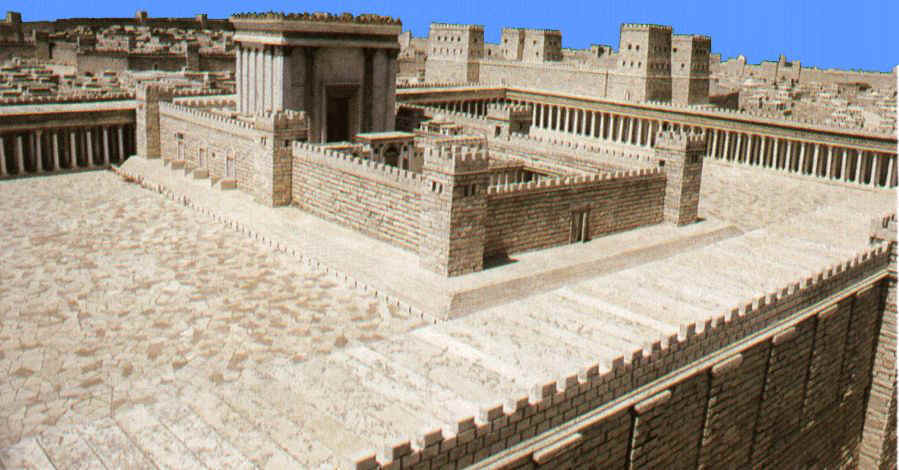
model of Herod's Temple
click picture to view full size
As was mentioned earlier, there were actually three temples built. The largest and most sumptuous of these was actually the last of the three. It was the lavish structure built by King Herod to pacify the Jews.
Herod's Temple was the temple visited by Jesus Christ. In the New Testament it is referred to as "... the temple of God..." (Mt 21:12) and Jesus verified that it was truly that by applying the Old Testament scriptures to it. (Mk 11:17 cf Is 56:7 & Jer 7:11)
Although Herod's Temple was recognized as God's Temple, there was one important article missing- the Ark of the Covenant. Nowhere in scripture does it state that the ark ever rested in the most Holy Place in Herod's Temple. In fact, the last time we hear about the ark in the bible was when it was installed in its proper place in Solomon's Temple some five centuries before the time of Herod. (II Chr 35:3) When Jerusalem had been destroyed in 587 B.C., the ark disappeared, never to be seen again.
There are several theories concerning its current whereabouts but none of them can be proved. Some believe that it has been taken to Heaven, and Rev 11:19 makes this a possibility, but this cannot be proved either for two reasons:
ONE: The passage in the Revelation, by context, could easily have been referring to a time before the existence of the ark on earth, not after its disappearance.
TWO: The book of Hebrews states that the ark and everything pertaining to it and the Tabernacle, were merely "shadows" of things already existent in heaven.
Heb 8:5 Who serve unto the example and shadow of heavenly things, as Moses was admonished of God when he was about to make the tabernacle: for, See, saith he, [that] thou make all things according to the pattern shewed to thee in the mount.
Therefore, the "ark" spoken of in the book of the Revelation could easily have been
speaking about the "reality" in heaven of which the ark constructed by Moses for the
Tabernacle was merely a "shadow." Which would leave us with
but guesses and surmisings as to where the ark
actually is, still on earth or in heaven.
Where the ark is now is really of no concern because it pertained to the Old Covenant under the Law and the world is now under the New Covenant under grace by the blood of Christ.
Even to the Jew it is of no scriptural significance today since the Law was fulfilled in Christ. And even their prophet Jeremiah foretold its disappearance and non-significance in Jeremiah 3:15-17. Eventually the ark will be superceded by Jerusalem itself which will be called the "throne of the Lord." Judah and Israel will once again be reunited and all the nations of the earth will be gathered unto the Lord's throne, of which the ark was a type, the reality of which will be the city of Jerusalem. What a glorious time that will be!
David and Solomon and the Temple- David conceived the original idea for the Temple. After seven months in the land of the Philistines, the ark of the Lord was sent to the land of Beth-shemesh. (I Sam 6:1-14) From there it was brought to Kirjath-jearim where it abode in the house of Abinadab for twenty years. (I Sam 7:1-2) From there the ark was brought to the house of Obed-edom where it rested for three months because of David's fear of the Lord over the death of Uzzah because of his error in touching the ark at the threashingfloor of Nachon. (II Sam 6:1-11) From there David brought it in the hands of the Levites to Jerusalem where it was settled in a tabernacle (tent) that David had constructed for it. (II Sam 6:17; I Chr ch. 15)
After the Lord had given David some rest from all of his enemies, David began to feel that it was not right that he lived "in an house of cedar" while the "ark of God dwelleth within curtains." (II Sam 7:1-2) Therefore David enquired of the prophet Nathan about the matter and Nathan brought word from the Lord that because David had conceived, on his own, this idea of a more permanent dwelling-place for God, then God would bless the house of David through his posterity. God promised that David's throne would continue after him and that his son would build the Temple of God. (II Sam 7:3-17)
That was, however, the one catch. David would not build the Temple that he conceived of, that job would be given to his son, Solomon. (I Ki 8:17-19) David was a man of war and blood, not of peace; therefore, it would be left to his son, who would have peace round about, to build the Temple. (II Sam chs. 11-12 esp. 12:10; READ: I Chr 22:7-9)
NOTE: The passage referred to in II Sam ch. 7 also contained prophecies concerning Christ. Solomon was the one in sight when referring to the building of the Temple and the immediate continuation of the throne of David. However, in verses :12 and :13, the view to the eternal kingdom and king that will spring from the line of David has to be referring to his eventual seed, Jesus Christ, the only one who will have an eternal kingdom. This can be seen by the statements in Heb 1:5 and :8.
Not only did David conceive of the Temple, he also began gathering materials for the
building of it and its contents. (II Sam ch. 8; I Chr 22:2-5) This, however, was all that David
had to do with the Temple. He conceived of it and gathered materials for it but he was not
allowed to build it. In fact he never saw it with the eye of flesh at all but only with the eye of
faith.
It is easy to see by what we have studied so far that the sole purpose of the Temple was to house the ark of God, which represented His throne, and thus it was to be the place where God would meet with man. (Ex 25:22; et al) In addition we have seen that the ark was to be replaced, eventually, by the city of Jerusalem which will be for both Jews and Gentiles. Therefore, the loss of it and its whereabouts now are no longer important.
Now, on to the temple itself.
Site of the Temple- Jerusalem was built on four hills, two of which, Zion and Mount Moriah, are mentioned in the Bible. The Temple was built on the easternmost of these two, the one known as Mt. Moriah (II Chr 3:1). This whole area collectively is also referred to in the Scriptures as Mt. Zion. The area at the top of the hill, slightly to the side of the peak, is where the Holy of Holies was to be located. That spot is generally believed to be the place where David built his altar after the plague of I Chr ch. 21 in which the Lord had destroyed 70,000 men because of the sin of David in numbering Israel. The angel of the Lord had been dispatched to destroy Jerusalem and the Lord stayed the angel's hand at the threshingfloor of Ornan (who also was known as Araunah). There David saw the angel "stand between the earth and the heaven, having a drawn sword in his hand stretched out over Jerusalem..." (I Chr 21:16) In obedience to the angel of the Lord, David then built an altar and sacrificed unto the Lord and The Lord accepted those sacrifices and told the angel to "put up his sword again into the sheath thereof." (I Chr 21:27) Upon that spot, years later, David's son Solomon would build God's Temple.
NOTE: Traditionally this spot is also believed to be the same spot where Abraham was told to sacrifice Isaac (Gen 22:2) and where Abraham proved his faith by telling Isaac that the Lord would "... provide himself a lamb for a burnt offering..." (Gen 22:8) A reading of the scriptures seems to suggest that this tradition is probably true.
Upon this site was built the altar of burnt offering (brazen altar) and just to the west of it was the Temple building.
Construction of the Temple-
 In preparation for the construction of the Temple,
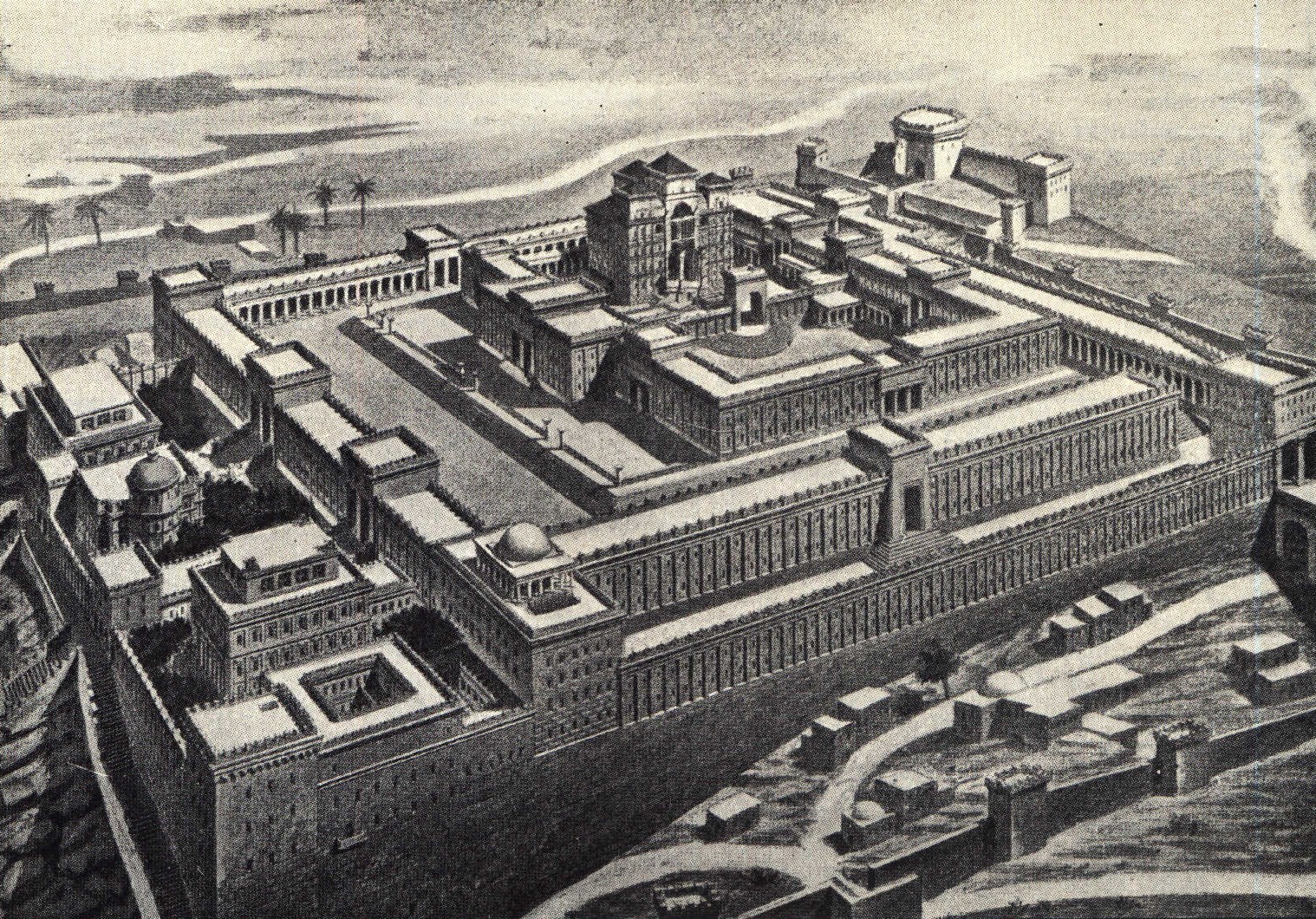 Solomon had the entire peak of Mt. Moriah
leveled off and the lower parts of the mountain built up upon "immense substructures."(1)
Such an extensive rearrangement and reinforcement of the mountain was necessary because
although the temple itself was not
particularly huge,
approx. 90' X 30' X 45',
the area covered by it
plus the other buildings
pertaining to the
Temple complex
probably covered some
600 ft. east to west and 300-400 ft. from north
to south (1) and stood
several hundreds of
feet above the city.
Solomon had the entire peak of Mt. Moriah
leveled off and the lower parts of the mountain built up upon "immense substructures."(1)
Such an extensive rearrangement and reinforcement of the mountain was necessary because
although the temple itself was not
particularly huge,
approx. 90' X 30' X 45',
the area covered by it
plus the other buildings
pertaining to the
Temple complex
probably covered some
600 ft. east to west and 300-400 ft. from north
to south (1) and stood
several hundreds of
feet above the city.
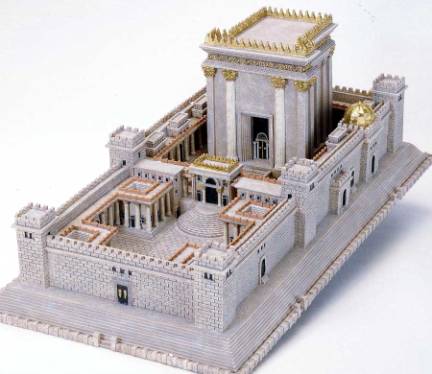
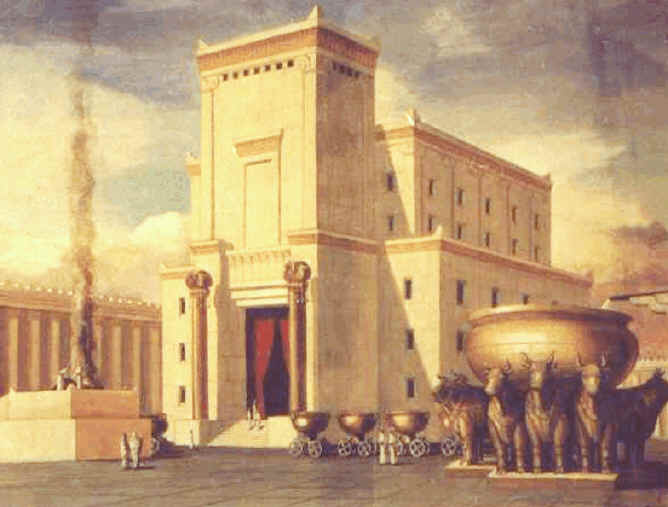
Solomon's Temple external- These renderings
follow a common pattern of depiction of the Temple. The drawing on
the right is closer to the biblical description of Solomon's Temple, except for
the lack of the front tower, while the one on the left actually is more like
what Herod's Temple would have looked like.
![KingSolomonsTempleModel[1].jpg (90067 bytes)](../../images/TabTempGrFINAL/KingSolomonsTempleModel[1].jpg) Alternate
model- Some models envision a tiered front
porch as is seen in this model patterned
after a conception by Joseph
Doctorwitz. However, the Bible gives
no indication at all about the outward appearance of this porch except its
overall dimensions. Contrary to the others, this model does agree with the
height given in the scriptures.
Alternate
model- Some models envision a tiered front
porch as is seen in this model patterned
after a conception by Joseph
Doctorwitz. However, the Bible gives
no indication at all about the outward appearance of this porch except its
overall dimensions. Contrary to the others, this model does agree with the
height given in the scriptures.
(This is the model preferred, and used, by the Masonic
Lodge.)
The drawing to the right also shows a tall front porch such
as is described in the scriptures.
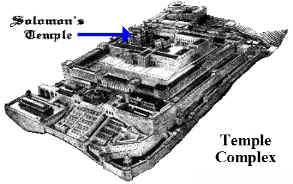
The Temple complex including Solomon's palace-
The arrangement of the complex is seen below and was quite extensive.
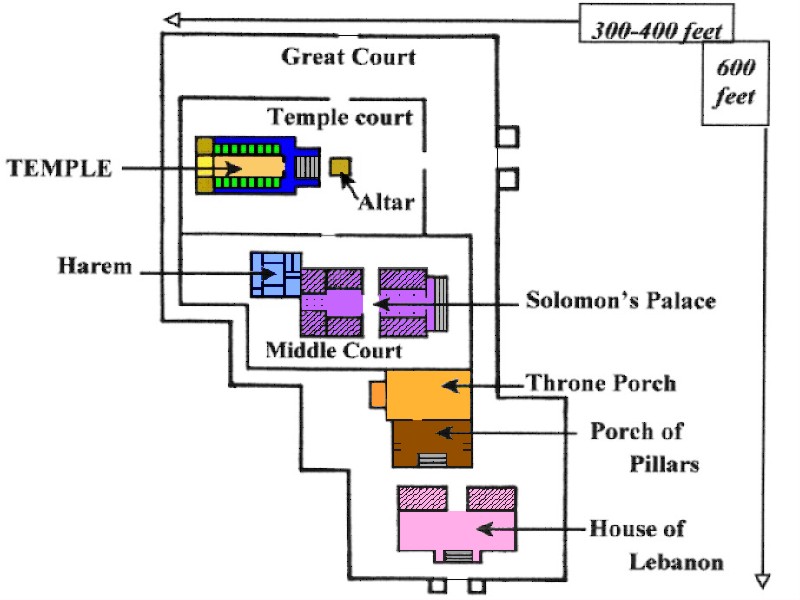
click picture to see full size plot plan
Although the complex, including the surrounding structures all built on this high spot above
the city, was quite imposing, the temple itself was quite ungrandiose. On the outside it was
somewhat of a plain structure made of limestone blocks, most of which probably came from
quarries in the immediate area of Jerusalem.
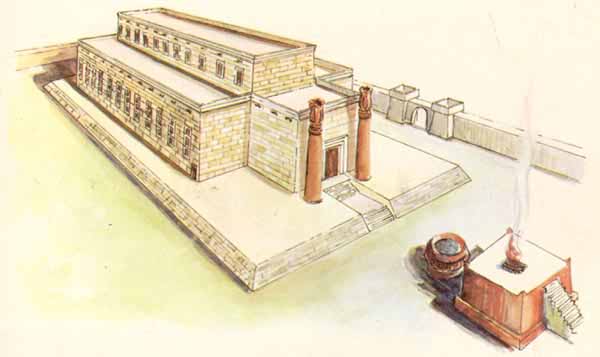
Solomon's Temple-
By itself, separated from the
surrounding complex, it most probably would
have looked somewhat like the picture
at right except the quite lofty front tower would have exceeded that of
the one shown in the drawing.
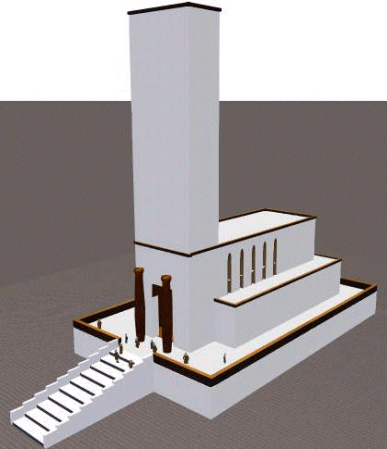 NOTE: Some scholars deny the
existence of the front tower, saying
that the figure given in II Chr 3:4 is
an error and that the porch was
probably the same height as the temple
proper, 30 cubits (45 ft.). However,
there is no reason to believe this. This
is the only place in the Bible that the
height of the porch is given. If the
Bible says that the porch was 120
cubits (180 ft.) high, then it was 120
cubits high! Why chose an arbitrary
figure when an exact measurement is
given. They do not question the other
temple measurements, so why
question this one? In the rendering to the left you can see what the
Temple would have looked like with the tower (porch) drawn to scale.
NOTE: Some scholars deny the
existence of the front tower, saying
that the figure given in II Chr 3:4 is
an error and that the porch was
probably the same height as the temple
proper, 30 cubits (45 ft.). However,
there is no reason to believe this. This
is the only place in the Bible that the
height of the porch is given. If the
Bible says that the porch was 120
cubits (180 ft.) high, then it was 120
cubits high! Why chose an arbitrary
figure when an exact measurement is
given. They do not question the other
temple measurements, so why
question this one? In the rendering to the left you can see what the
Temple would have looked like with the tower (porch) drawn to scale.
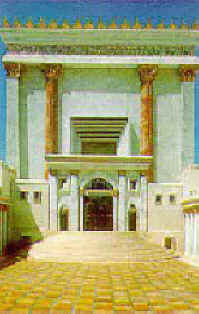
The Pillars- Standing in front of the structure were two brass (bronze) pillars (I Ki 7:15-22)
which can be seen in the picture to the left. The one on
the right was named "Jachin" (yaw-keen') and the one on the left was named "Boaz;" meaning
"He will establish" and "fleetness."
These
pillars were of a height of eighteen cubits (27 ft.) each.
NOTE:
In II Chr 3:15 the height of the pillars is given as "35 cubits." Some view this
as an error in the Bible. In actuality it is just a rough measurement of the combined
height of the "two pillars" and when one adds the "chapiter" of five cubits to the top
of each pillar plus the "chains" to hold the "hundred pomegranates" (v. :16) which
were placed on the "heads of the pillars," (I Chr 3:16 cf I Ki 7:22) then an agreement
is reached between the measurements given in I Ki 7:15 and those in I Chr 3:15.
The steps- In front of the pillars was a flight of steps leading up to the Temple platform.
Workers for the preparation- In preparation for the building of the Temple, Solomon used 3,300 foremen; 80,000 hewers
of stone and wood; 70,000 bearers of burdens; and 10,000 Israelites (30,000 total sent to
Lebanon 10,000 at a time for one month on and two months off) dedicated to the work of
preparation. Also Hiram, king of Tyre, had an unspecified number of workmen supplying
Solomon with timber for the work as well as lumber finishers and stone squarers (given the
magnitude of the job, 7,000 would not be an unreasonable number of lumberjacks, haulers, and
mariners). The Bible tells us that these 163,300 laborers from Israel plus the workers from Tyre
"prepared timber and stones to build the house."
(I Ki 5:13-18 also see
II Chr ch. 2)
|
ISRAEL (Israelites) 3,300 Solomon's chief foremen (foreigners) 80,000 hewers (of stone and wood) (foreigners) 70,000 bearers of burdens (Israelites) 10,000 Israelite workers (30k sent 10k at a time) |
TYRE ? Lumberjacks ? Haulers of logs ? Mariners ? Unloading crews |
|
Israel's total - 163,300
Tyre's total - ???
(7,000 would not be an unreasonable number) |
Grand total - approx. 170,000 workers
at any one time.
THE
CONSTRUCTION and CONSECRATION of the TEMPLE
The time frame- The Bible and other sources tell us that the Temple was dedicated around 957-58 B.C. and destroyed in 586 B.C. by the Babylonians under Nebuchadnezzar.(2) Construction began in 964 B.C.(2) in the fourth year of Solomon's reign (I Ki 6:1, 37) and continued for seven years (I Ki 6:38).
The construction-
It is logical to assume that work on the structure and the contents proceeded
concurrently during the seven years of its construction. (I Ki chs. 6-7; II Chr
chs. 3-4 )
The outer stone structure of the Holy Place and the Holy of Holies would have to have been
completed first, of course. Then the interior wooden walls with their gold plating and
inscriptions and pictures as well as the wooden flooring would have followed.
Meanwhile the interior work would have been in preparation including the various altars, the
laver, the table of shewbread, the tables for bread of the Presence, the
lampstands, and the
various utensils for the sacrifices and incense, as well as the 2 Cherubim in the Holy of Holies.
Consecration of the Temple- We have already found that the Temple was dedicated around 957-58 B.C. The building of the Temple was completed and everything was ready for the installation of the Ark in the Holy of Holies. Currently the Ark was in the temporary tent that had been constructed by David to house it upon its arrival from the house of Obed-edom. (I Chr chs. 15-16)
We see the consecration of the Temple in II Chr chs. 5-7 & I Ki ch. 8.
READ: II Chr 5:1-5
The order of the Consecration of the Temple-
First- In II Chr 5:5 we see two things:
1. The
Ark is brought up from its resting-place in the tent in Jerusalem.
2. The Tabernacle and all of its furnishings, including the altar, is brought from Gibeah.
- David had already brought the ark to Jerusalem where he installed it in a tent and had the Levites minister about it continually. (READ: I Chr 16:4-6, 37)
- But the Tabernacle and its furnishings he had left in Gibeah along with the brazen altar for the required sacrifices. (READ: I Chr 16:39-40)
- Back in II Chr 5:5-6, the first part of the dedication is when the ark and the Tabernacle are brought to the Temple with an innumerable count of sheep and oxen that were sacrificed at the installation of the ark in the Holy of Holies. (READ: II Chr 5:5-7)
- By that time the only things remaining in the Ark were the tables of stone (the Ten Commandments.) (II Chr 5:10)
Second- While the installation of the ark is taking place, hundreds of Levites sang and played instruments including 120 on trumpets alone. (II Chr 5:12)
Third- Upon the installation of the Ark, the glory of the Lord filled the Holy of Holies!
(READ: II Chr 5:13-14)
Fourth- The Prayer of Solomon dedicating the house and acknowledging
that it is a dwelling
place of God in symbol ONLY and not in fact; and, that it is in reality a house of prayer.
In essence, Solomon dedicated the Temple as a place for Israel to reach God's ear which
truly is in Heaven. (READ: II Chr 6:12-13, 18-21)
"hear thou from heaven"
is repeated throughout chapter 6, acknowledging that no
mere physical building can contain the totality of God.
Remember what Jesus said in Mat 21:13 as He quoted from Is 56:7?
"My house shall be called the house of prayer; but ye have made it a den of thieves."
Fifth- After Solomon's prayer, fire from heaven consumed the sacrifices and the glory of God filled the whole Temple! (READ: II Chr 7:1-3)
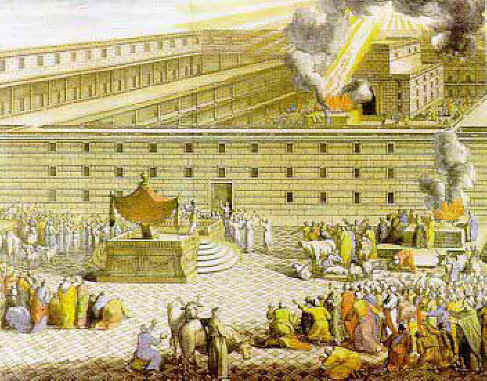 Sixth- Then sacrifices were made for seven days after the glory of the Lord came down.
(READ: II Chr
7:4-9)
- 22,000 oxen & 120,000 sheep
- So many that the brazen altar could not hold them, therefore,
they were offered all over
in the court before the Temple.
The Temple was
finished and the glory of God filled it. This was the place where He would hear
the prayers of Israel and also (from the outer court) the prayers of the Gentiles. (II Chr 6:32-33)
Next we will study the inner Temple, the furnishings and their use and significance and the priestly duties and dress. Included will be the various sacrifices and ceremonies.
END OF SECTION TWO
STOP
HERE and TAKE TEST!
SECTION TWO TEST
Should the test fail to open properly, please use F5 to reload or click the refresh symbol on the top of your browser page.
If you failed the test,
then restudy this section and retake the test.
Once you have passed the test, do not take it
again.
If you missed any questions on the test, then restudy the section and find all of the correct answers to any questions that you missed. A copy of your test was sent to you with the correct answers on it. You may use that for comparison purposes to make sure you have found the correct answers in the textbook.
THE FURNISHINGS OF THE TEMPLE
Although all of these furnishings were not inside the Temple itself, they all had to do with the sacrifices and, therefore, must be included as Temple furnishings.
As we move from the outside to the inside of the Temple we find that those things on the outside speak of the work of Christ and those on the inside speak of the person of Christ.
The Brasen Altar-
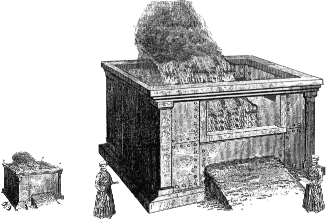
Both the portable altar of the Tabernacle and the permanent altar of the Temple served one
and the same purpose, to offer up burnt offerings unto God. The main
difference between the two was their size.
TABERNACLE
TEMPLE
ALTAR ALTAR
TABERNACLE ALTAR [ 7 ½ x 7 ½ x 4 ½ ]
Ex 27:1 "And thou shalt make an altar [of] shittim wood, five cubits long,
and five cubits broad; the altar shall be foursquare: and the height thereof
[shall be] three cubits... and thou shalt overlay it with brass."
TEMPLE ALTAR [ 30 x 30 x 15 ]
II Chr 4:1 "Moreover he made an altar of brass, twenty cubits the length
thereof, and twenty cubits the breadth thereof, and ten cubits the height
thereof."
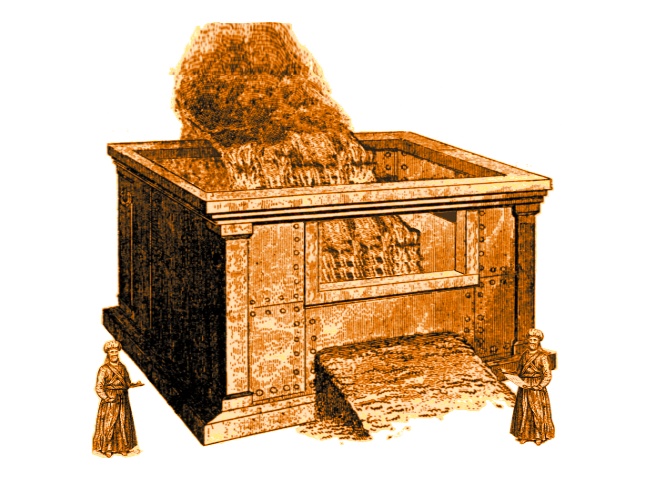
The brasen altar was the first article we
find within the eastern gate. Brass speaks of judgment; and, therefore, the brasen altar is placed
in the outer court. This is to show that before one can get to God within the Temple, one must first pass
through judgment. God allows no sin in His presence.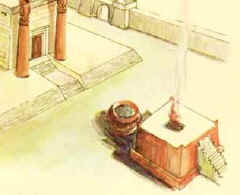
Some conceptions of this altar, such as the one to the left, show a
low ramp up to the front of the altar and an opening for offering the
sacrifice. Others, such as the one to the right, show a taller ramp or
stairs leading to the top of the altar with a grate
in the middle of the top on which the sacrifice is placed.
NOTE: All of the articles in the outer court were made of or covered with brass; while inside the Temple the furnishings were made of gold. This shows us that sin (brass) must be dealt with in the outer court before coming into the presence of a holy God. Then, and only then, can one enter into the holy place and behold those articles made of gold, which symbolize deity and the believer's communion with and worship of God.
Material- The altar of the Tabernacle, and we assume the altar of the Temple also, was made of shittim wood overlaid with brass. The shittim wood was extremely strong and hard. The brass overlay is of course speaking of sin and the wood speaks of strength.
Offerings- On the brasen altar of God's judgment were offered the sacrifices for sin. They were to be a male of the flock or herd and without blemish. (See NOTES 1 & 2 at the end of this segment.) They were to be wholly burnt on the altar except for their skins. (Lev ch. 1)
Symbolism- The brasen altar and the sacrifices burnt thereon picture perfectly the Lord Jesus Christ and His sacrifice for us on Calvary.
ark- Brass and wood. Brass speaks of our sin which He took upon himself and wood speaks of His strength to offer himself a sacrifice for us.
sacrifice- A sacrifice without blemish speaks of His sinlessness and the offering of the substitutionary sacrifice is a perfect picture of Christ our sacrifice.
Compare Lev 1:4, 10-11, 13 with John 1:29.
burnt sacrifice- The sacrifice must be wholly consumed in the fire upon the altar, just as
Christ was wholly consumed in God's wrath as a sacrifice for us. (See NOTE 2)
"a sweet savour unto the Lord." (Lev 1:9)
A smell
(savour) is all that is left when the actuality of our sin is consumed in the sacrifice. We once reeked of sin. We were a foul
odor in the nostrils of God. Now, when our sin is atoned for by the consuming of our
substitutionary lamb Jesus Christ, we are become a "sweet savour" unto God.
"overlay it with brass"- This shows that the inner strength, the wood, which represents Christ, was overlayed with brass, the type of judgment for sin. This pictures the perfect sinlessness of Christ, who was strong enough to resist sin, and His taking OUR sin and judgment upon himself.
II Cor 5:21 For he hath made him [to be] sin for us, who knew no sin; that we might be made the righteousness of God in him.
I Pet 2:24 Who his own self bare our sins in his own body on the tree...
Ro 5:11 And not only [so], but we also joy in God through our Lord Jesus Christ,
by whom we have now received the atonement.
the skin of the sacrifice (Lev 7:8)- All of the offering was burnt unto God, this as we said pictured Christ as the sacrifice for us. However, the skin was given over to the Levites for their use. This is the only part of the offering that represents the person whom Christ was offered for. In Christ our sin is paid for, it is totally consumed, leaving nothing but our skin, i.e., just the empty hull of the man. This empty hull is then given over to the Levites for use in the ministry. Once we are saved God makes us a new creature (II Cor 5:17) we just happen to still be in this old skin. Therefore, we are to turn that old skin over to the Levites (here symbolizing Christ, the one who offered our sacrifice to God, and also the pastor and the leaders in the Church) for use in the ministry. (Eph 4:11-12)
Remember this old skin filled with the new creature is not
redeemed nor is it redeemable, it must die. Till
then, we and the whole of creation wait eagerly and groan for that day. (Ro 8:22-23)
Alternate
offering for sins of Eve-
NOTE 1: Concerning the sacrifice being a male without blemish- there were two exceptions
to this. If the offering was for a sin done in ignorance or a sin of the lips, or a defilement
that is found out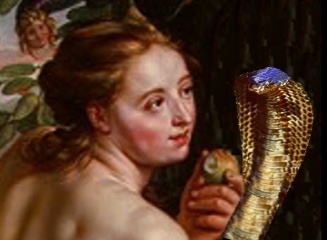 later, then a female of the flock may be brought. (Lev
chs. 4 & 5)
later, then a female of the flock may be brought. (Lev
chs. 4 & 5)
This exception can only be for but one purpose. It takes us back to Eden in the book of
Genesis. When Eve was confronted by Satan, her sins were of: ignorant defilement by the
devil, listening to things that ought not be listened to, and sinning with her lips. These are
exactly the sins that are atoned for by a substitutionary sacrifice of a female lamb without
blemish.
Burnt offerings-
NOTE 2: Concerning the sacrifice being wholly burnt upon the altar, those 14 types were
called (Heb) olah, or (Gk) olokautwmata,
hol-ok-ow'-toe-ma-ta,
(holocaust) meaning
wholly consumed "burnt offering." There were, however, other types of offerings and
sacrifices burnt upon the altar. These exceptions had certain portions burnt upon the altar
and the rest were burned in a certain place "without the camp." The symbolism of this
and its application to Christ are explained in Heb 13:11-13. Some offerings had only
particular portions burned upon the altar and the rest was consumed by the priests or the
offerer.
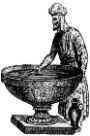
Tabernacle Laver-
The laver for the Tabernacle was a relatively small basin of brass used by the
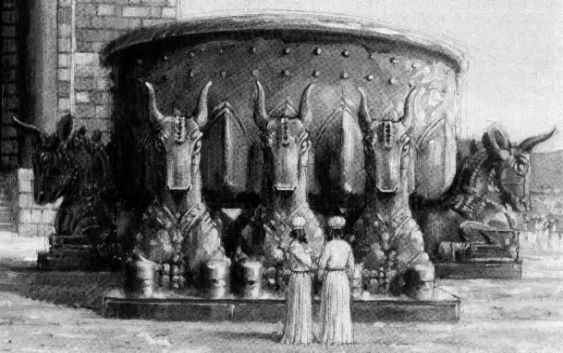
Priests for washing. (Ex 30:18) For the Temple, however, a much larger and more ornate
structure called a "sea" was built for that same use. (I Ki 7:23-26)
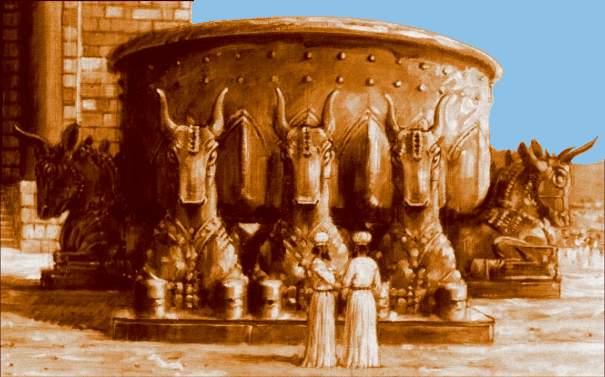
Temple Laver- According to I Ki 7:23-25 the "sea" was 10 cubits across, 5 cubits high, with a circumference
of approximately 30 cubits. This translates to 15 feet across, 7½ feet high, and with a
circumference of 45 feet.
This immense "sea" rested upon the backs of 12 oxen facing the four corners of the compass,
with three facing toward each point. This must have brought the sea to about the same height
as the brasen altar, approximately 15 feet. This immense basin held about 10,000 gallons of water.
Material- Again the construction material was of brass symbolizing judgment for sin.
Use- The sole use of this sea was for the washing of the priests. When approaching unto the
altar the priest had to wash and then after the sin offering was paid at the brasen altar the
priest had to wash again before going into the holy place. The priest could become defiled
between the altar and the holy place; therefore, cleansing was required of any defilement
encountered since the altar.
Symbolism- The brass speaks of judgment for sin, and use by the priests restricts the sea (laver)
to our use today as Christians, the New Testament priests of God. (Rev 1:6; 5:10; 20:6)
It is not for use by the lost.
Its place- standing between the altar, where atonement is made, and the holy place and the
inner sanctum known as the most Holy Place is most significant in two ways.
1. This sea (laver) symbolizes our cleansing by the Holy Spirit. Once Christ atones for our
sin on the altar, then the Holy Spirit cleanses us so that we can approach the Temple of our
holy God.
2. It also tells us that even after accepting the atoning sacrifice of Christ, we still encounter
sin from day to day. Yes, our sin was paid for at the altar and we were cleansed at the
laver. However, our daily sin must be forsaken and cleansed away also at the laver of
sorrow, repentance, and prayer, where the water again symbolizes the power of the Holy
Spirit which empowers us in our daily fight with and cleanses us from the defilement of
our daily sin. This we must do every day before we can enter in to commune with our holy
God or approach Him with our petitions lest our sin "kill" our communion with Him.
Ex 40:30-31
cf Jn 13:10
Jn 13:10 "Jesus saith to him, He that is washed needeth
not
save to wash [his] feet, but is clean every whit:"
Christ made cleansing available to us when He atoned for our sins at the brasen altar and the Holy Spirit cleansed us from our sin at the laver; but, we subsequently need to stop at that laver to wash our feet daily to remove the defilement of this sinful world in which we live and walk. Only then can we enter in to commune and fellowship with our God.
TEN
LAVERS
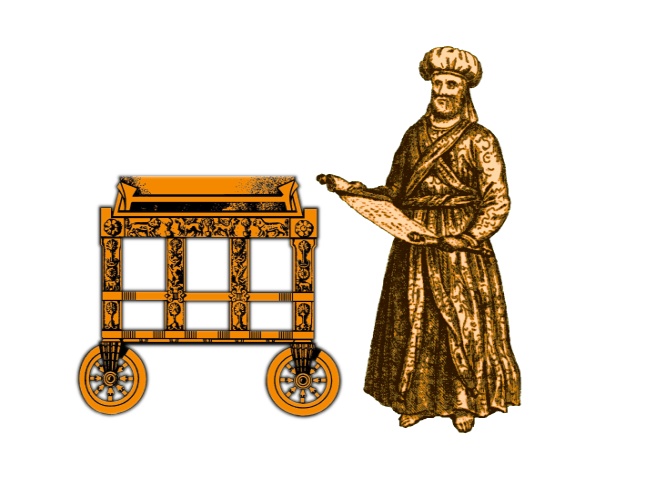
The ten lavers were placed five on each side on the north and the south of the Temple in the surrounding court and were used to wash the sacrifices so that they could be sure that they were clean before being offered. (Before is very significant here.)
These lavers were also made of brass and were 4 cubits by 4 cubits by 3 cubits; which is 6 feet square by 4 ½ feet high. They each were set upon bases which rested upon 4 wheels.
Symbolism- Again the brass stands for judgment for sin.
Its use before approaching the altar makes its application obvious. The use of the lavers
for the cleansing of the sacrifice symbolizes repentance upon our part of the filthiness of this
world.
Christ went to the altar to atone for our sins; but, before we could approach to that altar we
must be willing to rid ourselves of the filth and defilement of this world. Thus, we come to
the lavers of repentance filled with water that this time represents both the Word of God
(Eph
5:26)
which shows us our defilement, and also the Holy Spirit that applies the Word to our
heart and convicts us of our sin. Once we repent, then and only then can we come to the altar
to be sacrificed, symbolically in the clean animal and vicariously in the actuality which is the
person of Christ, as the sacrifice of Atonement.
(II Cor 7:10)
He was perfect and needed
no cleansing of repentance. We, however, need the cleansing of repentance before going to
the altar to be sacrificed in Him.
(II Cor 7:10)
Ten lavers and Tens of the Bible- As I was studying I began to think of the tens of the Bible and how they relate to the symbols of these ten lavers of repentance.
The other tens
in the Bible that concern cleansing (or repentance of if you will):
The Ten Commandments, the symbol of the first Covenant under the Law, both of which, the Commandments and the Covenant, were broken. Which necessitated both our repentance and the New Covenant in Christ.
The ten years that Abraham spent in Caanan before he and his wife decided to help God.
Their temporary unbelief in a moment of weakness brought forth a people from the loins
of Abraham that have become the greatest of the enemies of the true God and the children
of Israel and of Christianity. Ten lavers reminds us of the sin of unbelief of which we need
to repent to ward off eventual disaster for us and our progeny.
The ten righteous men that could NOT be found in Sodom, which, if they could have been
found, would have caused God to stay His hand of judgment. Thus showing us the
hopelessness of our condition and the widespread hold of sin that we need to repent of.
In addition it shows us that we need to spread God's righteousness, in Christ, to our
neighbors. Otherwise we may lose our homes in addition to the much greater loss of
having to answer for the blood of our neighbors on our hands.
Also it reminds us of the hopelessness of human society. In Sodom if ten righteous
men could have been found, God would've stayed His judgment; but, they could not be
found.
In actuality today we are only righteous in Christ; therefore, ten truly righteous
cannot be found now either. (Ro 3:23) And when we who have Christ's imputed
righteousness are gone in the rapture, then God's wrath and destruction will fall on the
whole world because of the lack of ten righteous within it. Ten lavers show that ALL of
our society needs to repent, one at a time; but they won't anymore than they did in Sodom.
II Pet 3:9 The Lord is not slack concerning his promise, as
some men count
slackness; but is longsuffering to us-ward, not
willing that any should
perish, but
that all should come to repentance.
Then we have the ten times that Laban changed Jacob's wages. Ten lavers show us the ten times multiplied deceptions of which we all need to repent.
Also in the Tabernacle we had the 10 curtains which covered it; and the boards of it that were all ten cubits in length; and the hangings for the east and west sides of the court which were hung on 10 pillars and 10 sockets. And the same for the two Cherubs within the Holy of Holies in the Temple that were each 10 cubits high and with a wingspan of 10 cubits. And the brasen sea that had a diameter of 10 cubits in the court before the Temple.
And both the Tabernacle and the Temple represented the presence of God with man; and, the sacrifices offered in them pointed to the Messiah to come. Man's sin necessitated God's coming to man and the ten lavers remind us of the Tabernacle and the Temple and the necessity of repentance before acceptance of the atoning sacrifice of Christ that clears the way for us to enter in to God's Holy presence within.
And what of the ten Plagues upon Egypt because of the sin of the heathen.
Or the ten times that the people of God tempted Him in the wilderness with their murmurings and complainings of disbelief and rebellion; even after seeing all of His wonders personally. Do we not do these same things and, therefore, need to repent of them as much as they?
Then there was the matter of the ten tribes that were taken from Solomon because of his sin in setting up idols in the house of God. Ten lavers to remind us of the repentance we need for the idols we had set up in our hearts when we were lost. And what of the idols that we set up in our hearts now even though we are God's people as Solomon was God's king over The People when he set up his idols? The key word, again, would have to be repentance.
In I Ki ch. 14 we find the 10 loaves (representing the 10 tribes that God had given to king Jeroboam) sent to the prophet Ahijah by the hand of Jeroboam's wife in deception. The prophet said that because of Ahijah's unrepented sin in not following God, that God would cut off all of the family of Jeroboam- to the last man! Ten lavers reminds us that delayed repentance and attempting to manipulate God with our deception brings the loss of God's blessings and, eventually, destruction upon us and upon our whole family.
Then we have the king of Syria sending 10 talents of silver and 10 changes of raiment, along with the six thousand pieces of gold, to have the king of Israel heal his servant Naaman of his leprosy (a type of sin.) The problem was that the request should have been sent to God through his prophet, which was required at that time, and not through the king of Israel; and to think you can buy God's favor is definitely the wrong approach. Wrong man, wrong approach. Ten lavers reminds us that we need to go about it God's way and not our own; and repent of our "I'll do it my way" affrontery to God.
And the 10 year reign of Menahem over Israel in which he misused his position of authority. God removed him and recorded him for all history as an evil ruler. The ten lavers reminds us of our need for repentance when we misuse whatever positions of authority that God gives us.
The 10 sons of Haman. Haman tried to exterminate God's people. (Book of Esther.) In addition to the death of Haman, his 10 sons were also hanged. Ten lavers remind us that our sin can grossly affect our children; maybe even kill them- on earth and/or in Hell.
And what of the ten untrue reproaches of Job by his "friends" who should have comforted him instead. Ten lavers remind us of our unjust treatment of others who are suffering tribulation. We need to repent of that sin also- especially amongst the brethren!
Lest we think that "ten" and the lavers are only to remind us of sin and repentance, there is also a positive side to "ten" just as there is a positive side to repentance.
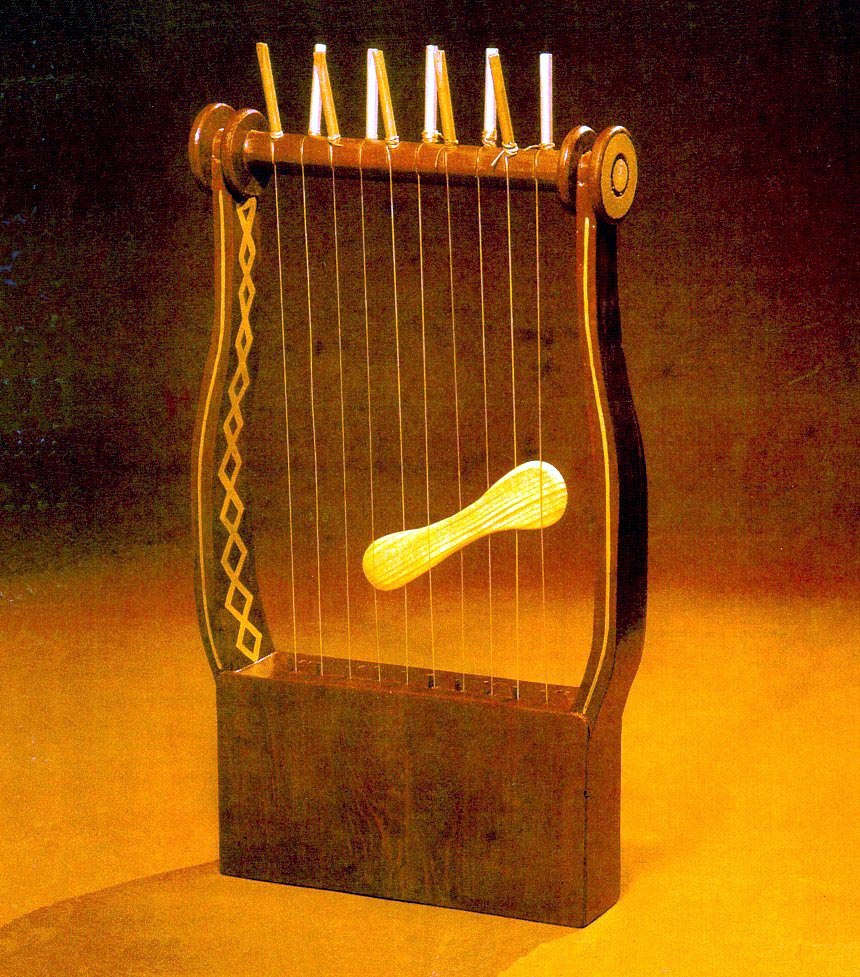
Remember the instrument of 10 strings which was used to give thanks and sing
praises
with songs of triumph because of the work, power, and the wonderful thoughts of God in
Psalm 92? The instrument of 10 strings that was used to send up songs of praise for
God's deliverance, salvation, and preservation in Ps 144!
Yes! We should look at the lavers and remember our multitude of sins- they are many! But, we also should see in them the promise of deliverance, salvation, and preservation, for us from our God! The Temple was a symbol of both need and supply. The ten lavers remind us of our sin and our need for repentance but they also remind us of the awesome God who promises- and is able- to cleanse us from our crushing weight of sin. They remind us of both our need AND His promise that was later fulfilled on the altar of Calvary (represented by the brazen altar) where Christ suffered in our place!
Ten also represents other things in the Bible; but for us the ten lavers are there to remind us of these things- our need and God's supply.
Our progression from the outer court to the Temple is as follows:
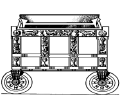

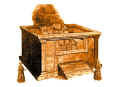
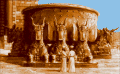
The articles, in their
order, show our progression into God's presence.
1. Ten lavers. 2. Brasen altar. 3. Brasen Sea.
4. From there we can enter the Temple.
END OF SECTION THREE
STOP
HERE and TAKE TEST!
SECTION THREE TEST
Should the test fail to open properly, please use F5 to reload or click the refresh symbol on the top of your browser page.
If you failed the test,
then restudy this section and retake the test.
Once you have passed the test, do not take it
again.
If you missed any questions on the test, then restudy the section and find all of the correct answers to any questions that you missed. A copy of your test was sent to you with the correct answers on it. You may use that for comparison purposes to make sure you have found the correct answers in the textbook.
INTO THE TEMPLE

(click to enlarge)
The first thing we notice as we ascend the steps and enter the Temple itself is that everything
on the inside is gold. In I Ki 7:48-50 & II Chr 4:19-22, we find that everything from the altar,
the table of shewbread, the ten candlesticks, the tongs, bowls, snuffers, basins, spoons, the
censers, and even the hinges for the doors of the Temple proper and the Most Holy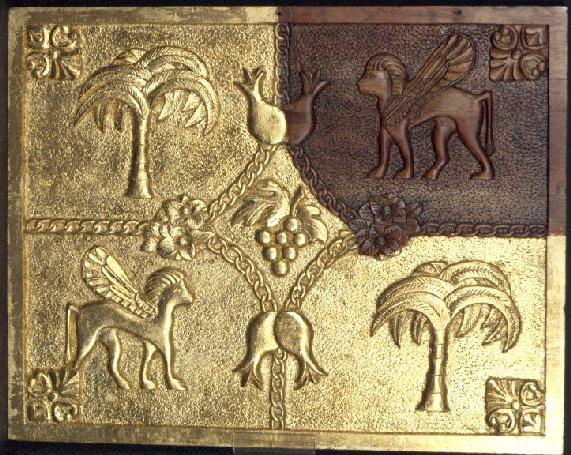 Place
("the
inner house,") were all made of gold. Even parts of the artwork upon the walls and doors were
overlayed or fitted with much gold. The first thing to catch your eye upon entering the porch,
which had no doors, and approaching the Temple doors would be the gold work in them; and
these were but a small preparation for what you were to behold as the doors swung open and the
gold gleamed in the flood of light from the ten golden candlesticks with their dancing flames
shining, reflecting, and rereflecting from gold to gold everywhere.
Place
("the
inner house,") were all made of gold. Even parts of the artwork upon the walls and doors were
overlayed or fitted with much gold. The first thing to catch your eye upon entering the porch,
which had no doors, and approaching the Temple doors would be the gold work in them; and
these were but a small preparation for what you were to behold as the doors swung open and the
gold gleamed in the flood of light from the ten golden candlesticks with their dancing flames
shining, reflecting, and rereflecting from gold to gold everywhere.
Outside we saw brass, the symbol of
judgment for sin, but inside we see only gold, the
symbol of divinity.
THE TEN GOLDEN CANDLESTICKS-
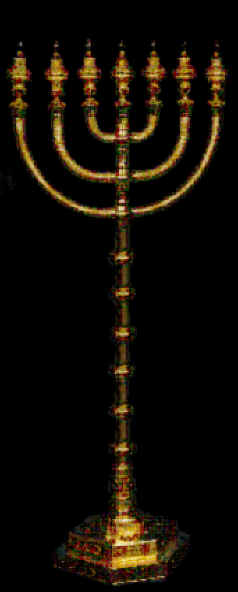
The first furniture we notice as we enter the Holy Place (the Temple proper) is the ten golden lamps, five on each side in the main hall, casting their light throughout the Temple and even spilling up and out through the tall narrow windows in the upper recesses. (I Ki 7:49) And these lamps were to be kept burning from evening to morning; i.e., all the hours of darkness. (Lev 24:4)
Use- Without these sources of light the hall would be a dark and
foreboding place. The windows high up on the north and south walls
were quite narrow (I Ki 6:4) and would have allowed the sun to cast light
into the lower parts of the Temple only during the bright hours of the
day. Their main use seems to have been as much for ventilation as for
light; although, as we said, they would have allowed some light in during
the daylight hours. From evening to morning, however, the only light in
the Temple was cast by the ten golden lamps; and their golden glow
reflecting off of the multitude of gold surfaces must have been rather
dazzling.
Construction- The lamps were to be made of a talent of pure gold beaten
out in one piece. (Ex 25:36) The tongs and snuffdishes for use with them
were also made of gold.
Symbolism- The symbolism here is three-fold.
ONE: The material of the candlesticks is pure gold. This represents the purity and divinity
of God and also represents the deity of the Lord Jesus Christ. And the
symbolism of each one being beaten out of one piece of gold emphasizes the unity
of the Godhead; i.e., the unity of the Father and the Son and the Holy
Spirit. Here, specifically, it would symbolize the unity of Christ with
the Father.
TWO: In addition, the light of the lamps filling the temple and spilling out of the upper
windows has but one significance. In Jn 8:12 & 9:5 Jesus tells us that He is the
"light of
the world..." and the Temple, the symbol of God's presence in the world and situated as
it was upon the highest hill of Jerusalem, shed its light through the upper windows out into
the darkness of the world round about. This was a visible indication of the presence of
God under the Old Covenant, represented earlier by the Tabernacle and here by Solomon's
Temple. And the Bible tells us that the symbols of the Old Covenant, and even the
Covenant itself, were superceded by Christ under the New Covenant. He fulfilled the Old
and established the New.
Mt 5:17 Think not that I am come to destroy the law,
or the prophets: I am not come to destroy, but to fulfil.
THREE:
Upon the establishing of His church, Christ told them that they were the light of the world and gave them a command to let the light of God shine out through them for all the world to see just as the world had seen the light of God symbolically spilling out of the windows of His Temple and factually spilling out of Christ while He was here on the earth. He knew that His days here were numbered and that the Temple of Jerusalem would soon be destroyed. Therefore, as He had replaced the Temple as the presence and light of God in the world, so too was His church to replace Him as the presence and light of God in the world after His own death, burial, resurrection, and ascension.Mt 5:14-16 Ye are the light of the world. A city that is set on an hill cannot be hid. Neither do men light a candle, and put it under a bushel, but on a candlestick; and it giveth light unto all that are in the house. Let your light so shine before men, that they may see your good works, and glorify your Father which is in heaven.
And He promised them that they, His church expressed always as Independent, Local Churches down through the centuries, would NEVER be replaced as God's light in the world until He came to take them out in the rapture and then returns to replace us with His own light.
Promise of continuation: Mt 16:18
Also see, The taking away in the rapture: II Thess 2:1-8
The ten golden candlesticks remind us of the light of God in the world:
1. In the Temple.
2. And in Christ.
3. And now in us- the Independent, local New Testament Baptist Church.
TABLES OF SHEWBREAD-
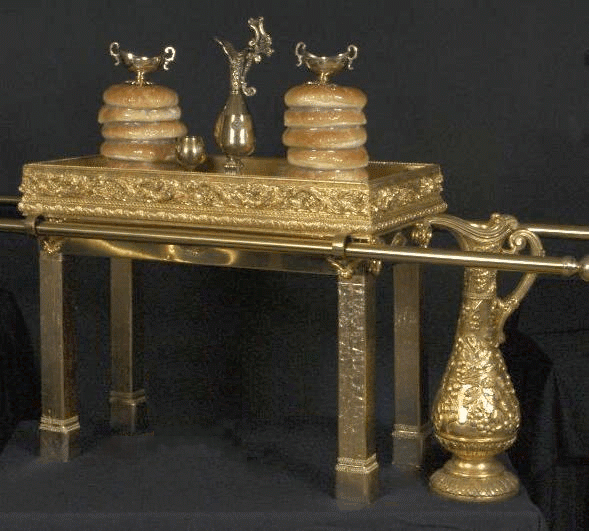
The Tabernacle had but one table of shewbread; but the Temple had eleven. These included the ten tables set five on each side over by the candlesticks and one set in the middle of the room. (I Ki 7:48; II Chr 4:8, 19)
The Tabernacle had but one table for the
shewbread and that table must also be, and was, included in
the furniture of the Temple. (I Ki 7:48) This table was made of gold and was use for the
display of 12 loaves of a special bread which were
stacked in two columns upon the table. It was also called "the table
of the presence."
NOTE: Some try to say that there were only ten tables
in the Holy Place; but, a comparison of I Ki 7:48 with II
Chr 4:8 & 19 shows that there were ten golden tables, five on each side of the room, and also
one more table, specifically called "the table of gold, whereupon the shewbread was." This
makes it plain that there were a total of 11 tables.
In addition to the original table of shewbread there were also these ten other tables in the Holy Place of the Temple. Whether there were loaves of shewbread upon these is somewhat in question but II Chr 4:19 seems to indicate there could have been. It is not certain however because the phrase, "the tables whereon the shewbread was set," could simply be referring to the tables as one class of furniture built by Solomon, which would agree with the context, upon one of which the shewbread was laid. However, the Bible does not make it clear one way or the other. Either way, we do know that the shewbread was set out- at the least on the one table in the center of the Holy Place and possibly on the other ten also.
This bread was set out before the Lord for one week and was then replaced with fresh bread each Sabbath (I Chr 9:32) and the priests then consumed the bread that was taken away upon "hallowed ground;" i.e., they had to consume it within the Temple.
Shewbread-
The bread was called "shewbread," which literally means "bread of the face," because it was set out before the face or presence of God.Hallowed bread-
The bread was specially made of the best of flour, "fine flour," and was hallowed. This meant that no one who was unclean could partake of it. In I Samuel 21:4-6, David and his men were allowed to partake of the shewbread that was removed; but, the priest would allow it only because they were ceremonially clean.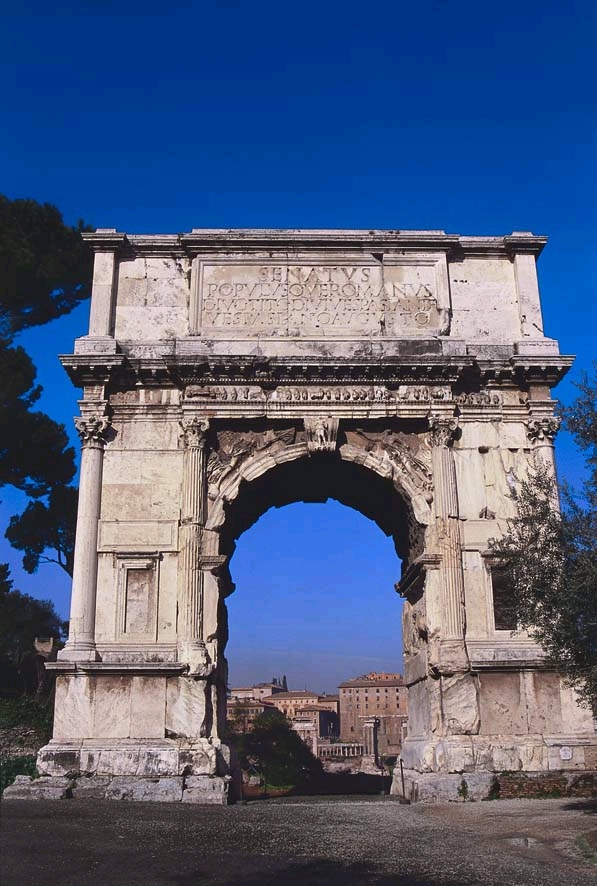
 Disappearance of the table of
shewbread-
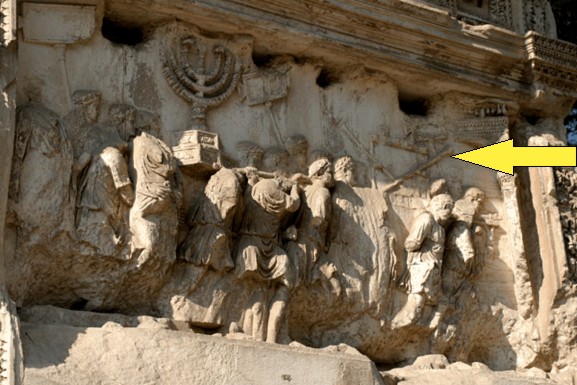
This golden table from the Temple was taken
away several times during the course of Israel's history. It was taken away once by
Antiochus Epiphanes when he stripped the second Temple of its treasures during the
intertestamental period and it was replaced with a new one by Judas Maccabaeus. The last
historical record of the table was when the third Temple, Herod's Temple, was destroyed
by Titus in 70 AD and it and the other Temple treasures were taken to Rome as trophies
of conquest. An image of it can be seen on the Arch of Titus as part of the representation
of the triumphal procession.
Disappearance of the table of
shewbread-
This golden table from the Temple was taken
away several times during the course of Israel's history. It was taken away once by
Antiochus Epiphanes when he stripped the second Temple of its treasures during the
intertestamental period and it was replaced with a new one by Judas Maccabaeus. The last
historical record of the table was when the third Temple, Herod's Temple, was destroyed
by Titus in 70 AD and it and the other Temple treasures were taken to Rome as trophies
of conquest. An image of it can be seen on the Arch of Titus as part of the representation
of the triumphal procession.
SYMBOLISM-
Golden tables- Once again, gold is the symbol of divinity.
Ten golden tables plus the one table-
The shewbread- The symbolism of the shewbread is varied. However we should start with what it does not
directly symbolize and then go on to what it does symbolize.
It does not directly symbolize the Lord Jesus Christ-
Jesus himself gave us the symbolism
of bread in the Old Testament but did not connect himself directly with the shewbread in
the Tabernacle nor with that in the Temple. He identified himself with that "bread which
cometh down from heaven, that a man may eat thereof, and not die." (Jn 6:50) And
that "bread"
which symbolized His flesh was the manna that God supplied to the people
in the wilderness. Christ made the comparison that "Your fathers did eat manna in the
wilderness, and are dead." and that He was "the bread which cometh down from
heaven, that a man may eat thereof, and not die." The shewbread symbolism included
the manna but was not restricted to only the manna. Therefore, the shewbread does
symbolize Christ indirectly but not directly; i.e., it is OK to apply the shewbread to Jesus
Christ but don't apply it to Him ONLY but as a part of a much wider symbolism.
God's provision-
The shewbread symbolized God's provision for His people; and, as the
children of Abraham by faith, it also symbolizes God's provision for us, His adopted
children.
Symbolism to Israel- The 12 loaves symbolized the 12 tribes of Israel and God's
provision of ALL THINGS for them.
Three-fold symbolism to all
people, Jew and Gentile, the latter 2 predicated upon the
acceptance of the first-
1. The shewbread symbolizes God's provision, in Christ the pure Lamb of God who is the
bread of life, for their Salvation and ours. (Jn 3:16)
2. The shewbread symbolizes God's provision through the Holy Spirit- the teacher,
reprover, and spirit of truth- for our spiritual sustenance and power as the children of God.
(Jn 14:16, 26; 15:26; Jn 16:7-8)
3. The shewbread symbolizes God's provision for our physical needs as our heavenly
Father, the giver of all good things and the sustainer of us, His children, exactly as an
earthly father supplies the physical needs and sustains his children. (Mt 6:11 & :25-34)
Summary-
Thus, the shewbread is a symbol of God's provision for
us from and through-
1.
God the Son.
2.
God the Holy Ghost.
3. God the Father.
Appropriation
of His provision through
the Holy Spirit for spiritual sustenance and the Father for Physical sustenance, is predicated
upon accepting His provision for our Salvation,
soul sustenance,
through Jesus Christ, His only begotten son.
click to enlarge
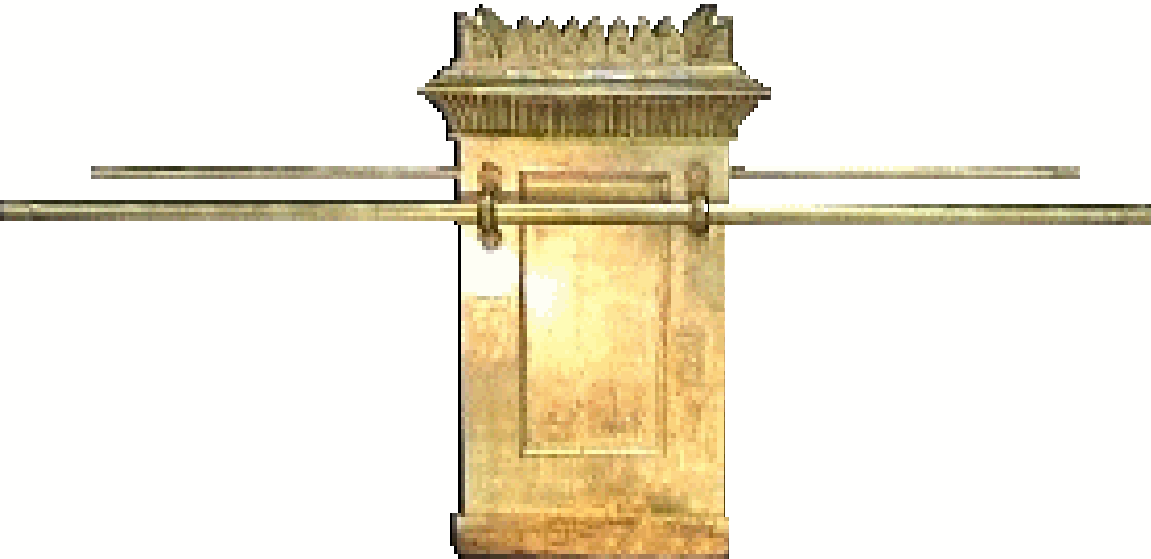 ALTAR OF INCENSE- (Ex 30:1-10)
The altar of incense, also called the
"altar of sweet
incense" (Lev 4:7) and
"the golden altar" (Ex chs. 39 & 40, et al,) was the last article in the Holy Place and was
situated immediately before the veil of the Most Holy
Place.
Construction- In the description of the furniture for the
Temple, we have no instructions for the construction of
this altar. We have it mentioned in
I Ki and in I & II
Chr in the Old Testament and in
Luke & Revelation in
the New Testament; but, there is no description in any of
those books that tells us of its size.
In
I Chr 28:18 we
are told that gold was gathered for use in its construction
but that is all. Therefore, we must assume that it was of
the same size, shape, and construction as the altar of
incense in the Tabernacle; and we find the description of
that altar given in
Ex 30:1-10 & 37:25-28.
Materials- Like the brasen altar, the inner frame of the altar of incense was made of an extremely hard wood called "shittim wood." However, in contrast to the brasen altar, this altar of wood was covered with gold not brass. The wood and the brass of the brasen altar spoke of the strength of Christ typified by the wood and the brass spoke of His offering of himself to suffer the judgment for our sin. The wood and gold of the altar of incense, on the other hand, speaks once again of the strength of Christ through the wood but the gold speaks of His deity.
Size- The altar of incense was one cubit square and two cubits high (1 ½' X 1 ½' X 3') and had golden "horns" on top of the four corners and was topped by a golden crown. On two sides it had 4 golden rings, two on a side, through which the shittim wood and gold overlaid staves were passed with which the altar was carried by the Levites.
Use-
Upon the altar was burned a special spice for incense. This was done every morning and
every evening at the same time as the morning dressing and the evening lighting of the lamps
by whichever priest was serving that day.
1.
In cases of sins of ignorance during the year by an anointed priest or the congregation as a
whole, the priest would anoint the horns of this altar with the blood of the sin offerings after he
had sprinkled it seven times before the veil of the sanctuary. Then the rest of the blood was
taken back out to the brazen altar and poured out at the bottom of it. (Lev 4:1-7)
2.
Also, once a year the High Priest anointed the horns of the altar of incense with the blood of
the sin offerings for the people of Israel collectively on Yom Kippur, the Day of Atonement, just
before entering the veil, also carrying a hand-censer of incense, to sprinkle the blood on the mercy
seat.
SYMBOLISM-
Comparison-
This shows us two things: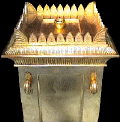
1.
It shows us that there is a difference between the process for the offerings for the sins of individuals and the offerings for God's People collectively.2.
That there is a difference between the sins of a priest and the sins of others.3. Application.
a.
That is why all people are not saved. His sacrifice for sin and the spilling out of His blood on the earth at the brazen altar of judgment, Calvary, paid for the sin of all individuals of all time; but, the presentation of the blood of the sacrifice of Atonement before the vail, then upon the horns of the altar of incense, and then on the mercy seat within the vail, is specifically and exclusively for God's People.
For us today that means that only those who are saved by first believing in and accepting the blood of the sacrifice for the individual, which also was made by Christ upon the brazen altar, the symbol of Calvary, can receive the atonement.
First you must individually accept the sin offering, which was made in Christ for the whole world, and then you automatically partake in the Atonement offering, the blood of which was also shed by Christ and then was presented by Him before God on the true mercyseat which is in Heaven.
Remember, these both happen at the same time and both in Christ.
NOTE: A bit more will be said about the blood of the Atonement when we address the Ark, the Mercyseat, and the High Priest.
General symbolism of the altar and the incense-
The symbolism of the altar of incense is misunderstood by some. Based upon a misunderstanding of Rev 8:3-4, they believe that the incense itself represents the prayers of the saints. This is not correct.The odour carried along with the odour of the incense ascending to Heaven represents the prayers of the saints but the incense itself does not. And this odour, symbolizing the prayers of the saints and carried along by and with the smell of the burning incense but separate from it, the Lord causes to be collected in bottles in Heaven. (Rev 5:8)
Be careful what you pray for because all of your prayers are collected in Heaven. They may not be answered immediately with a "yes" or even with a "no;" sometimes the answer is "wait awhile." Those prayers are all collected and come up before God when it is the right time and they all will be answered.
The incense-
The burning of incense must be done God's way or it will bring the curse of God. 1. Vain incense (carrying the prayers) from a vain heart is an abomination to God.
For this cause God cursed Judah and Jerusalem. (Isaiah)
2.
Burning incense to false gods, including "the queen of heaven" brought the curse of God upon Judah, including Jerusalem, and upon the Jews in Egypt. (II Chr, II Ki & Jeremiah)3.
Not offering proper incense (which carries the prayers) can bring the wrath of God.4.
Doing things God's way, including the sweet incense and prayers, brings victory in the battles as it did for Judah. (II Chr)5.
No one was allowed to offer incense upon this altar except the priests. Even kings were not allowed to do so. Uzziah, one of the Kings during the time of Zechariah, became leprous for burning incense upon this altar and remained that way until his death years later. (II Chr 26:1-21)6.
Offering strange incense brings destruction as it did in the matter of Nadab and Abihu and in the matter of Korah, Dathan, and Abiram. (Lev & Num)Only priests could offer incense and then in the proper way- only after anointing with the blood. The first two just mentioned offered strange incense without blood and the latter three were not priests, only Levites.
We, as Christians, are priests and can offer prayers because of the blood of Christ. Any others who pray are offering strange prayers (carried by strange incense) and bring nothing but destruction upon themselves. They are lost, and they are doubly cursed of God because they profess to know Him by praying to Him; and yet they will not come offering up their prayers with the blood as true priests in the way that God demands- forgiven because of the blood of the sin-offering that was spilled onto the earth and at one with God because of the blood of the Atonement with which the altar of incense was anointed and which was once sprinkled on the mercyseat by Christ!
The golden altar and the incense-
We have found that the incense is symbolic as that which carries the prayers of the saints to God; but we have not yet seen what both it and the altar of incense represent? We can answer this by reflecting back on what we know the incense represents and use some scripture and logic to figure out what each symbolizes.The connection between prayer and incense was made by David in
Ps 141:2.
Ps 141:2 Let my prayer be set forth before thee [as] incense;
[and] the lifting up of my hands [as] the evening sacrifice.
Then in the New Testament we are shown that the Holy Spirit helps with our prayers.
Ro 8:26 Likewise the Spirit also helpeth our infirmities: for we know
not what we
should pray for as we ought: but the Spirit itself
maketh intercession for us with
groanings which cannot be uttered.
Gabriel is associated with prayer and the altar of incense as he brought God's answers to
several people in both the Old and the New Testaments.
- In the Old Testament- with prayer. He brought the answer to prayer and the vision
of 70 week's concerning Israel. (Dan ch. 9)
Dan 9:21 Yea, whiles I [was] speaking in prayer, even the man Gabriel,
whom I had
seen in the vision at the beginning, being caused to fly swiftly, touched me about
the time of the evening oblation.
- And he is associated in the New Testament- with prayer and the altar of incense.
In Luke 1:5-20, The angel Gabriel appears next to the altar of incense to answer
Zacharias' prayer for a son. Zacharias' prayer was unspoken; but, God knew both the
prayer and the desire of his heart as he stood there by the altar of incense. This time
Gabriel brought an answer to prayer and word concerning the herald of Israel's messiah.
Lk 1:11-13 And there appeared unto him an angel of the Lord standing on the right
side of the altar of incense. And when Zacharias saw [him], he was troubled, and
fear fell upon him. But the angel said unto him, Fear not, Zacharias: for thy
prayer is heard; and thy wife Elisabeth shall bear thee a son, and thou shalt call
his name John.
Lk 1:19 And the angel answering said unto him, I am Gabriel, that stand in the
presence of God; and am sent to speak unto thee, and to shew thee these glad
tidings.
Therefore, the symbolism of the altar and the incense can only be God the Holy
Spirit since He alone meets all of the criteria.
1. He is deity.
2. His "groanings" (Gk stenagmoiV,
sten-ag-mois', groanings or sighs) ascend to God and
take our prayers with them.
The altar and the incense- Therefore, the golden altar and the incense must represent the Holy Ghost; and the smell of the incense ascending up is His sighs as they carry our prayers to God.
The smoke/smell of the incense ascending up-
Remember, the pneuma to agion tou qeo, pneuma tow hageeon taw theah, the Holy Spirit of God, is the pneuma hageeon, here meaning the Holy breath of God himself. Therefore, what we have in the smell of the burning incense is the sighing breath of God ascending up to himself from God the Holy Spirit and carrying our prayers with that breath with sounds and sense that can not be uttered by the mere human tongue.The blood applied to the horns of the altar-
This shows us that God hears our prayers by the Holy Spirit and through the blood of Christ.Prayer anywhere & everywhere-
Back then prayers had to be made either in or toward the Temple in Jerusalem and God promised He would hear from there. (II Chr) However, the Temple at Jerusalem is gone and, beside that, we are under grace not Law.
END
OF SECTION FOUR STOP
HERE and TAKE TEST! Should the test fail
to open properly, please use F5 to reload or click the refresh symbol
on the top of your browser page.
If you failed the test,
then restudy this section and retake the test. If you missed any questions
on the test, then restudy the section and find all of the correct answers to any
questions that you missed. A copy of your test was sent to you with the
correct answers on it. You may use that for comparison purposes to make
sure you have found the correct answers in the textbook. SUMMARY-
Therefore, the golden altar of incense symbolized in all respects the Holy Spirit who takes
our prayers to God. Also, we have the right to pray to God because we are at one with Him
through the Atonement blood, the blood of Christ, through which we pray. Under
the New Covenant we no longer need
the physical golden altar in the Temple in Jerusalem nor the incense burnt upon
it to carry our prayers to God; instead, we are commanded to pray everywhere and
our prayers are carried to God directly by the Holy Spirit who indwells us!
SECTION FOUR TEST
Once you have passed the test, do not take it
again.
 THE
ORACLE ROOM ITSELF-
THE
ORACLE ROOM ITSELF-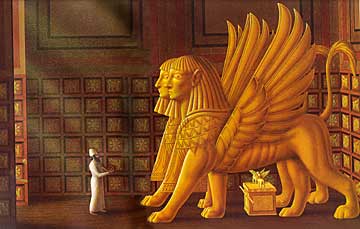
This Most Holy Place
within the Temple was a cube of 20 cubits (30' X 30' X 30') and its stone
construction was completely covered with cedar boards (I Ki 6:18) which
were carved with knops (knobs: ball or gourd shapes) and open flowers. Then, the entire room was overlaid with gold- walls, ceiling and
floor. (I Ki 6:19-20)
SYMBOLISM-
We also can view the engraved gourd shapes and open flowers as representing life and growth in its most visible form. Gourds and flowers are life at its most virulent and obvious as the gourds grow visibly day by day attached to their vine and flowers open and close with the light.
Gourds- Christ is the vine to whom we must stay attached or we will not grow as the gourd; nor will we bring forth fruit if we detach from that vine. (Jn 15:1-6)
NOTE:
Gourds have four uses:
 1.
As food to bring life.
1.
As food to bring life. 
2. For
ornamentation because of their beauty.
3. Some gourds of
the Luffa genus are called the vegetable sponge, or dishcloth gourd.
These vine/gourds have a fibrous interior that can be dried and used as a sponge
for cleansing.
 4.
When hollowed out, gourds are used as containers.
4.
When hollowed out, gourds are used as containers.
What better description of the
Christian that stays attached to Christ! We bring life, beauty, and cleansing to
a sin-darkened, sin-ugly, and sin-dirty world; and we can do all of this ONLY
through Christ as we bring Him, His Word, and His light to the lost.
But, if we detach ourselves from Christ we become worthless for
these uses. (Jn 1:4; 15:5-6; Is 12:3; Eph 5:26; I Jn 5:6)
And if we empty
ourselves of "self" and "the world" (hollowed out) then we
are fit to be filled with God the Holy Spirit to carry Christ to the lost.
Eph 5:18 And be not drunk with
wine, wherein
is excess; but be filled with the Spirit.
NOTE:
The flowers of the gourd are not included in the engravings. That is because the
flowers of the gourd only show their beauty in the night. As soon as the light
hits them they wither and die. It is only in this sin-darkened world that we
appear beautiful; but, when the light of Christ shines we wither by comparison.
Jn 3:30 He must increase, but I [must] decrease.
Open
flowers- As I said, the flowers of the
gourd are not mentioned, they would have
 withered and disappeared
 in the light;
but the light-seeking, living, "open flowers," are portrayed in
the engravings instead. Christ is the light that brings life and light to this world (Lk
2:30-32; Jn 1:1-9), and through Him we blossom as the flowers in the
light. (Jn 5:35) Only as we remain in his light can we grow and live and
blossom like the beautiful "open flowers;" and only in His
light can we show forth the beautiful colors of the Shekinah glory of Christ to
the world. Therefore, we must never walk in darkness but only in the light. (The
books
of John & I John. Given
for reference only, you don't have to read the entire books.)
in the light;
but the light-seeking, living, "open flowers," are portrayed in
the engravings instead. Christ is the light that brings life and light to this world (Lk
2:30-32; Jn 1:1-9), and through Him we blossom as the flowers in the
light. (Jn 5:35) Only as we remain in his light can we grow and live and
blossom like the beautiful "open flowers;" and only in His
light can we show forth the beautiful colors of the Shekinah glory of Christ to
the world. Therefore, we must never walk in darkness but only in the light. (The
books
of John & I John. Given
for reference only, you don't have to read the entire books.)
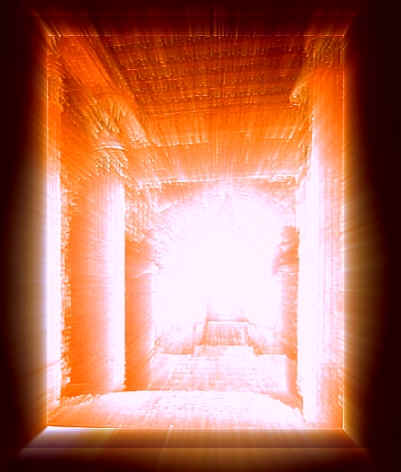
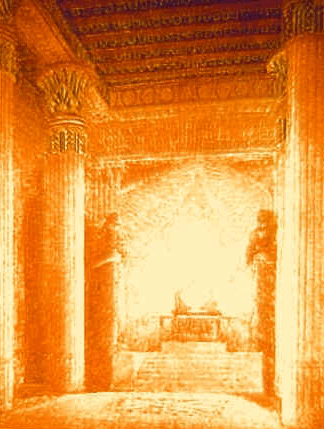 Reflected
glory- Within
the Holy of Holies there was no light. The beauty of the
gold
overlayed gourds and open flowers could only be seen by their reflecting of the
light of the Shekinah glory of God that radiated from between the cherubims. And
in that supernatural light their reflected glory paled into absolute
insignificance by comparison. So is man, even redeemed man, in comparison to the
God of glory! The only thing we can do is give off a relatively insignificant
reflection of His glory. We glory only in Christ; but still, through us the
world can see a dim pale reflection of that glory. (There are hundreds of
references that could be used from both the Old and the New Testaments.)
Reflected
glory- Within
the Holy of Holies there was no light. The beauty of the
gold
overlayed gourds and open flowers could only be seen by their reflecting of the
light of the Shekinah glory of God that radiated from between the cherubims. And
in that supernatural light their reflected glory paled into absolute
insignificance by comparison. So is man, even redeemed man, in comparison to the
God of glory! The only thing we can do is give off a relatively insignificant
reflection of His glory. We glory only in Christ; but still, through us the
world can see a dim pale reflection of that glory. (There are hundreds of
references that could be used from both the Old and the New Testaments.)
NOTE: We must also add that because of the indwelling of the Holy Spirit, the light of God not only reflects off of us to the world, as is symbolized here in the engravings in the Holy of Holies, but it also shines out from us as it did from the Temple of God.
This is true not only for us as individuals but it is also true of the called out, baptized, body of believers which is the local New Testament Baptist Church. Each such local church, the body and temple of Christ, also reflects the glory of Christ as well as shines it out from within. These lights draw the lost as moths in the night to the true glory of Christ, the true light.
Jn
8:12 Then spake Jesus again unto them, saying, I am the light of the world:
he that followeth me shall not
walk in darkness, but shall have the light of life.
Eph
3:21 Unto him [be] glory in the church by Christ Jesus throughout
all ages,
world without end. Amen.
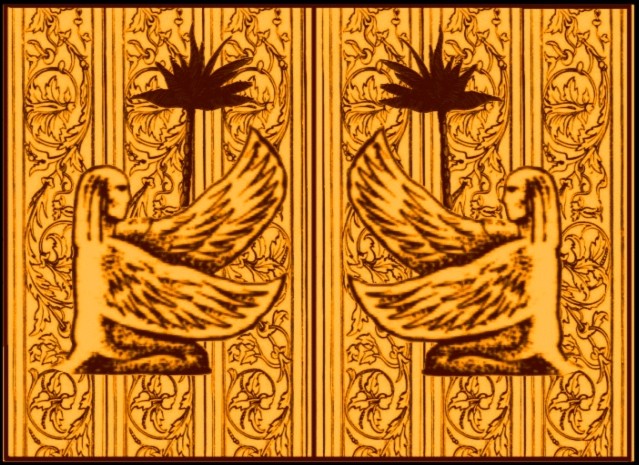 THE DOORS-
(I
Ki 6:31-32)
THE DOORS-
(I
Ki 6:31-32)
The Tabernacle had only a veil but in the Temple there were two massive doors built that covered the veil. These doors were suspended from two side posts that were 2 cubits (3') wide by (probably )15 cubits (22 ½’) tall and they hung beneath an overhead post, a lintel, 5 cubits tall (7 ½’) by 20 cubits (30') wide. This lintel and the upright posts were all of olive wood and held up the front edge of the floor of the 10 cubit by 20 cubit by 20 cubit room above the Holy of Holies (15' X 30' X 30') as well as the gold covered ceiling of the Holy of Holies itself.
SYMBOLISM- The symbolism of the flowers was already discussed, they represent life, light, beauty and growth; but on the doors were also palm trees and cherubim.
Cherubim- In Gen ch. 3 the cherubim were the impassable guardians of the garden of Eden to prevent man from approaching after the Fall. In Ex ch. 25 we find one on each end of the mercy seat covering it and looking toward the presence of God and they "cover," it with their wings. Which in the Hebrew, "saw'kak," means to screen, cover, block, to prevent approach. God spoke out to man from the between the cherubim; but, man could not approach to see or touch Him. The cherubim represented protection of us from the glory of God that would kill us if we approached Him face to face. And they also represented the omnipotence of God that protects His holy presence from sinful man. We can approach, in Christ, to God with our prayers but that is as close as we can get in our present sinful form. In II Sam ch. 22 & Ps ch. 18 the cherub is tied in with the awesome, fearful power of the omnipotent God, Creator of all things, at whose presence the very earth trembles. On the wings of the cherub God is figuratively said to travel to earth for dealings with the earth and mankind- and that is a similar symbol as that of God coming to earth and speaking to man from between the covering cherubim. In Ez ch. 9 God departs from between the protecting cherubim and strides forth for judgment.
Finally, the vision of Ezekiel describes the heavenly vision of the cherub and even tells us who one of them was. It was the devil. He was beauty itself until he fell. Then instead of protecting sinful man from God and God's awesome and fearful power from destroying man by to close a proximity- he rebelled against God and was cast out because of His misuse of the awesome power and responsibility that was given to him by God.
The cherubs represent the power of God to protect Himself from too close of a proximity to fallen man and the corruption of our sin (remember, we have been cast out of the garden); and, the cherubs also symbolize God's power of protection that allows Him to speak out from between the cherubs to us while not allowing us to be consumed by His glory by coming too close.
 Palm trees-
The
palm trees in Ex 15:27 represented rest. In Lev 23:40 they, along
with boughs and branches of other trees, represented rejoicing in God's
provision and deliverance. In Judg 4:5 Deborah judged Israel from beneath
a palm tree on Mt. Ephraim between Ramah and Bethel; and this reminds us of
God's judgment and deliverance. In Deut 34:3 Jericho is called the city
of palm trees; and that reminds us of God's ability to bring down great
strongholds.
Palm trees-
The
palm trees in Ex 15:27 represented rest. In Lev 23:40 they, along
with boughs and branches of other trees, represented rejoicing in God's
provision and deliverance. In Judg 4:5 Deborah judged Israel from beneath
a palm tree on Mt. Ephraim between Ramah and Bethel; and this reminds us of
God's judgment and deliverance. In Deut 34:3 Jericho is called the city
of palm trees; and that reminds us of God's ability to bring down great
strongholds.
In II Chr 28:15 Jericho the city of palm trees symbolized
God's succour and deliverance of His people from His just judgment at the hands
of our brethren; especially when they forget that they too are sinners just like
we who err. In Neh ch. 8 the palms remind us of God's mercy to the
wayward when they repent with tears and then return to God and His Word with
rejoicing and obedience. In Ps 92:12 we see that the righteous shall
flourish (bud, sprout, blossom) like the palm tree. In Song 7:6-8 & Jer
10:5 the palm represents strength and beauty of stature. In Ezek the
palm trees were upon the doors and the walls and the posts; i.e., the
protection, the strength and the supports of the building. In Joel 1:12
the drying up of the palm and the other trees and the vines and the fields
represent God's judgment. In Jn 12:13 the palm branches were for
rejoicing at the coming of Jesus to Jerusalem as the people rejoiced and cried
Hosannah- which means "salvation is come" or "save
now !"
And the last mention of palms is in Rev 7:9 at the great Hosannah in Heaven when the 144,000 Jews and a multitude out of all nations of the earth shout praises to God for His salvation and deliverance of them out of great tribulation.
The palms on the door of the Holy of Holies is the symbol of God's salvation, His deliverance, His beauty of strength and His ability to pull down the strongholds of heathenism and sin. Symbols of the sustenance and rest He gives us in the face of persecution and, yes, even His deliverance from just persecution and judgment. They symbolize His mercy and His grace as He welcomes back His wayward children when we repent with tears. And when we return to Him we can return with rejoicing when He welcomes us back as our loving Father, Saviour, Succorer, our Strength, our Deliverer and our Saviour!
The palm trees remind us of our God's strength, judgment, and mercy, and we can rejoice in His willingness to save us!
1. If we are lost- He will "save now ! Hosannah- SAVE NOW !"
2. If we are saved but backslidden and have lost our way in sin, He will save us from that life of sin- He will "save now ! Hosannah- SAVE NOW!"

THE VEIL (VAIL)- Inside the massive doors hung the veil.
(II Chr 3:14) It was made of blue, purple, and crimson (scarlet, Ex 26:31).
It was made of fine linen woven together; and, like the door, it also had
cherubim on it but not the flowers, gourds, and palm trees.
Symbolism- The symbolism of the veil is plainly given in Hebrews.
Heb10:20 By a new and living
way, which he hath consecrated
NOTE: You will notice that there is nothing on the veil except Cherubim. That is because this is the separation between man and the very presence of God himself. There are no palms to remind us of God as Father, Saviour, Succorer, our Strength, our rest, and our Deliverer. No open flowers or gourds telling of life and growth and sanctification of man for God's use, No! Those are without the veil. Here we are about to enter into the presence of our terrible, awesome God; and, to pass through this veil into the Holy of Holies without proper preparation would utterly destroy us because of our unprotected exposure to the power of His presence. Even the High Priest could only enter once a year and then only with blood. Hence, the protecting Cherubims. Protecting us all from the awesome presence of the God of all power that would destroy us in our present sinful state as well as protecting God's holiness from the presence of our corruption and sin here in His very Holy of Holies!
Christ and the veil- In Hebrews we find that Christ, the perfect and spotless Son of God entered through the veil as our High Priest, not every year as under the Law, but once with HIS OWN BLOOD to bring us ETERNAL REDEMPTION!
Heb 9:12 Neither by the blood
of goats and calves, but by his
own blood he entered in once into the holy
place, having
obtained eternal redemption [for us].
Calvary & the veil- With Christ's death upon Calvary the veil of the Temple was rent in two; thus symbolizing that the way into the Holy of Holies was clear.
Mt 27:51 And, behold, the veil
of the temple was
rent
in twain from the top to the bottom.
[Also
see Mk 15:38]
The way is clear to God- The veil is now of non-effect. Because of Christ's sacrifice, and upon our acceptance of Him, we need no longer to be separated from God. We can now pass through the veil. The protecting Cherubim are no longer needed to separate us from God and He from us, both for our protection from destruction by His glory and for the protection of His holiness from the corrupting presence of our sin.
Heb 10:19-20 Having therefore, brethren, boldness to enter into the
holiest by the blood of Jesus, By a new and living way, which he hath consecrated for us, through the veil, that is to say, his flesh;
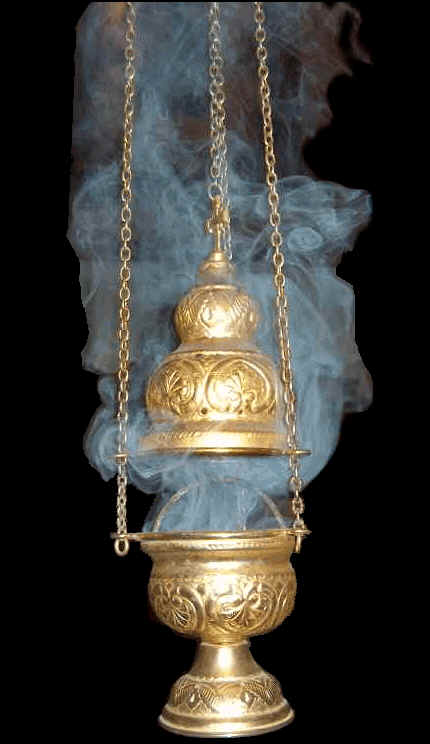 THE GOLDEN CENSER-
Remember, everything within the veil is gold and that includes the
censer.
This is to show that we are now completely in the presence of deity.
THE GOLDEN CENSER-
Remember, everything within the veil is gold and that includes the
censer.
This is to show that we are now completely in the presence of deity.
To further protect him from the presence of God, the High Priest who entered here, only once a year and only with the blood of the sacrifice for himself and for the people, also carried a portable hand-held golden censer for incense. This was used within the most holy place before approaching the ark of the covenant to prevent the glory of the Lord from killing the High Priest.
Lev 16:12-13 And he shall take a censer full of burning coals of fire from off the altar before the LORD, and his hands full of sweet incense beaten small, and bring [it] within the vail: And he shall put the incense upon the fire before the LORD, that the cloud of the incense may cover the mercy seat that [is] upon the testimony, that he die not:
Symbolism-
Once again the censer represents the Holy Spirit and the incense represent the
Holy Spirit and His intercession between us and, in this case, the judgment of
God. The fire from off the altar represents God's righteous judgment and the
cloud of incense represents the Holy Spirit taking that judgment, that was
already exacted in Christ's sacrifice, and presenting that sacrifice to God as
an accomplished fact, i.e., that God's judgment is already fulfilled for us
today. (Heb 9:14) In the book of the Revelation an angel will take the
censer full of coals and cast them to the earth and judgment and destruction
will follow- no incense, that had already been previously offered up with the
prayers of the saints. (Rev 8:3) Thrown to earth there will be only the
fiery coals of God's judgment from the golden censer.
(Rev
chs. 8-10)
In the Temple, however, the golden censer was full of the incense of the Holy Spirit offering up to God His protection of the High Priest by covering the mercy seat and the presence of God so that the Priest not die and that God's holiness be not corrupted.
This was necessary because the High Priest was still in his sinful flesh; covered by the blood of the sacrifice, yes, but still in his sinful flesh. One day we will worship God in flesh, the perfect flesh, that will not need protection from the perfect God; but, that day will not come until after the resurrection or the rapture. Today we can only worship God in spirit and in truth.
Jn 4:21-24 Jesus saith unto her, Woman, believe me, the hour cometh, when ye shall neither in this mountain, nor yet at Jerusalem, worship the Father. Ye worship ye know not what: we know what we worship: for salvation is of the Jews. But the hour cometh, and now is, when the true worshippers shall worship the Father in spirit and in truth: for the Father seeketh such to worship him. God [is] a Spirit: and they that worship him must worship [him] in spirit and in truth.
The rending of the vail- The veil was rent and we no longer need to approach God in the sinful flesh as did the High Priest under the Law in the Tabernacle and the Temple. We are under Grace and we have the right, in Christ who fulfilled the Law, to approach the very and real Holy of Holies in Heaven directly in prayer. Not just once a year, with the golden censer of the incense of the Holy Spirit to protect us, but anytime through prayer in the Spirit who now dwells within us and who makes direct intercession for us. (Heb 10:19-20 cf Ro 8:26-27)
Indwelling of the Holy Spirit-Boldness to enter anytime by
the blood of Christ-
Heb 10:19-20 Having therefore,
brethren, boldness to enter into the holiest by the blood of Jesus,
By a new and living way, which he hath consecrated for us,
through the veil, that is to say, his flesh;
The Holy Spirit makes direct
intercession for us-
Ro 8:26-27 Likewise the Spirit also
helpeth our infirmities: for we know not what we should pray for as we ought:
but the Spirit itself maketh intercession for us with groanings which cannot be
uttered. And he that searcheth the hearts knoweth what [is] the mind of the
Spirit, because he maketh intercession for the saints according to [the will of]
God.
Summary-
Therefore, we do not need the
symbols of the Temple, including the golden censer the symbol of
the Holy
Spirit, because we have the reality within us to help us as we approach the true
throne in
the true Holy of Holies in Heaven.
END OF SECTION FIVE
STOP
HERE and TAKE TEST!
SECTION FIVE TEST
Should the test fail to open properly, please use F5 to reload or click the refresh symbol on the top of your browser page.
If you failed the test,
then restudy this section and retake the test.
Once you have passed the test, do not take it
again.
If you missed any questions on the test, then restudy the section and find all of the correct answers to any questions that you missed. A copy of your test was sent to you with the correct answers on it. You may use that for comparison purposes to make sure you have found the correct answers in the textbook.
THE HIGH PRIEST'S GARMENTS-
The following are visual interpretations of the scriptures from various times and places. You will notice that they vary somewhat depending on the styles of clothing of the society in which the artist lived.
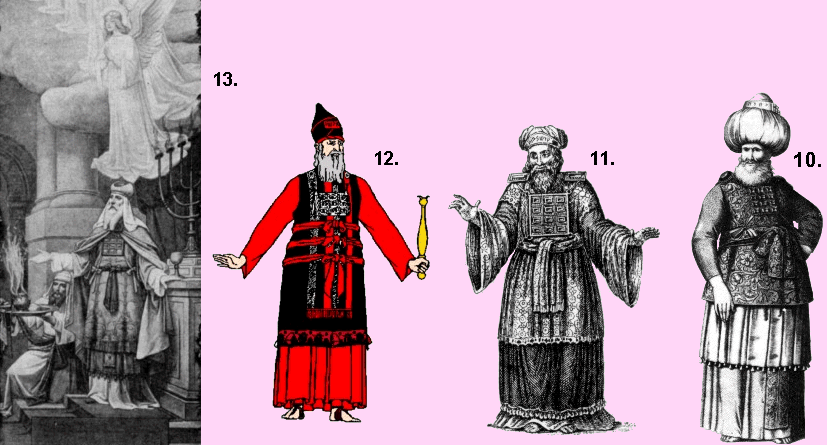
German-
The representation at far right (Fig. 10) is from an 18th
century engraving from Germany and the garments have a distinctively German look
about them.
American- Figure
11, second from right is an American representation.
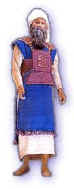
Romanesque/Catholic- The two representations
on the left (Figs. 12 &
13) have
Its easy to see from these representations that clothing styles from the society and time in which the artist lived had a lot to do with the way the clothing of the High Priest was represented.
Common ground- However, you will also notice that all of the representations have a lot in common. The general representations are basically the same because they are all based upon the scriptural description of the garments and those descriptions are fixed and final. Therefore, we need not worry about differences but we can use the basics to discuss the High Priest's garments.
From a Dutch text following
Exodus ch. 28.

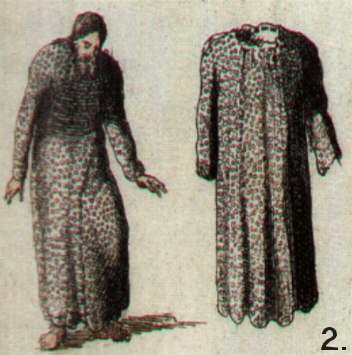
Garment 2- The second garment of the High Priest was the embroidered coat of fine linen. We are not told what designs were embroidered on it but we do know they were patterns only. "embroider" Heb shaw-bats', to weave in checkered or plaited work or pattern
Symbolism-
Again this represents the complete
covering supplied to Adam and Eve in Gen
ch. 3.
Garment 3 & 4-
The third garment was the "girdle" or sash of needlework that
was wrapped around the linen coat and the fourth was the "bonnet/mitre"
or hat (turban) to go upon his head.
(Ex 28:39; 29:9; et al) (click pictures to enlarge)
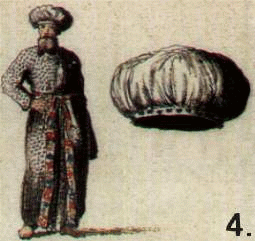
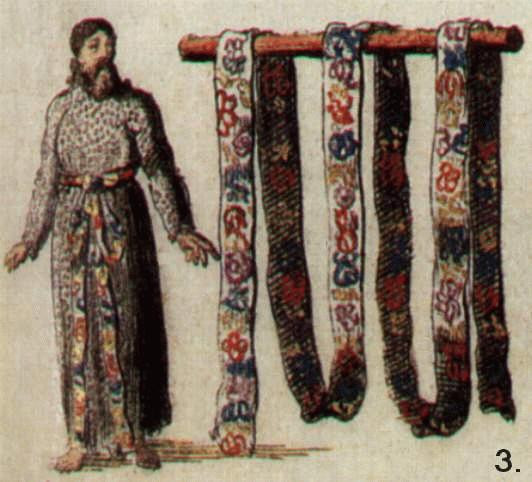 NOTE:
From Ex 39:27 and other references it is plain that the turban
is called a "mitre" when
referring to the High Priest and a "bonnet" when referring to
the turban of his sons who were lesser
priests. There are some places, however, where the terms are used
interchangeably.
NOTE:
From Ex 39:27 and other references it is plain that the turban
is called a "mitre" when
referring to the High Priest and a "bonnet" when referring to
the turban of his sons who were lesser
priests. There are some places, however, where the terms are used
interchangeably.
Symbolism of the sash (girdle) and the hat (bonnet)-
1. The sash is for girding oneself about; and since the undergarments bound in by it represented the covering of our sinful humanity by God, then the sash represents keeping and the bonnet is a covering. Keeping and covering- God not only clothes us with the sacrifice to cover our sinful humanity but He also keeps us. The two articles, girdle and hat, represent God's keeping of we who are also covered by Him.
2. The girdle also represents keeping our humanity bound in and living holy lives; and this we do through the power of the Holy Spirit. But it will not happen if we do not knowingly "gird up the loins of your mind" and use the power of God the Holy Spirit who dwells within us. God gives us the power but we must do the girding. (I Pet 1:12-16)
3.
The girding in of the clothes of the High Priest also represents God girding up
your proud humanity, if you will let Him, so that you will willingly become a
servant like Christ. (Jn 13:4-5)
4.
The symbolism of the bonnet is also found in the book of Romans.
Ro 4:7 [Saying],
Blessed [are] they whose iniquities
5. The bonnet is done away with for men and replaced for women in the New Testament. We approach God in prayer and in distinctive manners for men and women. Men do not wear covers but women do. (I Cor 11:4-7, 13-15) (This is in contrast to the priestesses of the false gods who shaved their heads; and they still do so today in some of the cults. Including the cult of humanism and some Satanists.)

 Garment
5- The fifth garment of the High Priest was
the blue robe.
Garment
5- The fifth garment of the High Priest was
the blue robe.
(Ex 28:31-35) (The Me'il Techelet)
Now that Jewish High Priest's humanity was completely covered and girded in, we come to the blue covering of royalty. This blue has a tinge of red to give it what we would call a violet color known as royal blue. From the bottom of it swung golden bells and pomegranates of blue, purple and scarlet.
Symbolism- Once our humanity is covered and girded in, then God covers us with the royalty of kings; and, that place of royalty was purchased with His own blood. (Rev 1:5-6) In the millennium we will finally receive our inheritance and reign as kings with Him. (Rev 5:10)
1.
The pomegranates represent God's promise of and supply of plenteousness in
Num 13:23  and Deut 8:8 because of His love and mercy and the promise
made to Abraham. And in Song of Solomon they represent love and fullness
of pleasant supply, as in the spring. In the rest of the Bible they represent
adornment.
and Deut 8:8 because of His love and mercy and the promise
made to Abraham. And in Song of Solomon they represent love and fullness
of pleasant supply, as in the spring. In the rest of the Bible they represent
adornment.
Thus the pomegranates remind us that the royalty that clothes us is
only because of the plenteous supply of God upon us. It is not something we have
of ourselves; it is something that God clothes upon us because of Christ, the
fulfillment of His promise made to Abraham. It is an adornment given to us by
God. It is not what we are underneath that is now prominent. That is but a
sinful humanity clothed upon with Christ and girded in. What is apparent to the
outside now is the adornment of royalty given to us in Christ.
2.
The symbolism of the colors of the pomegranates are important because they show
the way we gained our status of royalty. They are of three colors in a
particular order, blue (royal blue), purple, and scarlet or crimson. If we
viewed these colors side by side we would notice that they begin with a tinge
of red and progress to the color of blood, crimson red.
This shows us that the plenteousness of royalty with which God adorns us
was bought with the blood of Christ. And the progression from the royal blue of
the first pomegranate matching our garments and containing just a tinge of
blood-red for remembrance, through purple, with more of a mixture of blood, that
points toward the final color- crimson, the full blood of Christ that bought our
kingship. The progression is like a signpost that points directly toward the
blood of Christ that washed us from our sin and gave us royal kingship in
exchange.
The royal-blue of all of the kings of the world is tinged with
blood. History shows that the blood of wars always colored the robes of royalty
on this earth; i.e., kingship is always bought with the blood of men. In God's
way it is the same and yet in one way it is the different. The kingship of all
believers was bought with the blood of just one man, the man Christ Jesus. Not
many bloods for just one king; but one blood for many kings. The king-ship of
believers is bought with the blood of a man; yes. But, on the other hand the
kingship of men is not tinged with just the blood of a man but with the blood
of God himself.
3.
Finally, the golden bells remind us of God who gives us life and
kingship; and the sounds of life need to be heard to give hope to those without.
(Ex 28:34-35)
 The
pomegranates are a silent witness of why we are what we are in Christ; royalty
by the blood of Christ. The golden bells, on the other hand, sound out the fact
of our living royalty to the world outside. By the one, the pomegranates, they
can see what we are and how it came about, through the blood; and by the other,
the bells, they can hear what we are, living royalty in Christ, and how it came
about. The way we sound out the golden bells today is through the gospel by
which we received life and kingship. They are the sounding out of our faith.
The
pomegranates are a silent witness of why we are what we are in Christ; royalty
by the blood of Christ. The golden bells, on the other hand, sound out the fact
of our living royalty to the world outside. By the one, the pomegranates, they
can see what we are and how it came about, through the blood; and by the other,
the bells, they can hear what we are, living royalty in Christ, and how it came
about. The way we sound out the golden bells today is through the gospel by
which we received life and kingship. They are the sounding out of our faith.
Ro 1:16-17 For I am not ashamed of the
gospel of Christ: for it is the power of God unto salvation to every one that
believeth; to the Jew first, and also to the Greek. For therein is the
righteousness of God revealed from faith to faith: as it is written, The just
shall live by faith.
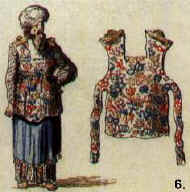
Garment
6- Over the blue robe the High Priest wore
the ephod. This garment was made with cunning work of gold, blue, purple, and
scarlet. (Ex 28:6) It was of fine twined linen and was made in two
halves, a front and a back, and joined together at the shoulders. (Ex 28:7)
Attached to the ephod was an embroidered sash ("the curious
girdle") that was wrapped around and tied together to hold the ephod
closed.
The main importance of the ephod was not the ephod itself but its accouterments.
Two onyx stones
Upon the shoulders of the ephod were two ("ouches," def plaited or filigree or chequered work) pouches. Made of intertwined gold wire they served to hold the two onyx stones. These stones were engraved with the names of the twelve children of Israel, six on each stone, (Ex 28:9-14) and they were placed in the pouches on the shoulders of the ephod.
Symbolism- The symbolism of two onyx stones set upon the shoulders of the ephod is explained in Ex 28:12.
They are a memorial unto the nation of Israel, God's People. Also, they remind us that the eternal High Priest, Jesus Christ, who fulfilled the Law and the type of the High Priest completely, must then also bear the name of His people, Israel, before God even today.
Remember, God has set Israel aside, for a time, but He will receive them back one day; and the two stones represent God's covenant status with the descendants of Abraham through Jacob (Israel.) (We, as descendants of Abraham's faith, could also be in sight here; however, that would definitely not be the main point of the symbolism.)The material of which the ephod is made, gold, blue, purple, scarlet, once again represent deity (gold) and the blue to purple to scarlet once again represent the blood of Christ (Messiah) by which and through whom God will once again receive His people.
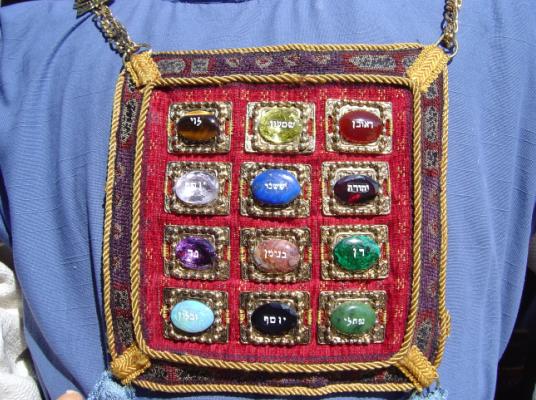 Garment 7 - The breastplate-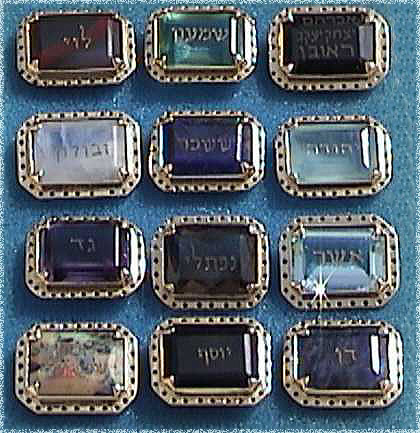
Over the ephod was a breastplate with twelve stones set in four rows of three; each inscribed with the name of one of the children of Israel. (Ex 28:15-29)
This was worn over the ephod
and was made of the same material, gold, blue, purple, scarlet, and fine twined
linen and was fastened to the ephod by golden chains on top and a "lace"
(def. a twisted cord) "of blue," on the bottom.
The picture shown above left, one that exists now in Israel which
has been made in preparation for the coming of Messiah, is typical of all of the
representations and reconstructions that I could find in my research.
The picture above right is a close up
of the stones themselves. These are also existent right now in Israel and
were also prepared, by a different group, for use in a different breastplate to
be constructed in preparation for the coming of the one they think is to be the
Jewish Messiah.
Symbolism- This article of clothing is called the "breastplate of judgment" (Ex 28:15, 29) and is, as were the onyx stones upon the shoulders of the ephod to which it was attached, once again a memorial before God of the children of Israel. This time however, it is a memorial of "judgment."
Combined symbolism- The stones and the breastplate of judgment remind us that though God's judgment falls, the names of His People are ever before Him for remembrance at the proper time. Also the colors of the material of which they are made remind us of the blood of Messiah, Jesus Christ, the High Priest who now bears their names in remembrance before God.
Positions of the names- Their names on His shoulders symbolize His bearing the weight of the sin of all The People; and their names on his heart symbolize the love that drove Christ to suffer their Judgment for them.
Finally, the fact that Christ eternally bears their names before God is a holy guarantee of the eventual fulfillment of the Covenant that God established with Abraham, the father of the faithful. It is a guarantee that they back then and on down through to Israel today, and all the nations of the earth of the past and those to come, will be (and now are) blessed through the promised seed, Jesus Christ the Messiah. And included in that guarantee is the fact that God will one day restore Israel to the land.
Urim and Thummim-
Urim, oo-reem'," lights" and "Thummim" toom-meem', "perfection, from a root word meaning complete"
These stones, carried in the breastplate, were used to divine God’s will in certain matters.
NOTE: Most people hold to the mistaken assumption that there were only two stones; however, both Urim and Thummim are in the plural. Therefore, that leads us to the conclusion that there must have been more than one of each. There were two groups, true; but, we do not know how many total stones were in each group.
Urim- First mention of the use of the Urim is in Num 27:21. Moses declared that Joshua would seek the Lord’s will ("judgment") from the Urim at the hands of Eleazar who was now the High Priest because his father, Aaron, had died earlier in Mount Hor in Num 20:28.
Because we know what they were to do in the promised land, conquer it and divide it among the tribes, then we know that the comings and goings referred to here would include:A. In Num 27:21, the orders were very specific. The Urim was used in the matter of the comings and goings of the people in the promised land.
B. In I Sam 14:40-42, the lot was cast to decide between the guilty and the innocent. To decide who had transgressed God’s rules for the going out to war of the people. Therefore, we must amend #2 above so that it now reads: "2. Whether and when they should fight in the wars. And in the case of a transgression by one of the people during these endeavors, the lot would decide who was guilty."
C. In other places in the Bible, lots were cast to decide various things. Sometimes the lot was cast by a heathen. Those lots could not be talking about the Urim or the Thummim because they were used only by the High Priest of Israel, never by a heathen.
D. In Joshua, Judges, I Samuel, I Chronicles, Psalm, Isaiah, Ezekiel, and Acts, the lot was cast by the High Priest concerning the inheritance of each tribe in the Promised Land.
This falls under use #1 in the list.E. In I Sam 28:6, Saul enquired of the Lord by Urim concerning the upcoming battle with the Philistines and God refused to answer him. This falls under use #2 in the previous list.
F. In Lev ch. 16, the High Priest cast lots to decide which goat would go away as the scapegoat representing the accomplished atonement and which would be sacrificed for the sins of the people. This would actually fall under #2 in the list.
G. The final mentions of the lot were to decide when and where the various families of the Levites served in the Tabernacle and where they were to live in the inheritances of the other tribes throughout the Promised Land. This would fall under both #1 and #2 above since it concerns the comings and goings of the Levites and when and where they should serve.
This would however amend # 2 in the list to read:
"2. Whether and when and how they should serve, including fighting in the wars. And in the case of a transgression by one of the people during these endeavors, the lot would decide who was guilty."
Conclusion- These are the only possible uses allowed for the Urim and the Thummim according to the Bible. Therefore, any other use than discerning the will of God concerning the going out and the coming in of the people of Israel is simply not scriptural.
Symbolism-
Since Urim, oo-reem', means " lights" and "Thummim" toom-meem', means "perfection, from a root word meaning complete" and were used to reveal the will of God, then they must represent the Word of God. God is the Father of lights (Jas 1:17), and His Word is perfect (Ps 19:7; II Tim 3:16-17). It is a light to guide the path (the comings and goings) of God’s people (Ps 119:105 et al) as they battle the battles to gain the individual possessions that God gives them in the promised land which, by the way, is the Christian life here on earth.
Since we now have the completed Word of God, we no longer need the Urim and the Thummim any more than we need the voice of prophecy to give us the Word of God in the New Testament Churches. There is no mention of the Urim and the Thummim in the NT except a reference to their Old Testament use given in the book of Acts. In God’s perfect Word we have the complete will of God to guide the going out and coming in of our Christian lives. In matters of the battles, judgment of transgression, inheritance, scapegoat and atonement, God’s leading through all of these is given to us in the Word of God.
In addition, the Urim and the Thummim were part and parcel with the Law. They were for the children of Israel and not the Gentiles. They were for use by the Jews while they were under the Law, which is fulfilled by Christ; and therefore, their use by Gentiles was prohibited.
The "lights of perfection," so to speak, of the Urim and Thummim are replaced by Christ the living Word and the Bible the written Word. Light in the Old Testament represent the presence of God for protection and guidance. (Exodus, et al) In the New Testament, Christ the living Word is the perfect light of God. He is God’s protection and leading to the Christian from New Testament time right down to the present for both Jew and Gentile. (Is chs. 42, 59, 60; Lk chs. 1 & 2; the book of John) In addition, the Bible, the written Word, is the perfect light of God. It is written down for us as a guide telling of atonement, the scapegoat, and the perfect light to guide our comings and goings in this life.
Conclusion-
The use of the Urim and Thummim was restricted to Israel of the Old Testament.
They were replaced by the living Word, Christ, and the written Word, the Bible.
They were under the Law and their use was strictly restricted to their use by
the High Priest of Israel for Israel while they were under the Law. And they
were the only nation given the Law by God.
Therefore, their use of Urim
and Thummim today, since the Law was fulfilled for them by Christ, would be
strictly unscriptural. It would be likened to the Old Testament use of the lot
by the heathen, which had nothing to do with the Urim and Thummim at all.
Neither would any supposed use of them today be a revealing of the will of God
for the going out and coming in of Israel but instead would be nothing else than
a complete counterfeit. We can conclude this for two undeniable reasons. Number
one because there is no High Priest of Israel to use them and number two because
the Law was fulfilled in Christ who negated the necessity of the Urim and
Thummim through himself and through the completed Bible that was inspired by
Him. We have the New Testament today and it supercedes the Law which has ceased
and the use of Urim and Thummim which were used under the Law.
Jesus the living Word of God is
the light as is the Bible, which is the written Word of God:
Ps 119:105 Thy word [is] a lamp unto my feet, and a
light unto my path.
Jn 8:12a Then spake Jesus again
unto them, saying, I am the light of the world...
The replacement of the prophets
as those who gave the light of God’s Word, including the Law.
Heb 1:1-2a God, who at sundry
times and in divers manners spake in time past unto
the fathers by the prophets,
Hath in these last days spoken unto us by [his] Son...
The end of the Law:
Mt 11:13 For all the prophets
and the law prophesied until John.
Lk 16:16 The law and the
prophets [were] until John...
Ro 10:4 For Christ [is] the end
of the law for righteousness to every one that believeth.
The transcendency of the Word
of God:
Ps 138:2c ... thou hast
magnified thy word above all thy name.
Obviously, the living Word, Jesus Christ, and the written Word, the Bible, have superceded the Urim and Thummim as the perfect lights of God. Leading His people by the perfect light of His Word is how God now deals with mankind, including the Jews, and not by means of the Urim and Thummim. No more casting of the lot to discern His will for our coming in and going out in both battle and occupation of our Promised Land or theirs; He leads ONLY by His Word!
 The plate of gold, the
holy crown-
The plate of gold, the
holy crown-
This plate was worn
upon the front of the mitre (turban) upon the High Priest’s forehead. (Ex
28:36-38; Lev 8:9) Upon it was engraved "HOLINESS TO THE LORD"
and to it was attached a royal-blue cord by which it was affixed to the mitre.
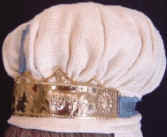 To
the right is a picture of a crown that a group of Jews in Israel has had constructed that they
intend for eventual use by the "High Priest" when the Temple is
rebuilt in Jerusalem. However, the pictures top left and immediate left
are actually much closer to the description given in the Bible.
To
the right is a picture of a crown that a group of Jews in Israel has had constructed that they
intend for eventual use by the "High Priest" when the Temple is
rebuilt in Jerusalem. However, the pictures top left and immediate left
are actually much closer to the description given in the Bible.
These ones on the left fit the biblical description as a plate for the
forehead held by a blue chord that goes around and over the mitre to hold it in
place. The one on the right is a circular crown, and that does not fit the
biblical description but rather follows a rabbinical tradition.
This golden plate represented the
sacrifices given to God and showed that they were sanctified to Him.
(Ex
28:38)
All gifts given to God were sanctified by the giving even if those things were offered incorrectly. In Numbers ch. 16, Korah, Dathan, and Abiram offered strange incense unto the Lord and the Lord sent fire from Heaven and consumed the 250 men that offered as well as their entire families and everything pertaining to them. However, the brass censers with which they offered the strange incense were gathered from the ashes and beaten into plates for the brazen altar. The censers were hallowed unto God even though the offerers were killed for offering in a different way than that prescribed by God in the Law. The plates were attached to the brazen altar to show God’s judgment for their sin. And that judgment for them was destruction.
On the other hand, the gifts offered properly through the High Priest, after being cleansed by the blood of the sacrifices prescribed by the Law, were acceptable to God. The golden plate signified His acceptance of those gifts which were offered to Him in this way.
Symbolism- Again, the gold represents deity and the royal-blue lace, blue tinged with red, represents the blood of Christ (the sacrifice), the means by which the gifts are hallowed and made royal gifts to God.
The wearing of the golden crown by the High Priest symbolizes to us that our gifts are also accepted and hallowed to God IF we offer them according to God’s prescribed path. That is, of course, not according to the Law which is done away, but only through the true High Priest, Jesus Christ, and with blood sacrifice, His blood. Gifts offered any other way are cursed with sin because they are part of this sin-cursed creation and can bring only destruction. Only by Christ are they hallowed; and only by our obedience to God in offering them through Christ are they accepted by God as holy gifts; and even as royal gifts from those to whom He has already given the blue robe of royalty. For us, the royal-blue chords of the golden crown means that our gifts are viewed as gifts from royalty to the supreme Royalty, the King of Kings- WHEN we offer them through Christ our High Priest!
Therefore, we now know that physical garments were restricted and temporal and, along with the Law of which they were a part, have been done away with. We also know that the spiritual holy garments given to us by Christ are unrestricted and eternal!
Melchizedek
NOTE: We
should mention here the one Priest in the Bible that was considered higher than
the Levitical/Aaronic priesthood (including the High Priest of the family of
Aaron); and that is the priesthood of Melchizedek. (Gen
14:18-20; Ps 110:4; Heb chs. 5, 6, 7:1-10)
There are several religions that claim this priesthood.
There are
some biblical problems with this claim:
1.
Nowhere in the Bible is it ever written that men, whether Jew or Gentile,
should strive or could strive to this priesthood. Even Christ did not strive
for it. The Bible says that God did not appoint Christ to it but simply
announced that Christ had it eternally. (Heb
5:6)
2.
No mere man could attain to that priesthood because Melchizedek was eternal;
i.e., he was not just a mere human being. Therefore, He must have been God,
the only eternal being, in the flesh.
Heb 7:3 Without father, without mother, without descent, having
neither beginning of days, nor end of life; but made like unto the
Son of God; abideth a priest continually.
This scripture makes it plain that Melchizedek was a manifestation of an eternal being. And the other scriptures in Hebrews make it plain that that eternal being was Christ who is STILL the only priest of the order of Melchizedek. They also make it plain that He is the one eternally abiding Melchizedek priest. Therefore, there cannot be another, ever.
3. In
the entire Bible there is only ONE Melchizedek priest, Jesus Christ.
It is obvious by the testimony of the
Scriptures that this eternal Melchizedek of the Old Testament was what is
commonly called a "Christophany;" i.e., a pre-incarnate appearance of
Christ, God the eternal Son, in the flesh.
4. Therefore, the religions that teach they can attain to this priesthood are mistaken.
Conclusions concerning the priesthoods of Aaron and Melchizedek-
It is obvious from our study of the Scriptures that the Aaronic priesthood and the priestly garments have been done away with and that every believer is a priest and wears spiritual garments given to them by God. Furthermore, we have seen that both of these are realized through Christ, our eternal High Priest.
Also, it is obvious that no human being other than Christ ever held the priesthood of Melchizedek. He holds it exclusively and eternally and no human is told by God to strive to it nor does God give such striving even as a possibility let alone a commandment. We have seen that even Christ did not strive to attain to it but was called such a priest by God and long before the days of His birth here on earth to Mary.
The Aaronic priesthood is gone, along with the Law; and Melchizedek, the priest of the most high God, is and eternally can be only one person, the eternal Son of God, Jesus Christ.
END OF SECTION
SIXSTOP HERE and TAKE TEST!
Should the test fail to open properly, please use F5 to reload or click the refresh symbol on the top of your browser page.
If you failed the test,
then restudy this section and retake the test.
Once you have passed the test, do not take it
again.
If you missed any questions on the test, then restudy the section and find all of the correct answers to any questions that you missed. A copy of your test was sent to you with the correct answers on it. You may use that for comparison purposes to make sure you have found the correct answers in the textbook.
SECTION SEVEN
The Ark of the Covenant and the Mercy Seat
Introduction- Golden Cherubim As we come now to the centerpiece of this, the Holy of Holies, the first thing we notice is the two gigantic golden cherubim under whose wings the ark rests. The cherubim were made of olive wood overlayed with pure gold and stood 10 cubits (15') high with a wingspan of 10 cubits (15') each from wingtip to wingtip. With their outstretched inner wings touching in the middle of the room over the ark, their outermost wings touched both sides of the Holy of Holies; and their faces stared toward the veil from each side of the ark. (I Ki 6:23-28; II Chr 3:10-13)
Symbolism- The symbolism of the cherubim in the Holy of Holies is the same as that of the cherubim elsewhere, protection for us from the awesome presence of God and protection of God’s holiness from our sinful selves. Only once a year and with blood for his own sins and the sins of the people could the High Priest enter in to the Holy of Holies and into the very presence of God. In Christ, our High Priest, we can enter in boldly at any time into the true Holy of Holies in Heaven; but, once again, only by the blood of Christ the perfect onetime sacrifice and through Christ our Eternal High Priest.
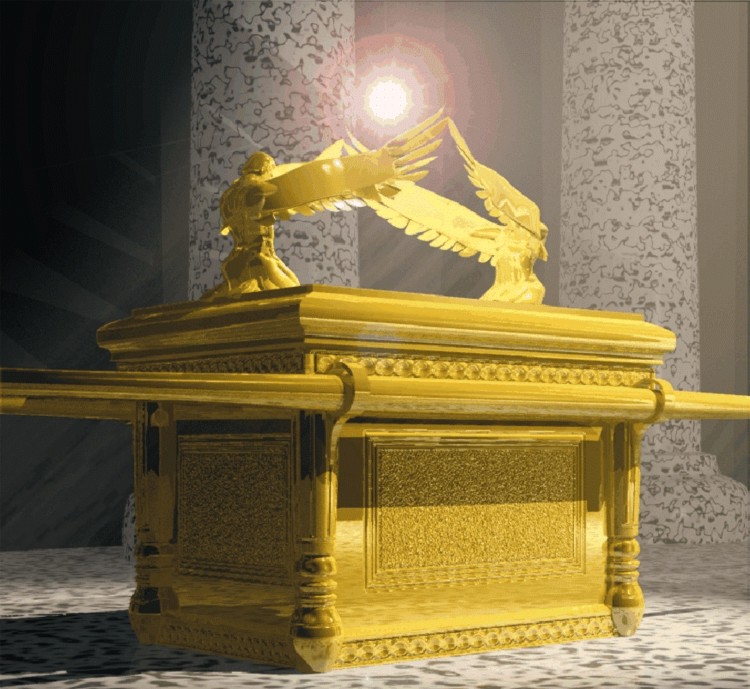
The ark of the covenant and the mercy seat-
The three pictures given at right show
the varied ways that the ark is visualized. The details may vary but the overall
design of each of them meets the scriptural description.
The ark itself was a box made
of shittim wood measuring 2.5 X 1.5 X 1.5 cubits (3.75' X 2.25' X 2.25') and was
overlaid with pure gold and had a gold crown around the top of it.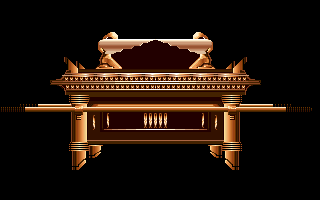
On top of the ark was a rectangular
cover called the mercy seat. It was made of gold and was a 2.5 cubit X 1.5 cubit
lid that exactly covered the top of the ark. On each end of this top was a
cherub beaten out of one piece of gold and these two cherubim faced inward
overlooking the mercy seat; also, their wings were stretched forward so as to
cover the mercy seat. (Ex 37:7-9) In the four corners were rings for the
two staves of shittim wood, also overlaid with gold, used for the carrying of
the ark by the Levites.
(The references are numerous and can be found in
Exodus; Leviticus; Numbers;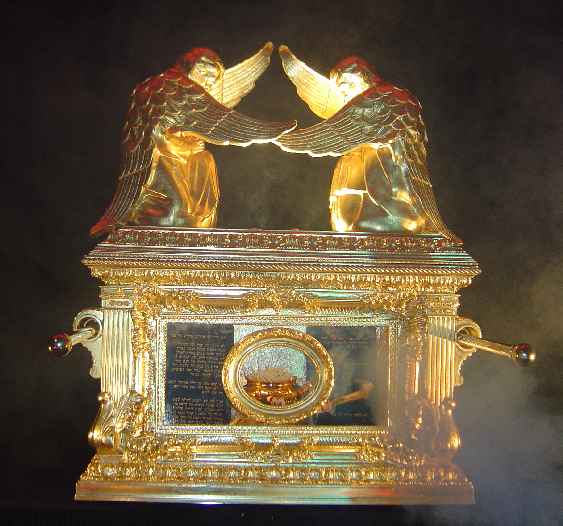 Deuteronomy; Joshua; Judges; I & II Samuel; I
Kings; I & II Chronicles; and in the New Testament in the book of Hebrews.)
Deuteronomy; Joshua; Judges; I & II Samuel; I
Kings; I & II Chronicles; and in the New Testament in the book of Hebrews.)
Inside the ark, while it was in the Tabernacle, was a golden pot of manna, Aaron’s rod that budded, and the tables of the Covenant; also known as the Ten Commandments. (Ex 25:16; Deut 31:9 and various other OT references as well as Heb 9:4 in the New Testament) These three were the only articles inside the ark while it was in the Tabernacle.
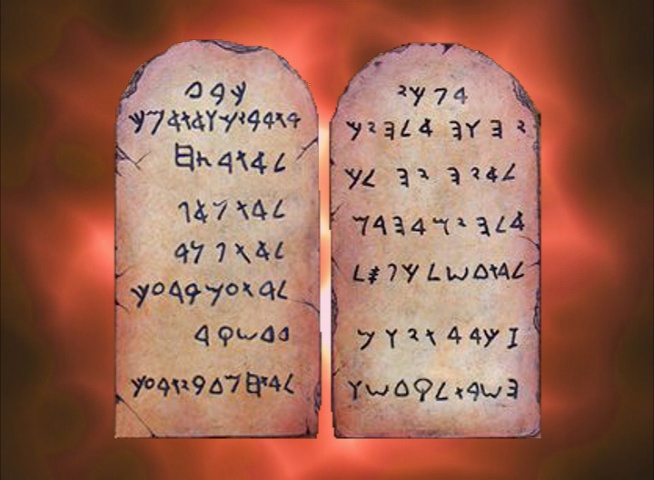
NOTE: The Jews reject the New Testament; and, therefore, they believe that nothing else was in the Ark except the "Tablets of the Covenant." (The Ten Commandments)
(34, 35)
It is true, however, that by the time of the construction of Solomon’s Temple, all that remained within the ark was the two tables of the Covenant. (I Ki 8:9) This tells us that the rest of its contents must have disappeared sometime between its capture by the Philistines in I Samuel 4:11 and its return when it was brought to the house of Abinidab in I Samuel 7:1 seven months later. It is possible that the other contents were removed by the men of Bethshemesh when they looked into the Ark. We don’t know, we can only speculate. But we do know that God smote 50,070 of them because they removed the lid (the mercy-seat) and looked into the Ark (I Sam 6:19) but we don’t know if they or someone else before them removed the other contents.
When you come right down to it, we really don’t know when the other contents were removed. All we really know is that by the time of its placement in the Holy of Holies in Solomon’s Temple, the only thing left in the Ark was the Tables of the Covenant and that the other contents were removed at some time by someone.
Brought to Jerusalem by David- From the house of Abinidab in Kirjathjearim, where it abode for twenty years, the ark was then brought by David to the house of Obededom the Gittite where it abode for three months. (II Sam 6:10-11) From there it was brought to Jerusalem by David and placed in a temporary tent (II Sam 6:17) where it remained until placed in the Holy of Holies in Solomon’s Temple.
The location of the Ark now- The ark has long since disappeared as have all of its contents. No one knows where it is or even if it still exists. It may have been stripped of its gold and destroyed when the Temple was razed by the Babylonians on the "ninth day of Av" (Hebrew dating) in 586 B.C under Nebuchadnezzer. By the time of the reconstruction 70 years later under Ezra, which temple I number as the Second Temple, the Ark of the covenant and many of the Temple vessels had disappeared and could not be returned to Jerusalem. Where and how it disappeared we do not know. All we do know is that it was in the Holy of Holies of Solomon’s Temple but it was never seen again after the captivity. The last biblical mention of it was during the time of Josiah in the seventh century B.C. when he repaired the Temple and reinstituted proper worship there and rescued the Pentateuch from obscurity. (II Chr chs. 34 & 35 esp. Jer 3:16-17; II Chr 35:3) The scriptures seem to indicate that the Ark had been kept with the Levites during the time that the kings before Josiah had destroyed the Temple and defiled it and the whole country and most of The People with pagan worship. From that time on, scripture makes no mention of the whereabouts of the Ark.
NOTE: Jewish Rabbinic traditions say that it could have possibly been hidden by Jeremiah; but there is no biblical or even any extra-biblical proof of that.
SYMBOLISM-
The Ark and its cover and contents have varied symbolism.
Jesus summarized the Law for us in the New Testament:
Mat 22:36-40 Master, which is the great commandment in the law? Jesus said unto him, Thou shalt love the Lord thy God with all thy heart, and with all thy soul, and with all thy mind. This is the first and great commandment. And the second is like unto it, Thou shalt love thy neighbour as thyself. On these two commandments hang all the law and the prophets.
For us today, both Jew and Gentile, the tables of the Covenant, symbolize God’s commandment of Separation:
II Cor 6:17-18 Wherefore come out from among them, and be ye separate, saith the Lord, and touch not the unclean [thing]; and I will receive you, And will be a Father unto you, and ye shall be my sons and daughters, saith the Lord Almighty.
The disappearance of the Tables of the Covenant symbolizes the doing away of the Law by Christ through His fulfillment of it for us and for the Jew.
Col 2:14 Blotting out the handwriting of ordinances that was against us, which was contrary to us, and took it out of the way, nailing it to his cross;
Also, the disappearance of the tables is a symbol of how Israel nullified the Law of God by their refusal, time after time, to keep it as a nation. And lest we become too puffed up as Christians, remember that the same thing is already under way today in Christianity. It is apparent to anyone that knows God’s Word that His commandment of separation, symbolized by the tables in the OT and plainly stated in the NT, is nullified by the majority of Christians and churches.
This was even prophesied in the New Testament and we are seeing the beginnings of the fulfillment of that prophecy today.
Prophecy of the nullification of God’s commandments during the church age:
II Tim 4:1-4 I charge [thee] therefore before God, and the Lord Jesus Christ, who shall judge the quick and the dead at his appearing and his kingdom; Preach the word; be instant in season, out of season; reprove, rebuke, exhort with all long-suffering and doctrine. For the time will come when they will not endure sound doctrine; but after their own lusts shall they heap to themselves teachers, having itching ears; And they shall turn away [their] ears from the truth, and shall be turned unto fables.
Concerning the apostasy before
the Second Coming of Christ, the Bible tells us:
II Thess 2:3 Let no man
deceive you by any means: for [that day
shall not come], except there
come a falling away first...
"falling away,"
Gk
In the case of religious apostasy, and specifically apostasy from the Christian faith, the scriptural definition would be "a falling away from the biblical precepts of the Christian faith by those who claimed salvation but never actually possessed it."
Clarification- In Acts 21:21, Paul was accused of preaching apostasy (apostasian, a-pos-ta-see-ahn) away from the faith as taught by Moses (the Jewish faith.) Derivations from the same Greek word are used in both places, II Thess and Acts, and it shows that what is being talked about is religious apostasy and not the rapture as some teach it means in II Thess 2:3. And if there has ever been a time in human history when apostasy away from God and His commandments of Separation is running rampant it is today; and it was never more apparent than it is among the "churches" of today and those who claim God’s salvation in Christ and yet deny Him by their actions!
Therefore, the loss of the tables of the Commandment from the Ark symbolizes what both the Jews and the largest portion of the Gentile Churches have done with God’s Law of Separation- lost it!
Finally, the disappearance of the tables of the Law symbolizes its replacement by the grace of God in Jesus Christ.
Ro 5:20-21 Moreover the law entered, that the offence might abound. But where sin abounded, grace did much more abound: That as sin hath reigned unto death, even so might grace reign through righteousness unto eternal life by Jesus Christ our Lord.
The golden pot of manna- This
represents God’s provision for His people.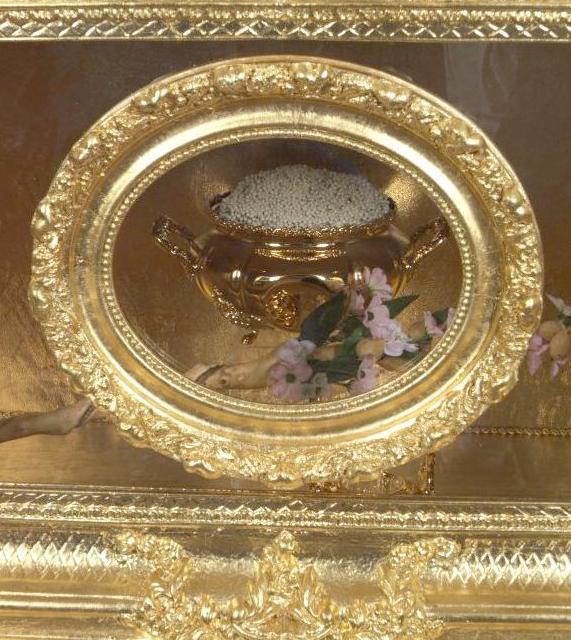
For us today, both Jew and Gentile, the disappearance of the golden pot of manna symbolizes God’s replacement of the old, physical and temporary, provision for the people during their time of need in the wilderness, with His provision for all of us in Christ. The manna of the old brought temporary life; but the life given through Christ fulfills both temporal and Eternal needs.
Jn 6:31-35 Our fathers did eat manna in the desert; as it is written, He gave them bread from heaven to eat. Then Jesus said unto them, Verily, verily, I say unto you, Moses gave you not that bread from heaven; but my Father giveth you the true bread from heaven. For the bread of God is he which cometh down from heaven, and giveth life unto the world. Then said they unto him, Lord, evermore give us this bread. And Jesus said unto them, I am the bread of life: he that cometh to me shall never hunger; and he that believeth on me shall never thirst.
Jn 6:58 This is that bread which came down from heaven: not as your fathers did eat manna, and are dead: he that eateth of this bread shall live for ever.
The bread of God, Christ, is not just temporal, lasting through this life only and then disappearing as did the last of it in the golden pot of manna, but is Eternal; i.e., it is sufficient for life from the time of it first consumption on through the unnumbered ages of eternity!
The rod of Aaron that budded- This represents God’s choice of a certain line with which He would deal directly on behalf of all The People. That being the line of the High Priest which was the family of Aaron.
NOTE: We know that the priestly line of Aaron was the line chosen for the earthly high priests; but, the Heavenly Priest, Jesus Christ, is of the higher priesthood, that of Melchizedek. (See earlier section on Melchizedek.)
Therefore, the disappearance of Aaron’s rod symbolizes the disappearance of the earthly line of the High Priest, the line of Aaron, and its replacement by the High Priest, Jesus Christ, who is eternal; i.e., He has no ancestors nor any progeny to precede or replace Him as High Priest. The priestly line of Aaron has disappeared; but, the line of Christ can not disappear because it is not an earthly line at all but one eternal person, Jesus Christ, who eternally reigns as High Priest.
Heb 7:24 But this [man], because he continueth ever, hath an unchangeable priesthood.
The Ark- The symbolism of the Ark, which normally includes its cover, the Mercyseat, which we will address separately, is varied.
The Ark itself represented, in
its most basic symbolism, God’s presence with His Chosen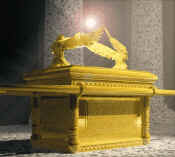 People, Israel.
Including its contents, it represented God’s Law of forced Separation (10 Commandments), His provision for the needs of His people (pot of manna), and His choice of a certain line of earthly High Priests through whom He would deal with His People (Aaron’s rod). In addition, when it went before the people into battle it represented God’s presence with The People and His strength for offense and defense against the enemies of both God and His People in the battles of conquest and possession of the Promised Land.
Finally. When it was, for a short time, in the possession of the Philistines it represented God’s displeasure and judgment upon the heathen who thought that possessing it would guarantee His presence among them and blessing upon them. Such possession by the heathen brought immense destruction upon them because of God’s judgment for their false appropriation of His presence and their defilement of the symbol of it, the Ark, when they looked inside it.
For the local Independent Baptist Church of today, the Ark symbolizes God’s presence with us in Christ:
Mt 28:20b ...I am with you alway, [even] unto the end of the world. Amen.
I Cor 12:27 Now ye are the body of Christ...
ONE: It symbolizes God’s presence and power, strength for offense and defense, in the battles as we go forth to evangelize the world, baptize them, and train them to do what God has commanded them to do:
Mt 28:18-20 And Jesus came and spake unto them, saying, All power is given unto me in heaven and in earth. Go ye therefore, and teach all nations, baptizing them in the name of the Father, and of the Son, and of the Holy Ghost: Teaching them to observe all things whatsoever I have commanded you: and, lo, I am with you alway, [even] unto the end of the world. Amen.
TWO: The Ark symbolizes God’s presence and power with us as we attack the gates of Hell in the power of Christ as His church:
Mt 16:18b ...I will build my church; and the gates of hell shall not prevail against it.
THREE: The appropriation by lost Jewry and apostate and hypocrite Christians and Christianity (those who claim God as theirs when He is not) of the presence of God among them brings no blessing, as they suppose, but brings a curse upon them instead as it did upon the Philistines.
Hypocritical and false Jewry:
Jn 9:39-41 And Jesus said, For judgment I am come into this world, that they which see not might see; and that they which see might be made blind. And [some] of the Pharisees which were with him heard these words, and said unto him, Are we blind also? Jesus said unto them, If ye were blind, ye should have no sin: but now ye say, We see; therefore your sin remaineth.
Apostate and unlearned "Christians;" i.e., those who PROFESS Christ but do not actually possess Him. Those who are religious but lost:
II Pet 3:15-16 And account [that] the longsuffering of our Lord [is] salvation; even as our beloved brother Paul also according to the wisdom given unto him hath written unto you; As also in all [his] epistles, speaking in them of these things; in which are some things hard to be understood, which they that are unlearned and unstable wrest, as [they do] also the other scriptures, unto their own destruction.
Also see the entire book of Jude and Romans ch. 6.
The
Jews bemoan it's loss today.
The disappearance of the Ark will no
longer be bemoaned by the children of Israel as it is today. God promised them
that it will be replaced and no longer brought to remembrance in the day that
Israel and Judah will dwell together in the Promised Land when the city of
Jerusalem, not the Ark, will denote the presence of God to the world. (Jer
3:16-18)
Its disappearance after the time of king
Josiah was the beginning of the fulfillment of the prophecy of Jeremiah; but,
the ending of their lamentation over its loss is still a part of the prophecy
that will be fulfilled during the Millennial reign of Messiah, Jesus Christ,
from Jerusalem the city of God, and especially after the new Heaven and the new
Earth when the Law and the rod of iron will be done away and He will rule from
the New Jerusalem. (Rev chs. 3 & 21)
NOTE: As an answer to the question of the current whereabouts of the Ark, God is very specific. Is it in Africa as some assert? Is it hidden away somewhere on the Temple Mount as the Rabbis say? Was it destroyed as some say? God speaks of it in the last book of the Bible, the book of the Revelation. Let’s see what He says.
Rev 11:19 And the temple of God was opened in heaven, and there was seen in his temple the ark of his testament: and there were lightnings, and voices, and thunderings, and an earthquake, and great hail.
Now whether this is speaking of
the physical Ark that once existed in the Tabernacle and later in the Temple of
Solomon or not is a moot point. If it is the physical Ark it is in Heaven; but
if it is the spiritual Ark which was the pattern showed to Moses on the mount
after which pattern he built the physical Ark here on earth, then it is the
reality of which the Ark on earth was patterned and supercedes it in importance.
(Ex 25:9, 40; Heb 8:5)
Therefore, it matters not whether it is actually
the physical Ark brought to Heaven or the reality of the Heavenly Ark that is
being spoken of. If the former, then it will never come back to earth but will
be replaced by Jerusalem itself. If it is the latter, then it is the reality and
the fate of the shadow (Heb 8:5) is not even important. What is important
is that the Ark from the Tabernacle and the Temple has disappeared and the fact
of its disappearance and its current whereabouts means nothing for saved
Gentiles and Messianic Jewry today. Nor will it, one day, mean anything to the
restored Jew when Messiah is accepted by them as a nation and God’s city,
Jerusalem, becomes the symbol of God’s presence with them and all of mankind.
The Mercy Seat-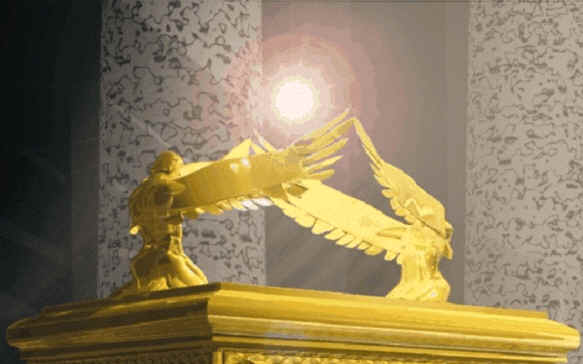
It was also the place where God’s mercy was shown to man in return for the blood of the sacrifice which was applied to it. The blood was sprinkled on the eastern end of the mercy seat and also seven times before the mercy seat. (Lev 16:12-15) In the Tabernacle and the Temple this had to be done once a year in perpetuity.
SYMBOLISM-
Gold and the cherubim-
The gold, of course, represented deity and the cherubim once again represented protection. Protection of us from the consuming presence of God and protection of God’s holiness from the sinful presence of man.The blood of the sacrifice- The blood of the sacrifice was necessary to atone for the sins of the High Priest, a sinful human being himself, as well as for the sins of The People.
Today, in Christ, we who are the people of God, both Jew and Gentile, need no physical mercy seat nor the blood of the temporary sacrifice that is required year by year to be sprinkled on it and before it to atone for the sins of the people of God. Nor is the blood for the sins of the High Priest necessary anymore. Those symbols were pointing to the sacrifice of Christ and the shedding of His blood, once, for all sin for all men for all time; and, since He was without sin, He needed no blood atonement for His sins as did the High Priest under the Law. (II Cor 5:21; Heb ch. 4, espec. 4:14; & Heb ch. 9)
The sprinkling of the blood seven times-
The number seven symbolizes completion and rest. (The references in the Old and the New Testaments from Genesis to Revelation are to numerous to list.) In the sprinkling of the blood of the sacrifice seven times we see the symbol of the complete atonement by Christ. Under the Old Covenant, the sprinkling had to be repeated once each year; but under the New Covenant in Christ it was done once. Therefore, the reality in Christ was symbolized by the shadow in the earthly sanctuary. (Heb chs. 4, 7, 9, 10 ) Christ truly gave us the 7 (completion) of God’s sacrifice and, through that, gave us entrance into rest from our works for atonement. (Gal 2:8-9)The voice of God from between the cherubim on the mercy seat-
The voice of God from between the cherubim gives the mercy seat the added symbolism of representing the Word of God. They had not the completed and authoritative Word of God. Therefore, He spoke to them through the prophets and through the Urim and Thummim to the High Priest and also, once a year, through the mercy seat to the High Priest only. These men through whom and to whom He spoke directly then relayed the Word of God to The People.
Today we have the reality of the perfect, complete, preserved Word of God. We don’t need any of the partial Words of God; one of the portions of which was the voice of God communing from between the Cherubim on the mercy seat. At the appearing of Christ, God spoke to us through Him who was the living Word of God. Now, since Christ is ascended to Heaven, God speaks to us through the Bible, the written Word of God. Upon its completion, all other forms of communication from God ceased. (Ps 138:2; Jn 1:1-14, Heb 1:1-3; II Tim 3:14-4:5; I Cor 13:8-10; Rev 22:18-19)
Therefore, in the sense of God speaking from the mercy seat, it symbolized the Word of God.
The mercy seat itself as the propitiatory place where the blood was sprinkled-
The mercy seat was the only place in God’s entire creation where He would accept the blood of the sacrifice. When sprinkled upon it, the mercy seat became the place of propitiation. It alone was given as the place where God would accept the blood of the sacrifice and the appeasement of God would be achieved. (Propitiation means to appease and dispose to kindness or favor.) Remember, the blood sacrifice of the Atonement reconciles us to God, the crucifixion of Christ in full satisfaction of the penalty called for by God made expiation for our sins and brought satisfaction under the law of God, but the mercy seat symbolized the appeasement of the lawgiver, God.
The reality of which the mercy seat, the place of propitiation or appeasement upon which the blood must be sprinkled, is given to us in the book of Romans.
Ro 3:24-25 Being justified freely by his grace through the redemption that is in Christ Jesus: Whom God hath set forth [to be] a propitiation through faith in his blood, to declare his righteousness for the remission of sins that are past, through the forbearance of God;
"propitiation" Gk ilasthrion, hil-as-tay’-ree-on
NOTE: "... for the remission of sins that are past" is speaking of the sins of The People that were committed in Israel in the past under the law and for which God was appeased by the sprinkling of the blood on the mercy seat in the Tabernacle and the Temple. (That this is what is meant can easily be seen from the context of Romans ch. 3.)
The only other place where this exact same Greek word, ilasthrion, hil-as-tay’-ree-on, is used in the whole of the New Testament is in the book of Hebrews.
Heb 9:5 And over it the cherubims of glory shadowing the mercyseat; of which we cannot now speak particularly.
"mercyseat" Gk
ilasthrion, hil-as-tay’-ree-on (The same word used in Ro 3:25.)
The use of this word for both Christ and the physical mercy seat in the Holy of Holies, used only for those two and nothing else in the entire Bible, cannot be just a coincidence. I believe it is God’s way of showing us that the mercy seat of the Old Testament, upon which the sprinkling of the blood would appease His righteous wrath and turn it to favor, was a perfect symbol of Jesus Christ, the mercyseat of the New Testament. Christ was the only place in the entire creation upon which the application of the blood of the sacrifice would appease God’s righteous wrath and turn it to favor. Christ was not only the perfect sacrifice which supplied the blood of atonement, but His body was the mercyseat upon which that blood was presented to God. He supplied both the blood and the place where it was to be applied; and God was pleased with and accepting of both.
Therefore, the mercy seat in the Holy of Holies in the Tabernacle and in Solomon’s Temple was a perfect symbol of the body of the Lord Jesus Christ. Both were places in this physical creation through which God would be appeased. The first, the mercyseat upon which the blood was sprinkled in the Tabernacle and the Temple, was the channel of temporary appeasement; and the second, the body of the Lord Jesus Christ upon whom as the mercyseat His own blood was sprinkled, was the channel for eternal appeasement. (Hebrews) The mercy seat was a symbol, an imperfect and temporary shadow, of the eternal reality which is Christ.
SUMMARY
We are finished with the symbolisms of the Tabernacle and Solomon’s Temple and all of their various furnishings as well as the priests and their accouterments. The symbolisms are many and varied.
The overall symbolism of both Tabernacle and Temple was that each of them was the sole instrumentality through which God directly communed with man during the time of their existence. The Tabernacle was the instrument from the time of Moses until the dedication of Solomon’s Temple and then it was replaced by that Temple upon its dedication in the 10th century B.C. Then that second instrumentation, Solomon’s Temple, was rebuilt once under Ezra and Nehemiah after the return from the Babylonian Captivity, this being called the Second Temple, and it was neglected and defiled and restored upon several different occasions.
NOTE: The Temple under Ezra and Nehemiah can easily be seen to be the "Second Temple" when one reads the scriptures where that Temple is called "this latter house" and Solomon’s Temple is referred to as "the former." Obviously those two houses of God were considered to be two separate buildings. The First Temple, "the former," was Solomon’s Temple and the Second Temple, "this latter house" was the one built under Ezra and Nehemiah. (Hag 2:9)
During the reign of the Roman appointed puppet, King Herod, the Second Temple was leveled to the ground and the Temple Mount was leveled and expanded so that a completely new and much more grandiose temple could be built upon the site of the old one which it replace around 20-19 B.C. This temple, 46 years in its original construction (Jn 2:20) but 70 years total until it was finished, was known as "Herod’s Temple" and is usually considered a restoration of the "Second Temple;" but, in actuality it should be called the "Third Temple." Any time that a building is leveled to the ground and a completely new one of a totally different architecture and pattern is built upon the site, then by no stretch of the imagination can the new one be considered a restoration of the one that was totally destroyed! A replacement, yes! But a restoration? No!
This third Temple, Herod’s Temple, was not even built out of love for God; but rather as a bribe to appease the Jews that Herod was attempting to rule. Then, within 40 years of the death of Christ, this Temple of Herod was completely destroyed by Roman legions under Titus in A.D. 70. God allowed this to happen because its usefulness as the instrumentality through which God communed with mankind had ended with the death of Christ. When the veil was rent in twain, God shifted to the new instrumentality that He had set up in the place of the old. In fact, when you come right down to it, that Third Temple, Herod’s Temple, was never the place where God communed with man in the first place; and neither was the Second Temple under Ezra and Nehemiah. The ark of God was never restored to the Holy of Holies of any of the Temples after the destruction of Solomon’s Temple. That missing Ark, through which God directly communed with man through the High Priest, necessitated the coming of Christ to earth to restore God’s direct communion with mankind. (Heb 1:1; et al)
While Christ was here, He was the temple through which God communed with mankind.
True, the temples built after the destruction of Solomon’s Temple were the centers of worship for the Jew; however, they were just that, places of worship only and not places of communion.
Now that the old instrumentalities for communion, the Tabernacles and the Temples, have been done away, then how does God communicate with mankind today? The Temple in Jerusalem will one day be rebuilt, but not yet! Is there another, intermediate, Temple of God? Did Christ, who communicated God to mankind while He was here (Heb 1:1), leave a new temple behind when the temple of His body was destroyed according to the plan and purpose of God? Is there an instrumentality through which God has communicated with mankind from the death of Christ down to today? The answer is, Yes! He had a direct line of communication with mankind in the Tabernacle and that was replaced by the Temple which in turn was replaced by the temple of the body of Jesus Christ. And Christ set something in motion during His lifetime that would replace himself after His death; and it is the only Temple through which God would continue to directly communicate with man from Christ’s time down to today!
Now we come to the final segment of our study- the New Testament Temple of God.
END OF SECTION
SEVENSTOP
HERE and TAKE TEST!
Should the test fail to open properly, please use F5 to reload or click the refresh symbol on the top of your browser page.
If you failed the test,
then restudy this section and retake the test.
Once you have passed the test, do not take it
again.
If you missed any questions on the test, then restudy the section and find all of the correct answers to any questions that you missed. A copy of your test was sent to you with the correct answers on it. You may use that for comparison purposes to make sure you have found the correct answers in the textbook.
SECTION EIGHT The Temple Of God Today
Introduction: We have seen that the Tabernacle and the
Temple were not only places of worship and sacrifice but were also places of
communication, from God to man. In order to get to the scriptural Temple of God
for today, we must address the issues of worship and communion (communication)
separately.
Worship-
First we will address the issue of worship before Christ and since Christ. Up to the time of Christ, and during His time here on earth, worship was restricted to certain "holy" places. From Moses to Solomon it was centered around the structure known as the Tabernacle; and from Solomon to Christ it was centered around the structure known as the Temple at Jerusalem. There were other false places of worship, such as the golden calves at Dan and Bethel, but those were never recognized as legitimate; and the only reason they were placed there after the division of the Kingdom by Jeroboam was to prevent the people of the northern kingdom, Israel, from going to Jerusalem which was the capitol of the southern kingdom, Judah. They were a political move made by Jeroboam because he feared that if his subjects went to Jerusalem to worship at the Temple, then they might want to follow Rehoboam, king of Judah; and, if that happened, he was afraid they might want to kill him (Jeroboam) to get him out of the way. (I Ki 12:26-30)Jn 4:21 Jesus saith unto her, Woman, believe me, the hour cometh, when ye shall neither in this mountain, nor yet at Jerusalem, worship the Father.
Jn 4:23-24 But the hour cometh, and now is, when the true worshippers shall worship the Father in spirit and in truth: for the Father seeketh such to worship him. God [is] a Spirit: and they that worship him must worship [him] in spirit and in truth.
Let’s analyze these verses to see what Jesus is telling her (and us) here in this passage.
1. She mentioned two places for worship- the mountain of her fathers and the Temple. (4:20)
2. Jesus negated both of those places. (4:21)
3. He then directed her thinking from physical places to a spiritual place. (4:23-24)
4. He then told her that the transition was in effect from that time on.
(4:23 "... the hour cometh, and now is...")
It is obvious that from that time on that no PHYSICAL PLACE was acceptable for true worship of God. This was a radical departure from the thinking of the day. Historically Jews had been taught that worship of God took place only in certain physical places. Whether Tabernacle, Temple, or mountain, worship was attached to certain places. Altars or Tabernacle in the wilderness or the Temple in the Holy City, high places and groves, pillars of stones, true places or false places, in the collective psyche of Israel worship was always associated with certain places.
Now, however, Jesus Christ has closed the chapter of worship in physical places and opened the way of true worship "in spirit"(ual) places. Only in the spirit of the believer can true worship take place.
But wait! Throughout the New Testament believers still gathered for worship, so we must reconcile these two variances. Obviously worship is now consigned to a spiritual place but yet believers congregate for communal worship in a physical gathering.
We will reconcile these seeming differences as we go along.
Communion/communication:
As we said earlier, the Tabernacle and the Temple were not
only places of worship but were also places of communion. God communicated with
man from between the cherubim on the mercy seat in the Holy of Holies and
through the High Priest with the Urim and Thummim. We know, of course, that He
also communicated through the prophets; but, during the times of the Tabernacle
and the Temple when the Ark of the Covenant was actually there in the Holy of
Holies, these two were each the main channel of communication from God to man
with the High Priest being the go-between.
The prophets were replaced by Christ (Heb 1:1-2) as God’s means of communication to man but what of the Temple? Was it replaced also? And was Christ also replaced upon His death? We have already seen that the Temple, a physical place, was replaced as the acceptable place of worship (Jn 4:21-23) but was it also replaced as the place of communication between God and man? We will answer all of these questions in this segment.
The Ark and its contents-
In order to properly address the question of the Temple for today we must examine a few more things concerning its contents and purpose.
In the Ark we found the Tables of the Covenant, the golden pot of Manna, and Aaron’s rod that budded. We have already seen that the Tables represented God’s Law to mankind; which is a form of communication so it fits into that category concerning the purpose of the Temple. We also saw that the Law was a document of forced separation from the ways of the world.
The golden pot of manna represented God’s temporary provision and was replaced by Christ who is God’s way of eternal provision.
The rod of Aaron that budded represented the line of the High Priests that were replaced by Christ the eternal High Priest.
The Ark itself represented God’s presence with a particular people for power and strength for offense and defense.
Finally, the mercy seat represented the place of God’s complete and finished mercy in Christ as well as the place of His direct communication of His will to mankind. Also, we must remember that it was through the Holy Spirit that God always spoke including from the mercy seat and through the prophets; and that His communication through them could be in the form of word and/or deeds. We will address this more later. (Ex 28:3, 31:3; Num 11:17, 26; 24:2; 27:18; Judges; I & II Sam; also a multitude of other references in both the Old and New Testaments)
WHAT IS
The Temple of God Today
To begin with, we must review
one fact; that the physical Temple is done away with.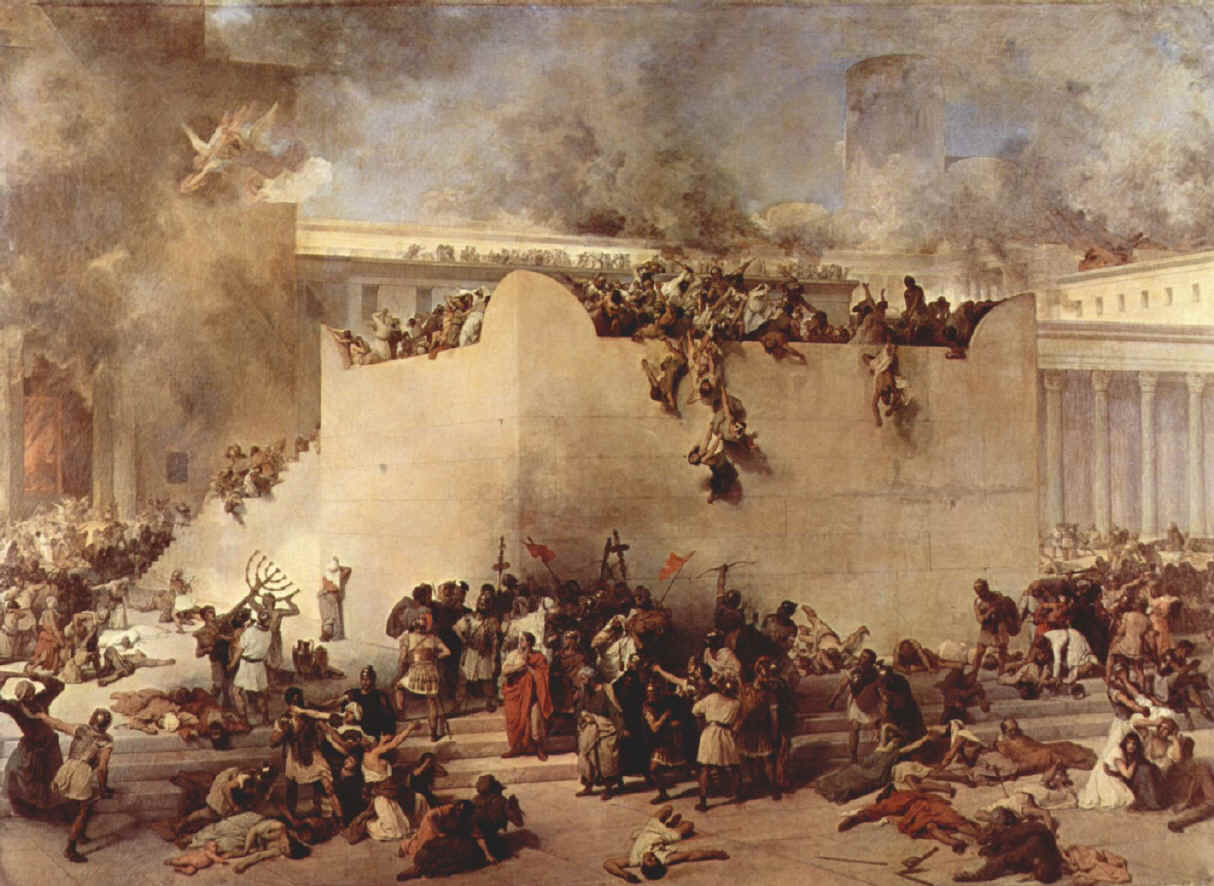
Physically it was destroyed in A.D. 70 by the Roman Legions under Titus and it will be rebuilt but that will not take place until the Tribulation Time. (There are a multitude of references in both the Old and the New Testaments that teach this fact.)
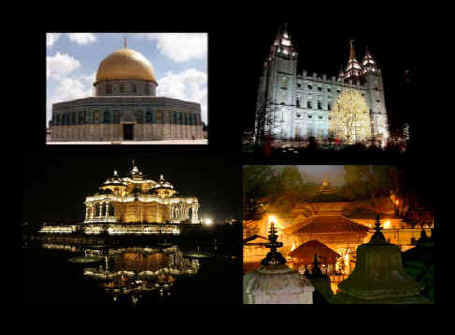
Therefore, no matter how beautiful or awe inspiring they might be inside or outside, the physical buildings shown here CANNOT be the Temple of God for today!
No physical construct can be!
Also, Christ taught that He had replaced the Temple at Jerusalem with the greater Temple of His body; (Jn 2:21) and that the Jerusalem Temple had its purpose fulfilled and was no longer needed because the way into the Holy of Holies was opened to all men through himself, Jesus, who was the Christ. (Mt 12:6; 27:51; Mk 15:38; Lk 23:45; Heb 9:8-14, 24-28; Heb ch. 10; et al)
Therefore, the picture given here to the right, of a physical auditorium (St. Peter's Basilica, Rome, considered the largest and most beautiful in the world) CANNOT scripturally be the Temple of God! No physical construct can be!
THE TWO TEMPLES OF GOD TODAY-
ONE: The individual Christian is the Temple of God.
The first temple of God today can be found in I Corinthians.
I Cor 6:19 What? know ye not that your body is the
temple of the Holy Ghost [which is] in you, which
ye have of God, and ye are not your own?This particular scripture is talking of the individual bodies of the members of the Church at Corinth.
This can be seen by the context of the passage:
1. The preceding verses, :1-14, are speaking of individuals in the church.
2. And verses :15-18 are talking about the bodies of those individuals.
3. Then if we go to the verse immediately after verse :19, we find that it is speaking about the "body" and the "spirit" of the individual members of the church.
Conclusion- Given this total context surrounding verse :19, it is easily seen that it has to be talking about the bodies of the individual members of that local New Testament Baptist Church. Therefore, the individual believer is the temple of God through the Holy Spirit that dwells within them.
TWO: The local New Testament Baptist Church is the Temple of God.
As we found earlier, corporate worship is found all through the Old and the New Testaments. In the Old Testament that worship was centered around certain physical places such as Altars, groves, high places, pillars of stone, the Tabernacle in its various resting places and then the Temple at Jerusalem. We have also seen that Jesus Christ taught that physical places had been supplanted by a spiritual place, "in the spirit." (Jn 4:21-24) Also, we know that the Jerusalem Temple’s purpose had been fulfilled by Christ and its use as the place of worship and the presence of God for power and guidance had been supplanted by Christ, who was God, and He even called His own body a "temple."
Logic- Now let’s use some logic.
1. The Tabernacle and the Temple had supplanted all other physical places as the only acceptable place for worship and as the place of communication and atonement and they were augmented by the prophets who also communicated to mankind the word of God.
2. The necessity of physical places for worship had been negated by Christ; and He also replaced the prophets. This meant that all communication was through the Son (Heb 1:1-2) and worship of God by believers could be done anywhere as long as it was done in the spirit. (Jn 4:21-24)
3. We know that Christ is now physically passed into Heaven.
4. Then the only question remaining is: Did Christ leave something behind as the authoritative entity to carry on His work of communicating between God and man? And if the answer to that is, "Yes," then the second part of that question has to be, what was (and is) it?
5. The answer to that final question is a resounding Yes! Christ established a spiritual entity on earth that carries His power and His message (His Word), and it works in His stead as the only authoritative means of communication between God and mankind. This entity has within it the very presence of God and that presence is communicated to the world in power. And the answer to the second part of the question, what was (and is) that entity, is as follows:
The local New Testament Baptist Church has carried on as Christ and is the Temple of God.
In I Corinthian God speaks to the church at Corinth and declares the following:
I Cor 3:16 Know ye not that ye are the temple of God,
and [that] the Spirit of God dwelleth in you?
We know by the context that in this verse in ch. 3 God is talking to the Church rather than the believer as He did in ch. 6. In chapter 6 the context was individuals; but here in chapter 3, the context "among you (corporately)" (3:3) and "God’s building" (3:9) and "foundation, and another buildeth thereon" (3:10) make it obvious that God is referring to the church as a building which He then calls "the temple of God" that is indwelt by the "Spirit of God."
Since the Church is a called out, baptized, body of believers, (in other words the church is the people) then combining the teachings in ch. 3 and ch. 6 we can conclude that God teaches that the church is the Temple of God and is indwelt by the Holy Spirit; and, that it is the corporate gathering of the individual members who are also indwelt by the Holy Spirit individually and who, themselves, are also the Temple of God.
The indwelling by the Holy Spirit of the individual members of Christ’s Church at Jerusalem happened in John 20:22 in fulfillment of His promise in John 16:7 and that happened quite some time before the empowering of the Church at Pentecost. That individual indwelling of the members of His Church happened after His resurrection but before His ascension to Heaven. Then the infusion of the power of the Holy Spirit into the Church corporately happened later at Pentecost according to Acts 2:1-4 in fulfillment of Christ’s word in Acts 1:8 that they would receive "power, after that the Holy Ghost is come upon you." Remember there is only one indwelling but there can be many fillings; both individually and corporately. The first event, indwelling, is when you receive the Holy Ghost and that happens once and forever as it did for the disciples in John 20:22. The second, the filling with the Holy Ghost, happened the first time corporately for the Church in Acts 2:1-4 on Pentecost and then it happened again in Acts 4:31. Then there are multiple instances where individuals were filled with the Holy Ghost. (Acts 4:8; 9:17; 13:9, 52) That being filled with the Holy Ghost is a recurring event can be seen in the command given in Ephesians 5:18 when it is compared to the recurring event of being "drunk with wine, wherein is excess." Then we are admonished to be "filled with the Spirit." In such a comparison, if the negative example is something that is an event possible of repetition then the positive must also be an event that is possible of repetition.
In conclusion we must observe that when the Church was corporately filled with the Holy Ghost it was always stated that they were "all filled with the Holy Ghost;" meaning that each and every individual member was filled with the Holy Ghost at the same time. Therefore, we must believe that filling, even when it involves the whole church corporately, is done through the filling of the individual members with the Holy Spirit. This helps us to understand that "The Church," always local, Independent, and Baptist, is THE PEOPLE not the building.
Three more preparatory things.
First- In the first part of the book of Acts in chapters 2-5, every person that was saved was added to that original Church at Jerusalem; and those who believed in Antioch were added to the Church there according to Acts 11:24. These and other scriptures are consistent in teaching the same thing. And I Cor ch. 5 teaches that only by an act of the Church can the individual be expelled from the Church body because of ungodly deeds. Also, even the spiritual gifts given to individual believers are restricted in their use to the context of the edification of the local Church of which they are a part. (I Cor ch. 12, esp. 28-31; 14:1-4, 12; Eph 4:7-12; I Pet 4:10) Therefore, we must conclude from the scriptures that every believer is part of a local Church unless he removes himself from it by absence or deed; and that the spiritual gifts given to the individual through the indwelling Holy spirit are given solely for the edification of the Church.
Second- The New Testament Baptist Church did not take over for Christ as the Temple of God but simply continued on AS CHRIST when He ascended to Heaven; i.e., it is the body of Christ here on earth (I Cor ch. 12; Eph ch. 4, 5:30; Col 1:18) of which He is the head (Eph 5:23; Col 1:18).
Third. Lest someone wonder why I say "the Local Independent Baptist Church," when speaking of the Temple of God today and when speaking of true, scriptural, New Testament churches in general, I would bring your attention to the fact that the Church that Christ started carried the baptism of John the Baptist; and the Baptist’s baptism was approved of and declared as authoritative by Jesus Christ, the founder of the Church at Jerusalem, when He commanded submission to it. (Mt 3:13-17; Mk 1:9-11) How do you become a Baptist today? By being scripturally baptized by a Baptist under the authority passed on from that first Church in Jerusalem. Since there was no confusion back then as there is today, there was no need to call that first Church at Jerusalem by the name of Baptist. Because confusion abounds today, then it is necessary to call the descendants of that first Church by a name that delineates our beliefs and practices as a Church; and that name is Baptist. Also, because of that confusion, it is necessary to call ourselves Independent Baptists to delineate us from those Protestant groups that also choose to call themselves by the name "Baptist." Furthermore, it is needful for me to use the term "Local" because there are Protestant "Baptists" who believe in the invisible, mystical, Universal Church, which heresy they carried with them out of Catholicism when the came out in the "Protestant" schism with their mother church, Roman Catholicism. There is no kind of Church here on earth that is recognized by the scriptures except the "local" Church. And the only recognition of a "Universal Church" is the Church in heaven that will never be gathered and complete until after the last Christian is taken to heaven in the rapture. And the only time it will exist here on the earth will be after the Tribulation when it will come back with Christ.
Therefore, I use the term "Local, Independent Baptists" because "Local" is the only kind of Church here on earth that is spoken of in the Bible. And I use the term "Independent" to delineate us from the Protestant "Baptists" who are not of the lineage of the Church that Christ started but are offshoots of the heretical Roman Catholic Church that formed in the 3rd to 4th centuries as a heretical group trying to usurp authority over all of the Churches. And I use the term "Baptist" as a badge of authority from Christ himself to signify the scripturality of our baptism and our descent from that first Church that had the baptism of John the Baptist. The term, "Local, Independent Baptist Church," taken as a whole, signifies our existence as the body of Christ here on earth descended directly from that first Church in Jerusalem started by Christ himself while living here on this earth.
Symbolism applied- As the Temple of God here on earth, the Local, Independent Baptist Church fulfills all of the actuality of the symbolism of the Tabernacle and the Temple in the Old Testament. (To save time and space I will use the term "Baptist Church" as meaning ONLY the Local, Independent Baptist Church.)
1. The local Baptist Church fulfills the type of the OT Temple as the symbol to the whole world of God’s presence with His people wherein resides the glory of God. (Eph 3:21)
2. The local Baptist Church fulfills the type of the Ark of the Covenant as the entity whereby the power of God goes before in the warfare with the devil here on earth. (Mt 28:18-20)
3. The local Baptist Church fulfills the type of the Mercyseat whereby God communicated with man in the Temple. (Mt 28:18-20; Acts 1:8; Ro 10:14-15; I Thess 2:13-14; II Pet 1:3)
Also, we fulfill the type of the mercyseat as the place where God has placed His authority for remission of sins; i.e., we have the commandment and the authority to carry the Gospel of Christ, which is the power of God unto salvation (Ro 1:16) to the world. (Mt 28:18-20; Mk 16:15; Jn 15:16; Acts 1:8) This is what Christ meant when He said in John 20:21-23 where He was speaking of the Holy Spirit working through the members of His church:
Jn 20:23 Whose soever sins ye remit, they are remitted unto
them;
[and] whose soever [sins] ye retain, they are retained.
And in Matthew when speaking to His Church He said:
Mt 16:18-19 And I say also unto thee, That thou art Peter, and upon this rock I will build my church; and the gates of hell shall not prevail against it. And I will give unto thee the keys of the kingdom of heaven: and whatsoever thou shalt bind on earth shall be bound in heaven: and whatsoever thou shalt loose on earth shall be loosed in heaven.
Therefore, we fulfill the type of the Temple as the place where God’s approved and authoritative means of Atonement resides- the mercyseat which resided in Solomon’s Temple, the physical Temple of God, and the Gospel of Christ which resides in the local Baptist Church, the spiritual Temple of God.
4. The local Independent Baptist Church is the repository of the glory of God as was typified by the Shekinah glory that appeared in Solomon’s Temple. (Jn 17:22)
5. The local Baptist Church, the Temple of God today, has the true and eternal High Priest who was typified by the temporal High Priest in Solomon’s Temple; and that High Priest in the Church is the Lord Jesus Christ himself. (Heb ch. 10)
6. We are the house of God, the spiritual Temple, as was typified by the OT physical Temple which also was called the house of God. (Heb 10:21-25)
7. As the light of God shining all through the night in a dark world was seen from afar by the light streaming from Solomon’s Temple from the 10 golden candlesticks bearing 7 lamps each, so is the light of God seen in the world streaming from the local Baptist Church in this sin-darkened world. (Mt 5:14-16; Lk 8:16) In fact, the churches are actually called candlesticks. (Rev ch. 1) And the glorious light that we bear before the world that brings light where once there was darkness is the glorious gospel of Jesus Christ. (II Cor 4:4-6)
SUMMARY-
There are a multitude of other symbols in Solomon’s Temple that are applicable to the Local, Independent Baptist Church of today. We just don’t have time to go into them all.
Suffice it to say that the New Testament teaches that the physical Temple has been replaced by the spiritual Temple. No longer do people need to worship in a place; instead, they worship in the spirit. The individual is the Temple of God through the Holy Ghost.
Also, the gathering of those individuals into local Independent Baptist Churches is also taught in the scriptures. This gathering, called a "church" in over 100 different scripture references, is always local, always independent, carries the authority of Jesus Christ and the baptism of John; and is ordered to evangelize, baptize, and raise to maturity those who are saved and baptized. This "Church," descended directly from the one started by Jesus Christ, carries the power of Christ, the authority of Christ, and is the spiritual Temple of God as the aggregate of the baptized believers who are individually also the Temple of God. And the gathered group of baptized believers is called the "body of Christ" and does not replace Him, but IS Him on earth till He comes back!
It will never disappear, it will never be replaced, and it has been the repository of the Gospel of Jesus Christ since its inception under His ministry and its empowerment at Pentecost. That Church, that body, that Temple of God has this command from God the Son himself.
Mt 28:18-20 And Jesus came and spake unto them, saying, All power is given unto me in heaven and in earth. Go ye therefore, and teach all nations, baptizing them in the name of the Father, and of the Son, and of the Holy Ghost: Teaching them to observe all things whatsoever I have commanded you: and, lo, I am with you alway, [even] unto the end of the world. Amen
No physical construct can be the Temple of God today! Because it is scripturally impossible. Only the spiritual Temple exists today. And that Temple, that body, that local Independent Baptist Church had not only a command from God the Son but it also has a promise from Him concerning its unstopability and its entrustment with the Gospel of Jesus Christ.
Mt 16:18-19 ... I will build my church; and the gates of hell shall not prevail against it. And I will give unto thee the keys of the kingdom of heaven: and whatsoever thou shalt bind on earth shall be bound in heaven: and whatsoever thou shalt loose on earth shall be loosed in heaven.
It is still here! It will remain here until Christ comes to take us away! It is unstoppable! And it carries the Gospel of Jesus Christ to the world!
The devil and the gates of Hell cannot stop us as long as we stay in the will of God and carry out the command He gave us- TO WIN ‘EM; TO BAPTIZE ‘EM; TO GROW ‘EM!
The Temple of God today can only be the Local, Independent Baptist Church which is not the building but the people. They are the Temple individually and the Church is the Temple corporately!
Individually-
the Believers!
Corporately-
the Local
Independent Baptist Church!
END OF SECTION EIGHT
STOP
HERE and TAKE TEST!
SECTION EIGHT TEST
Should the test fail to open properly, please use F5 to reload or click the refresh symbol on the top of your browser page.
If you failed the test,
then restudy this section and retake the test.
Once you have passed the test, do not take it
again.
If you missed any questions on the test, then restudy the section and find all of the correct answers to any questions that you missed. A copy of your test was sent to you with the correct answers on it. You may use that for comparison purposes to make sure you have found the correct answers in the textbook.
NOW
TAKE THE FINAL TEST
TESTING Make sure you read the testing instructions if you have not already done so.
FINAL
TEST This test
is open book!
- Once
you have completed all sections of the
textbook and passed all of the corresponding tests, and found the correct
answers to any questions missed on any test, then you may Retrieve the Password
and, upon receiving the Password, take the Final Test for the course.
(click
on words or picture)
RETRIEVE PASSWORD
You must
have this password to gain access
to the Final Test.